

Stand in front of the Duke of Wellington in Edinburgh’s Princes Street Gardens long enough and you start to notice that his coat is not one colour at all. There are streaks of pale green near the seams, darker blue-black in the hollows, warm ochre where the metal has been polished by passing hands or tourist shoulders, and a kind of sooty grey across the upper planes that catches the flat Scottish light. Nobody painted him that way. Most of it happened by accident, or by chemistry, or by pigeon. The rest was done deliberately by a foundry worker with an acid brush somewhere around 1852. Bronze statue patina conservation in the UK is a subject that touches all three of those processes at once, and once you start looking, you cannot stop.
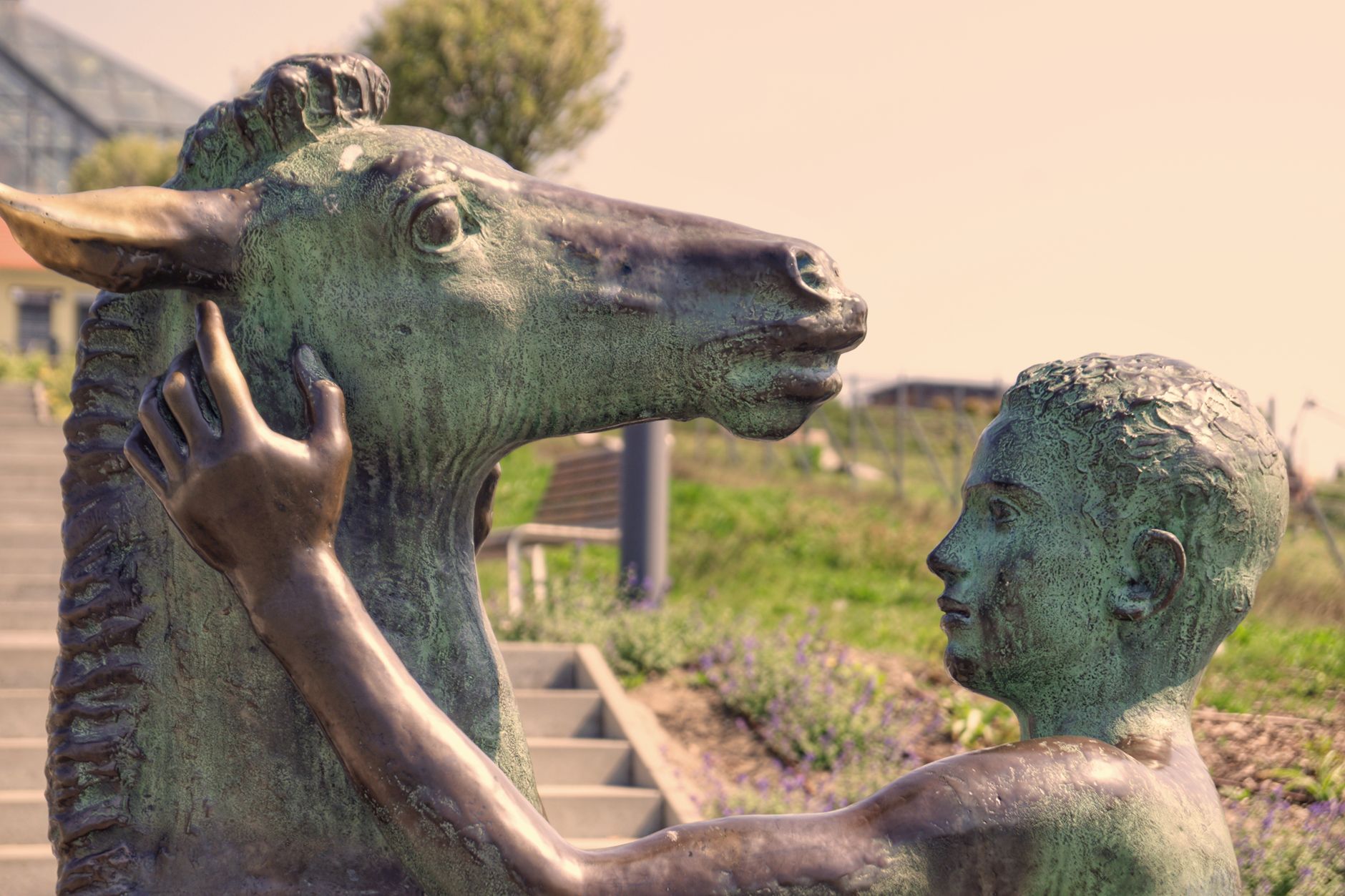
I have spent quite a bit of time over the years peering at outdoor bronzes, not just in Edinburgh, but in Bristol’s College Green, Manchester’s Piccadilly Gardens, and any number of market squares across the Midlands. Every one tells a different chemical story, and the differences between them are not random. They reflect local air quality, microclimatic rainfall, proximity to traffic fumes, and the precise mix of alloy that came out of whichever foundry cast them. What looks like mere age is actually a multilayered record of where a city has been.
What foundries actually did to start the patina
The common assumption is that bronze turns green because it gets old and wet. That is partly true, but the foundries of the Victorian era were never content to leave it to chance. A raw casting emerges from the mould a warm, slightly pinkish-gold, and the Victorians found that colour undignified. They wanted their public bronzes to look weighty, permanent, ancient, even when the statue had just been unveiled. So they chemically induced the patina before a sculpture ever left the workshop.
The most widely used method involved applying solutions of ammonium chloride, potassium sulphate or acetic acid to a heated surface. The heat opens the grain of the metal slightly, letting the compounds react more deeply. Different acids produced different hues: liver of sulphur (potassium polysulphide) drove the surface towards a dark brown-black; sal ammoniac solutions pushed it towards early green. Some foundries used proprietary recipes they kept close, and there are surviving letters between Victorian sculptors and their casters negotiating the exact colour required by the commissioning body. The patina was, in other words, an aesthetic decision with a specific chemistry behind it, much in the same way the prehistoric peoples of the Mendip Hills chose their ochres and clays with a purpose in mind, as I wrote about previously when looking at the earliest human urge to coat a surface.
Once the foundry patina was fixed, a layer of wax was often applied, beeswax, sometimes combined with a little turpentine. This sealed the reactive surface and gave a subtle sheen. In theory, it also slowed further change. In practice, outdoor exposure in a British city meant that within a generation the wax had gone entirely, and a new and rather less controlled chemistry had taken over.
What acid rain, pollution and pigeons actually do to outdoor bronze
Britain’s air in the century between roughly 1860 and 1960 was extraordinarily corrosive. Coal burning in domestic grates, industrial furnaces and gasworks saturated urban atmospheres with sulphur dioxide. Combined with moisture, this produced dilute sulphuric acid that fell as rain across every Georgian square in the country. The effect on bronze was to dissolve the artificially induced patina and drive new corrosion products into the surface. The characteristic bright green you see on many outdoor bronzes, the pigment sometimes called verdegris in casual usage, is actually a mix of copper carbonates and copper sulphates, and their exact ratio depends heavily on local atmospheric chemistry. Bristol’s bronzes and Manchester’s bronzes aged differently because their cities burned different things and sat in different weather systems.
Then there are the pigeons. I do not mention them lightly. Uric acid in bird droppings is remarkably aggressive on copper alloys. The white and cream deposits that cake the shoulders of so many public statues are not merely unsightly; they locally accelerate corrosion in ways that can create deep pitting beneath the surface crust. The Nelson in Trafalgar Square, the Haig in Whitehall, the various civic worthies perched on plinths in Manchester’s Albert Square, all have been marked by decades of pigeon activity in ways that no foundry worker in the nineteenth century anticipated. You can often see the damage most clearly on horizontal surfaces: the tops of heads, outstretched arms, anything that acts as a convenient ledge. The chemistry that happens under a pigeon’s contribution is subtly different from the surrounding patina, and under a certain light it is visible as a mottled, pitted region with a slightly different hue.
Acid rain has declined significantly since the Clean Air Act of 1956 and the subsequent reduction in coal burning, as documented by the UK Centre for Ecology and Hydrology. But decades of damage had already been done, and many bronzes carry the legacy of that era in their current surface condition. The corrosion did not stop; it simply changed character as the dominant airborne acids shifted from sulphur compounds towards nitrogen oxides from road traffic.
How conservators approach a bronze that has been through all of this
The conservator’s job is not to restore the original foundry patina, that is rarely achievable and often not even desirable. The aim is generally to stabilise whatever surface currently exists, remove any actively damaging compounds, and slow further deterioration. The approach varies considerably between institutions and even between individual statues.
Cleaning is the first challenge. Mechanical cleaning with soft brushes and wooden tools removes loose deposits without scratching the patina layer beneath. More stubborn material, calcified pigeon excrement, atmospheric grime, residues of previous conservation treatments, may need poultices of sepiolite clay or specific chemical solvents applied carefully and removed before they can do their own damage. I have spoken to conservators who describe this as the most nerve-wracking part of the process, because old patina layers can be thinner than they appear, and an overzealous approach can strip a century of surface history in minutes.
Once clean, a corrosion inhibitor is typically applied. Benzotriazole (BTA) has been the industry standard for outdoor bronzes for several decades; it forms a molecular bond with copper ions at the surface and essentially blocks the electrochemical reactions that drive further corrosion. It is not permanent, but in combination with a topcoat of microcrystalline wax it can slow deterioration significantly. Some conservators working on the most exposed statues in coastal or high-traffic locations apply wax annually.
There is a broader philosophical question underneath all of this that genuinely interests me. The patina on a bronze outdoor sculpture is not a sign of failure. The foundry patina was always going to evolve; that was understood. What conservators are really managing is the rate of change, trying to ensure that a surface which has already survived a century and a half does not deteriorate in the next twenty years faster than it did in the previous hundred. The copper patina on the roofs of Cardiff’s civic buildings, which I have written about separately, follows a similar logic, the green is not decay, it is stability. The same is true of the best-preserved outdoor bronzes: their surfaces are complex, layered, and chemically active in ways that, properly managed, actually protect the metal beneath.
What the differences between Edinburgh, Bristol and Manchester reveal
Edinburgh’s bronzes sit in a relatively cool, wet, often windy environment. The prevalent westerly and south-westerly winds carry relatively clean Atlantic air most of the time, though the city’s own urban heat island and traffic contribute nitrogen compounds. The result on many of the older figures along Princes Street and in the New Town’s squares is a fairly even, mid-green patina with relatively little active pitting, the corrosion has reached something close to equilibrium.
Bristol’s outdoor bronzes, particularly those closest to the harbour, show the additional influence of maritime air. Salt aerosols do not just affect iron and stone, as I explored in the article about salt damage to Britain’s flood-affected churches; they also accelerate copper corrosion in specific ways, producing a slightly different chemistry at the surface, with traces of copper chlorides that present as a powdery, pale green that can be unstable and friable. Conservators working on Bristol’s harbour-side sculpture tend to be particularly alert to this.
Manchester’s Piccadilly and Albert Square bronzes carry the heaviest legacy of the industrial atmosphere. Even now, decades after the worst of the coal smoke cleared, the surfaces of older statues in the city centre retain layers that formed during the worst decades of sulphur pollution. Under microscopic analysis, many show a banded structure, different corrosion products laid down in different eras, almost like growth rings on a tree. The way cast iron weathers differently across Britain’s canal network mirrors this same principle: local environment leaves its specific signature on metal surfaces over time.
A bronze statue was never truly meant to stay the same. The foundry workers knew it. The sculptors knew it. What nobody quite anticipated was exactly how relentless the British climate, combined with a century of industrial pollution and the unending contributions of urban pigeons, would prove to be. That the best of these figures are still standing and still coherent is a modest miracle of both metallurgy and, more recently, careful conservation science.
Frequently Asked Questions
Why do bronze statues turn green?
The green colour comes from copper carbonates and copper sulphates that form on the surface when copper in the alloy reacts with oxygen, moisture and airborne acids over time. Victorian foundries often accelerated this process chemically before a statue left the workshop, using ammonium chloride or acetic acid solutions to create an immediate, controlled patina.
Is the patina on an outdoor bronze statue damaging the metal underneath?
A stable, well-formed patina actually protects the underlying metal by slowing further corrosion. The problem arises when the patina becomes unstable, through acid rain damage, pigeon droppings, or chloride attack in coastal environments, at which point actively corrosive compounds can penetrate and pit the surface below.
How do conservators clean outdoor bronze sculptures in the UK?
Conservators typically start with soft mechanical cleaning using brushes and wooden tools to remove loose deposits, then use chemical solvents or clay poultices for more stubborn material. After cleaning, a corrosion inhibitor such as benzotriazole is applied, followed by microcrystalline wax to seal the surface and slow future deterioration.
How often do outdoor bronze statues need conservation treatment?
It varies considerably depending on location and exposure. Statues in coastal or heavily trafficked urban environments may need wax reapplication annually, while those in more sheltered positions might be assessed every three to five years. Major conservation interventions involving full cleaning and inhibitor treatment are typically carried out every ten to twenty years.
Do different UK cities have different patina colours on their bronze statues?
Yes, quite noticeably. Local air quality, rainfall chemistry and proximity to the sea all influence the mix of corrosion products that form. Bristol’s harbour-side bronzes show traces of copper chlorides from salt aerosols, giving a paler, sometimes powdery green; Manchester’s older statues carry layers formed during decades of coal-smoke sulphur pollution; Edinburgh’s tend towards a steadier mid-green in its cooler, wetter but relatively clean Atlantic air.
Leave a Reply