

There is a persistent image of the Hebridean blackhouse: low, dark, hunched against the Atlantic gale, its walls the colour of old peat and its interior permanently wreathed in smoke. The name itself seems to confirm it. Black house. End of story. But spend any time with conservation work being carried out on the surviving pre-clearance croft structures on Lewis and Harris, and that picture starts to shift in some quietly remarkable ways. The buildings were not simply black. They were, at various points in their history, pale, warm, faintly luminous things, and what has been found beneath the accumulated soot of centuries is a surface history that nobody expected.
I find this sort of discovery genuinely thrilling. The idea that a building regarded as the very emblem of austerity and hardship was once plastered and washed and finished with materials gathered from the shore and the hillside, that its occupants took the trouble to give it a surface at all, changes how you think about those communities entirely. These were not people simply enduring. They were, in their quiet way, making.
What the walls were actually made of
The structural technique of the Hebridean blackhouse is well documented: double-skinned dry-stone walls, often a metre or more thick, with an infill of earth and rubble, and a thatched roof that sat on the inner wall, leaving a broad outer ledge that helped anchor the thatch against wind. What has received less attention is what those walls were coated with on the exterior and in some cases the interior.
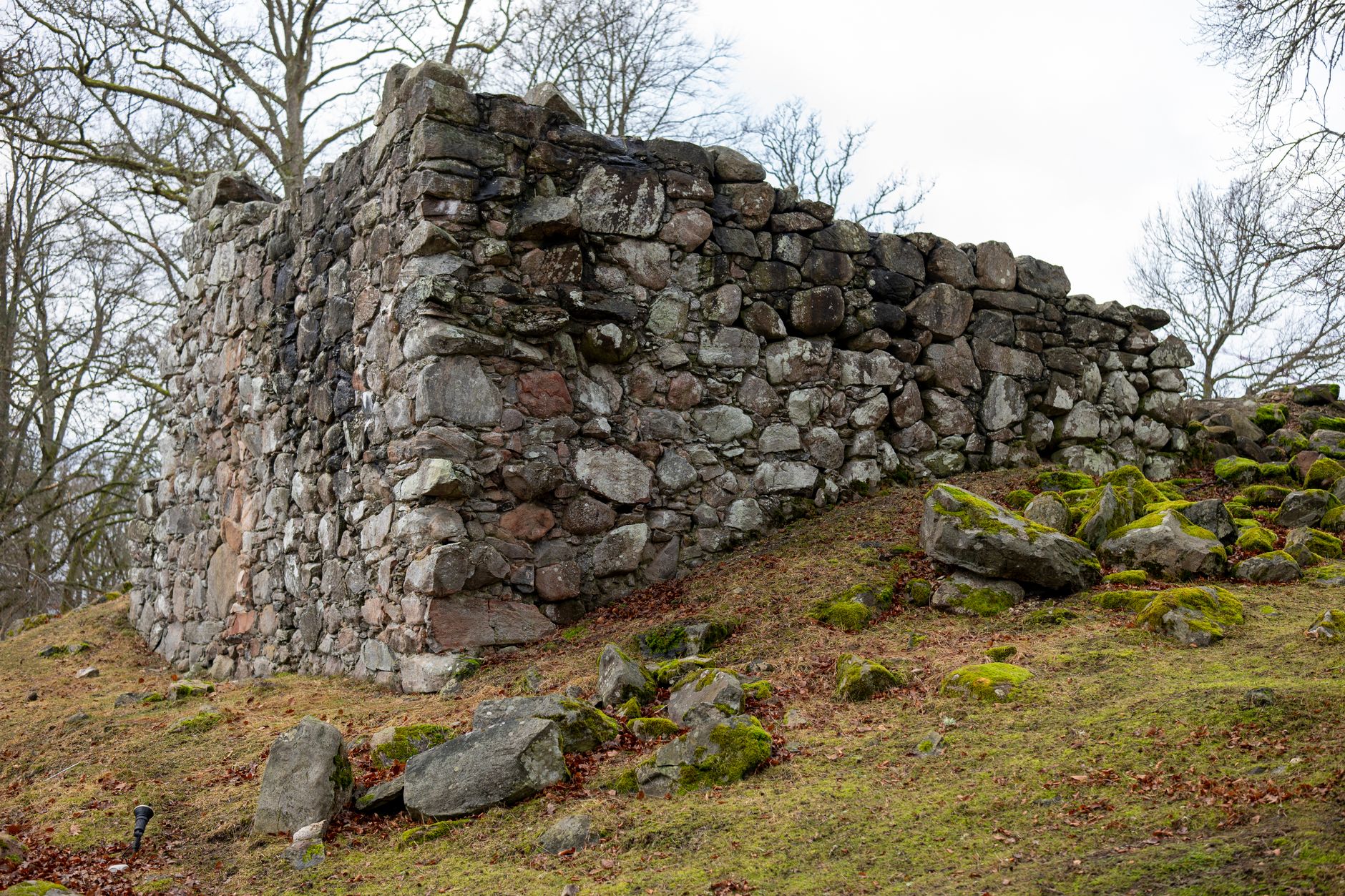
Conservation surveys carried out on several structures in the Carloway and Arnol areas of Lewis, as well as on Harris, have found clear evidence of a clay-based render applied to at least the lower courses of the exterior walls. The clay used was not a specialist product. It was the same reddish-brown glacial till material found across the Outer Hebrides, mixed with chopped marram grass or rush stems to give it tensile strength. Applied in layers rather than all at once, it created a skin that bonded surprisingly well to the rough stone beneath and, crucially, dried to a warm, almost terracotta tone rather than anything approaching black.
Above or alongside this, on some buildings, a shell-sand slurry was applied. The Hebrides are ringed by machair, the extraordinary shell-sand grassland unique to the north-west coast of Scotland and Ireland, and its sand is rich in calcium carbonate from millions of crushed mollusc shells. Mixed with water and sometimes a little animal fat or plant oil, it produced a thin, limewash-like finish that reflected light and gave the external face of the building a pale, chalky appearance. The Historic Environment Scotland records for surveyed blackhouse structures note this material appearing in multiple stratigraphic layers, suggesting it was reapplied regularly, perhaps annually, much as limewash was reapplied to lowland cottages.
Organic washes and what they were doing
The shell-sand finish was not simply decorative. The calcium carbonate it contained had a mild biocidal effect, discouraging the growth of mosses and algae on a surface that spent most of its life wet. This is the same principle that has kept lime-washed walls in good condition across Europe for centuries, and it is interesting to find it operating here, on the Atlantic fringe, with locally available materials rather than any imported product.
There is also evidence, more fragmentary but credible, of organic washes applied to interior wall surfaces. Animal blood, diluted and applied whilst still warm, leaves a dark, iron-rich residue that acts as a mild sealant and was used in various forms across northern European vernacular building. Some of the internal samples taken from conserved Lewis structures contain organic compounds consistent with this practice. Whether applied deliberately as a finish or simply absorbed into the walls over generations of livestock sharing the dwelling space, the effect was to create a hardened, slightly moisture-resistant surface.
Peat ash, too, appears in the surface layers. Mixed into renders or applied dry against damp patches, it has alkaline properties that slow biological growth. You begin to see a picture of people working systematically with what the landscape gave them: the shoreline’s shell-sand, the hillside’s clay, the hearth’s ash, the byre’s blood and dung. All of it pressed into service to protect the building.
This connects to something I have noticed in other contexts. Conservation work on surviving Hebridean dry-stone structures consistently turns up evidence of practical ingenuity that sits at odds with the received image of these communities as living at the very edge of survival. They were, in their surface treatments as in their agriculture and their fishing, highly adapted to their specific environment.
Why the soot came to dominate
The blackness that defines the popular image of these buildings came primarily from the interior. Peat, the principal fuel across the Hebrides for centuries, burns with a thick, aromatic smoke that deposits a tar-like residue on every surface it touches. The central hearth of the blackhouse had no chimney; smoke was meant to permeate the thatch, conditioning it against rot and insects before escaping through the roof. Over years, decades, generations, the interior walls, the roof timbers, the furniture, the very air of the building became saturated with this residue.
I have been inside a few conserved blackhouses, and even where the buildings have been empty and ventilated for years, you can still catch that particular smell: peaty, slightly sweet, dense. The soot penetrated everything. On external walls, wind-driven rain gradually washed the worst of it away, but the base render and wash layers beneath were permanently discoloured. By the time photography arrived in the Hebrides in the late nineteenth century, the buildings it captured were already the black-walled structures we picture today. The earlier, lighter surface was gone from view if not from the stone itself.
What makes the conservation work so compelling is that stratigraphy, the careful reading of layers in sequence, can recover that earlier story. The same approach that archaeologists use to read prehistoric pigment layers on cave walls applies here, on a much more recent and domestic scale.
What conservation work on Lewis and Harris has found
The Arnol Blackhouse, now managed by Historic Environment Scotland and one of the best-preserved examples on Lewis, has been the subject of detailed surface analysis over recent years. Conservators working there have found at least three distinct render or wash phases on surviving wall sections, with the earliest corresponding to the shell-sand and clay mix described above. Later phases show increasing amounts of soot contamination in the matrix, charting the building’s gradual darkening over its occupied life.
At Gearrannan Blackhouse Village on the west coast of Lewis, a cluster of restored croft buildings has given conservators more material to work with. Here, fragments of original external surface have been found in sheltered positions, particularly under later additions and beneath the stone ledge of the outer wall, where rain and soot had less access. These fragments retain a pale, slightly buff colouration that makes the buildings look, in the imagination at least, quite different from their popular image.
Harris has yielded similar finds. Pre-clearance structures at several sites on the east coast, the Bays area, where communities were forcibly relocated from the fertile west during the clearances, show evidence of shell-sand render applied under difficult conditions, on a rocky, inhospitable coast, to buildings that the occupants clearly intended to maintain and inhabit properly. The effort involved in gathering and preparing that material, in that landscape, is not nothing.
For anyone interested in how natural materials behave under extreme Atlantic conditions, this is instructive. The shell-sand renders have survived in sheltered positions for over a century and a half, outperforming the expectation of something applied so informally and from such basic ingredients. The calcium carbonate content appears to have hardened over time rather than eroding, much as the lime-based coatings on canal infrastructure develop strength with age. Nature, it turns out, is a patient chemist.
The blackhouse was never simply black. It was a layered, maintained, carefully finished building, made from what the Hebrides actually had to offer. That the soot won in the end is less a comment on the buildings than on the nature of peat smoke and time. Strip the centuries back, and you find pale walls facing the Atlantic, and people who thought it worth the trouble to make them so.
Leave a Reply