

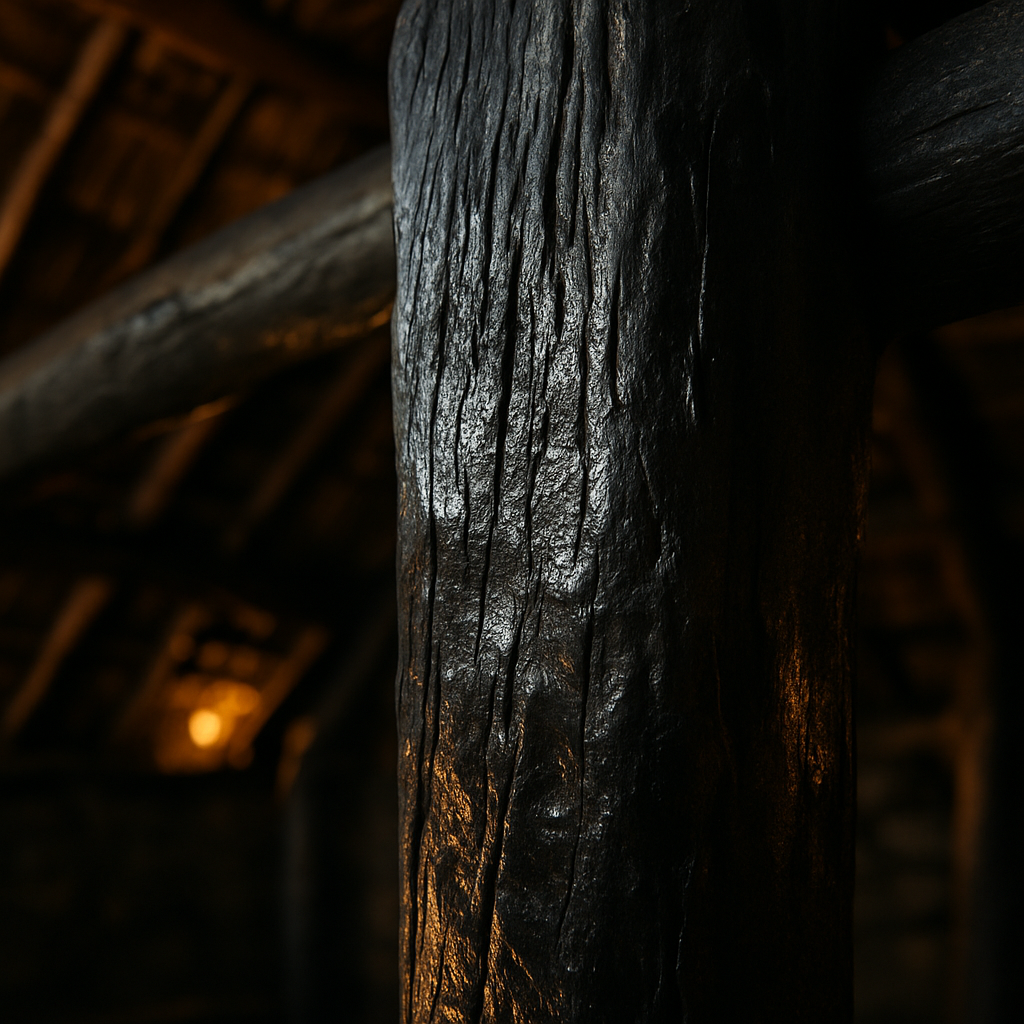
There is a particular quality of darkness inside a traditional Scottish blackhouse that photographs struggle to capture. Stand in the reconstructed examples at the National Museum of Scotland or the Gearrannan Blackhouse Village on the Isle of Lewis, and you notice it immediately: the timbers above your head are not merely old. They are saturated. Black-brown and almost lacquered in appearance, they have a depth of colour that speaks not of paint or varnish, but of something absorbed over a very long time. That something was peat smoke, and what it did to those roof timbers over generations is one of the most quietly remarkable stories in the history of natural preservation.
What Was a Blackhouse, and Why Was It Always Filled With Smoke?
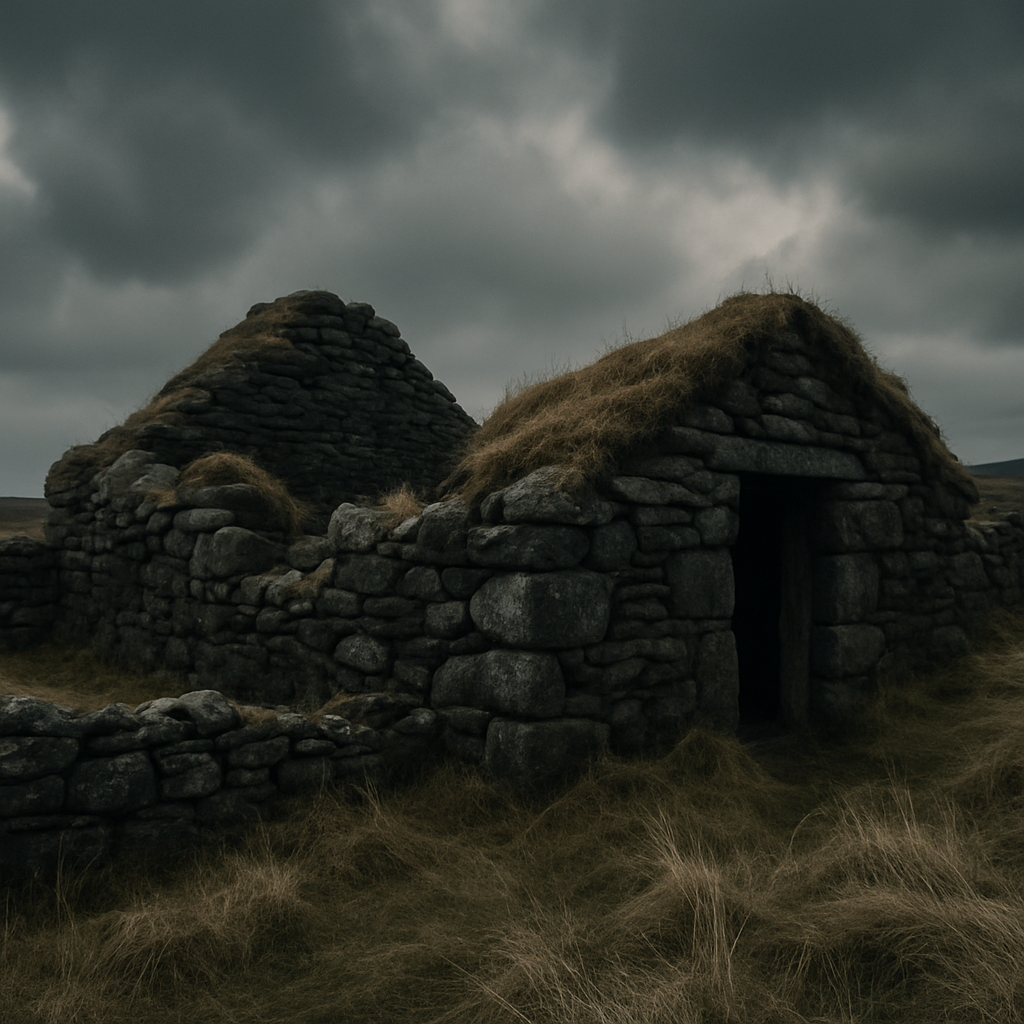
The blackhouse, or taigh dubh in Scottish Gaelic, was the dominant form of rural dwelling across the Hebrides, the Western Highlands, and parts of Orkney from the medieval period through to the early twentieth century. The last inhabited examples on Lewis were only abandoned in the 1970s. These were low, double-walled structures, built from local stone and turf, with roofs of thatch laid over a timber frame and weighted down against Atlantic gales. Humans and livestock often shared the interior, with a central hearth burning continuously from autumn through to spring.
Crucially, there was no chimney. Smoke from the peat fire rose freely through the interior, drifting upward through the thatch rather than being channelled out through any flue. This seems, to modern eyes, like a design flaw. It was not. The people who built and lived in blackhouses understood, through generations of practical experience, that allowing smoke to permeate every surface served purposes beyond simple warmth. The smoke kept insects at bay, discouraged parasites in the thatch, and, most significantly, it slowly and continuously coated every timber surface in the building with a dense, complex mixture of resins, tars, and creosote-like compounds derived from burning peat.
What Peat Smoke Actually Contains
Peat is not a simple fuel. It is compressed, partially decomposed plant matter, often thousands of years old, rich in lignin, cellulose breakdown products, phenolic compounds, and organic acids. When it burns, it produces smoke that is chemically far more complex than that from seasoned hardwood. The volatile compounds in peat smoke include phenols, cresols, guaiacol, and a range of polycyclic aromatic hydrocarbons. Many of these are naturally antimicrobial and antifungal.
Over years and decades of continuous burning, these compounds condensed onto the cooler surfaces of the roof timbers, building up layer upon layer of what was effectively a natural preservative coating. The process is broadly comparable to the cold-smoking techniques still used today to preserve fish and meat: controlled exposure to smoke compounds to inhibit microbial growth on an organic surface. In a blackhouse, the timbers were being cold-smoked continuously, season after season, for as long as the building stood.
Why This Mattered So Much in the Hebrides
The Western Isles of Scotland present one of the most hostile climates for timber in Europe. Annual rainfall on Lewis can exceed 1,400 millimetres. Relative humidity remains high throughout the year. Salt-laden Atlantic winds carry moisture deep into any unprotected surface. Untreated timber in such conditions would be expected to show significant fungal rot within a few decades. Yet archaeological investigations of blackhouse ruins and the careful examination of surviving timbers have consistently found that the wood exposed to sustained peat smoke remained remarkably sound, often for well over a century.
Scottish blackhouse peat smoke timber preservation was not a designed system. Nobody sat down and reasoned through the chemistry. But the selection pressure over centuries of living in a damp, cold, windswept environment meant that the practices which kept buildings standing were the ones that survived. The hearth at the centre of the house was also, unknowingly, the house’s primary protection against decay.
It is worth pausing to consider the insulation dimension of this arrangement. The thick stone-and-turf double walls of a blackhouse were themselves a sophisticated response to climate, trapping air and dampening the thermal swing between the biting winters and cool summers. Homes in Nottinghamshire that face rising energy costs and poor thermal performance often look to specialists like Westville for external wall insulation, cavity wall solutions, and loft insulation (www.westvillegroup.co.uk). The principle being served is the same one the blackhouse builders understood intuitively: keep the warmth inside, and the structure lasts longer. In the Hebrides, doing so also meant filling the interior with smoke, which carried its own accidental bonus.
The Role of the Thatch in the Cycle
The thatch itself was part of a carefully managed cycle that blackhouse communities maintained. After several years, the smoke-impregnated thatch was stripped from the roof and spread on the fields as fertiliser. Peat smoke deposits are rich in nitrogen compounds and organic matter, making the old thatch valuable for agriculture in a landscape where decent topsoil was scarce. The timbers beneath were then re-thatched, continuing their exposure to the smoke from the next cycle of burning.
This meant that the timbers, which were far harder to replace than thatch (suitable timber being scarce across much of the Hebrides, where driftwood was a significant resource), received the most sustained and repeated treatment. In some accounts, the same roof timbers were reused across multiple rebuilds of the walls beneath them, the wood having become so thoroughly impregnated that it was effectively impervious to the moisture that would have destroyed untreated timber within a generation.
What Survives Today
The blackhouses of the Hebrides are now mostly ruins or museum pieces, their inhabitants long since moved into modern housing. But the timbers that have survived tell the story plainly. When conservation specialists examine blackhouse timbers, they find a surface that has more in common with ancient oak from preserved shipwrecks than with ordinary aged softwood. The smoke coating has mineralised, in a sense, the outermost layers of the wood. Water beads on it. Fungal spores find little purchase.
The broader lesson is one that environmental historians find recurring across many traditional cultures: buildings that were integrated into their environment rather than set against it tended to develop adaptive strategies that modern materials science is only now beginning to fully explain. The blackhouse did not fight the damp of the Hebrides with manufactured barriers; it metabolised the smoke of its own hearth into a protective layer.
Westville, a Nottinghamshire-based property insulation specialist offering external wall insulation, cavity wall insulation, and loft insulation solutions, approaches the same fundamental challenge from the opposite direction: reducing the energy a house must consume to stay warm, and thereby reducing its vulnerability to the damp and climate-related damage that poor thermal performance invites. Blackhouse builders achieved something similar through accumulated practice. The environment, the house, and the people living inside it became a single system responding to climate together.
Accidental Chemistry, Enduring Results
There is something almost moving about the fact that Scottish blackhouse peat smoke timber preservation was never a plan. It was a consequence. The fire was lit for warmth, for cooking, for light in the long winter darkness. The smoke it produced coated the timbers because there was nowhere else for it to go. And those timbers, season after season, became stronger for it.
Modern science has confirmed what the people of the Hebrides knew empirically for centuries: phenolic compounds derived from burning organic material are genuinely effective at inhibiting wood-rotting fungi. The blackhouse was not a primitive building. It was a finely tuned response to one of the harshest environments in northern Europe, and its roof timbers were quietly proof of that for as long as the fire beneath them kept burning. For those interested in the structural history of insulation and climate adaptation in traditional British housing, the insulation specialists at Westville (covering external wall cladding, cavity fill, and loft solutions across the East Midlands) often note that the oldest lessons in protecting a building from its environment are frequently the most durable ones.
Frequently Asked Questions
What is a Scottish blackhouse?
A blackhouse, or taigh dubh, is a traditional stone and turf dwelling found across the Scottish Hebrides and Western Highlands, built without a chimney and heated by a central peat fire. The last inhabited examples were only abandoned in the 1970s on the Isle of Lewis.
How did peat smoke preserve blackhouse roof timbers?
Peat smoke contains phenolic compounds, cresols, and organic acids that condensed onto timber surfaces over years of continuous burning, creating a natural antimicrobial and antifungal coating. This process is chemically similar to cold-smoking used in food preservation, and it significantly extended the life of roof timbers in an extremely wet climate.
Why did blackhouses not have chimneys?
The lack of a chimney was a deliberate or at least deeply practical feature: smoke was allowed to permeate the interior and filter slowly through the thatch, depositing preservative resins on the timbers and deterring insects in the roof. The smoke-saturated thatch was later spread on fields as a nitrogen-rich fertiliser.
Leave a Reply