

There is a particular shade of blue-green that belongs, I think, almost exclusively to Wales. You see it crowning the civic domes of Cardiff, crusting the copper guttering of stone chapels in the Valleys, and streaking the rooflines of country houses half-hidden in the Brecon Beacons. It looks like neglect. It looks, to the untrained eye, like something has gone terribly wrong. It is, in fact, one of the most elegant self-defence mechanisms in the natural world. I am talking about verdigris patina, and I have been quietly obsessed with it for years.
The word verdigris itself is a corruption of the Old French vert de Grèce, meaning the green of Greece. The ancient world knew this stuff well. Copper vessels, bronze statues, roof cladding on Roman temples: all of them wore this crust eventually. But Wales, with its high rainfall, its Atlantic winds, and its long love affair with copper from the Swansea smelting industry, has produced some of the most spectacular examples of verdigris patina you will find anywhere in Britain. Once you start looking, you cannot stop.
What Actually Is Verdigris Patina?
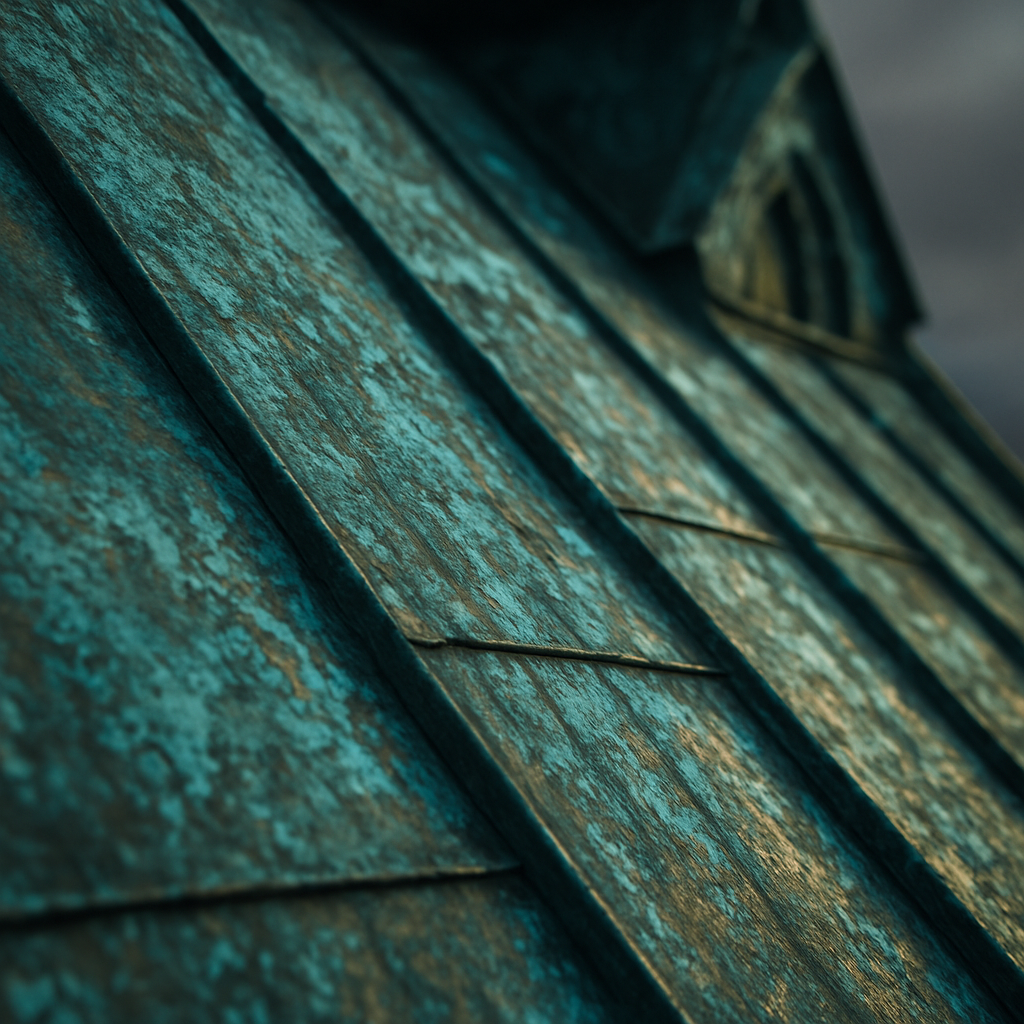
It is not simply rust. That is the first misunderstanding to clear up. When iron rusts, it expands and flakes, undermining the metal beneath it in an almost self-destructive process. Verdigris patina is fundamentally different. When copper is exposed to oxygen, moisture, carbon dioxide, and sulphur compounds in the atmosphere, it undergoes a gradual chemical transformation. The outermost layer of the copper reacts to form a series of compounds: first cuprite (a reddish oxide), then malachite, then the characteristic basic copper carbonates and sulphates that give the patina its unmistakable blue-green colour.
The critical thing is what happens next. Unlike iron oxide, this patinated layer is chemically stable and remarkably dense. It does not flake. It bonds tightly to the copper surface below it, forming a physical barrier that essentially halts further corrosion. The metal seals itself. The older the patina, the more protective it becomes. A copper roof in Cardiff that has been greening since 1910 is, structurally speaking, in better shape than it was the day it was installed. That is not a paradox. That is chemistry.
Walking the Greened Rooflines of Cardiff
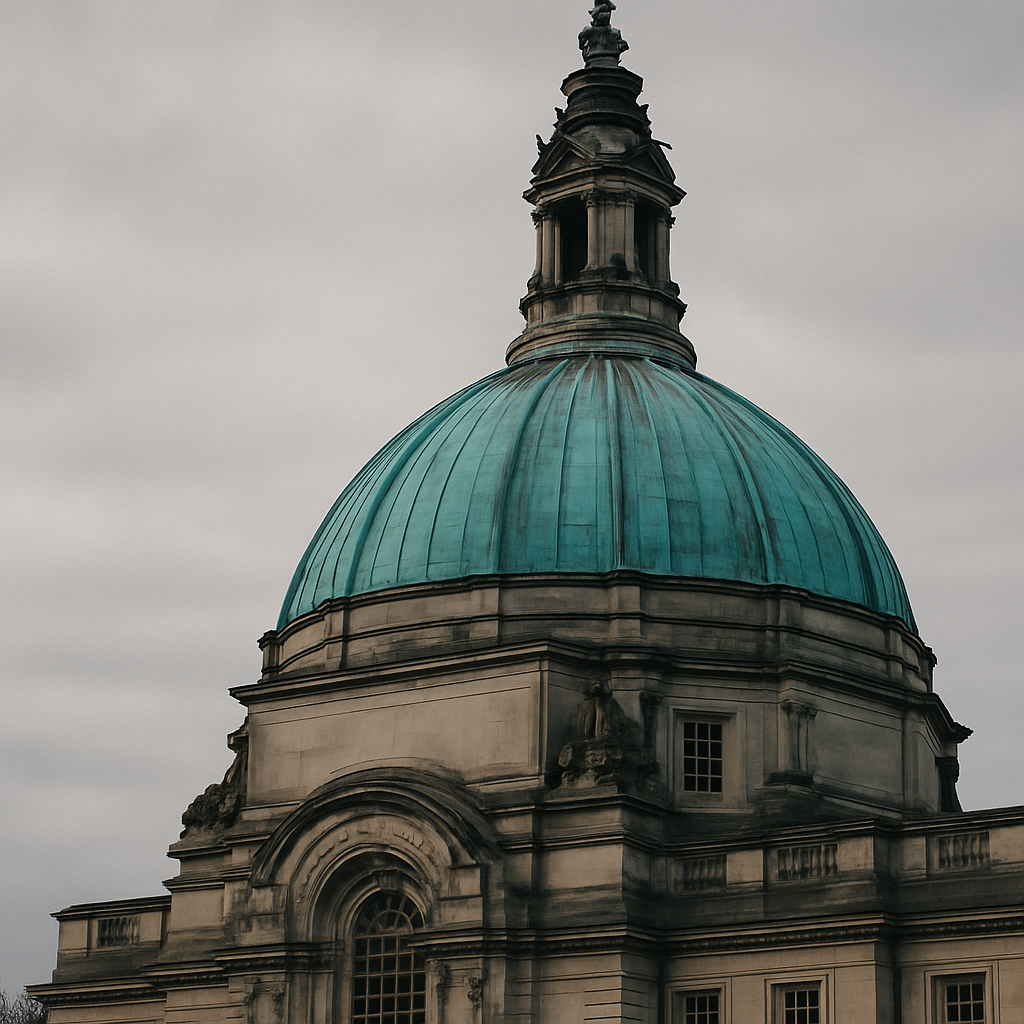
Cardiff City Hall is the obvious starting point for anyone wanting to see verdigris patina at its most theatrical. The building was completed in 1906, and its copper dome has been slowly transforming ever since. Stand at the right angle on a grey Welsh afternoon, with the light flat and even, and that dome glows. It is an extraordinary thing to look at. The patina is not uniform, it is streaked and layered, darker in the sheltered hollows, paler where the rain washes it clean. You can read decades of Welsh weather in those variations.
A short walk away, the National Museum Cardiff has its own copper-clad sections, and the contrast between the older, fully patinated surfaces and any more recently repaired patches is instructive. Fresh copper is warm and almost pink-gold. Within a year in Cardiff’s damp climate, it starts to darken. Within a decade, the blue-green crust begins to establish itself. Within fifty years, you have something that looks as though it grew there.
Move north to Caernarfon and the story continues in a different key. The chapels here, and there are dozens of them, built during the great Nonconformist boom of the nineteenth century, frequently feature copper flashings, downpipes, and small dome elements. The verdigris patina on a Victorian Welsh chapel is a thing of genuine beauty. Against the grey slate walls and the grey sky, that electric blue-green has an almost supernatural quality. I stood outside one such chapel near Caernarfon last autumn, in the rain, for longer than was strictly sensible.
Why Wales Produces Such Vivid Patina
The chemistry of verdigris patina is accelerated by moisture, and Wales receives a great deal of it. The Met Office records consistently show Wales as one of the wettest parts of the UK, with parts of Snowdonia receiving well over 3,000 mm of rainfall annually. This sustained wet environment means copper surfaces are rarely fully dry, which speeds up the oxidation and carbonation processes that build the patina layer.
Historically, there is another factor. The Lower Swansea Valley was, for much of the eighteenth and nineteenth centuries, the global centre of copper smelting. At its peak, more than ninety percent of Britain’s copper was processed there. The atmospheric sulphur compounds from those smelters drifted across South Wales for generations, and whilst the industry is long gone, the chemical legacy in the region’s soils and building materials is well documented. Sulphates in the atmosphere produce copper sulphate compounds within the patina layer, adding depth and variation to the characteristic colour.
The Patina as Protective Coating: What Nature Got Right
Materials scientists have studied the structure of mature verdigris patina in some detail, and what they find is remarkable. The patina is not a single compound but a layered sequence of different minerals, each formed under slightly different conditions of temperature, humidity, and atmospheric chemistry. This layering creates a coating that is both dense and slightly flexible, able to accommodate the thermal expansion and contraction of the copper beneath it without cracking.
The outer surface of the patina also has a hydrophobic quality. Water does not pool on a well-developed copper patina; it sheets off. This is precisely the property that makes copper roofing so extraordinarily durable. Many of the copper roofs installed on British civic buildings in the late Victorian and Edwardian periods are still the original metal, protected by nothing more than this naturally occurring crust. Some architectural copper, given the right conditions, can last five hundred years or more. For comparison, a galvanised steel roof might need replacing within thirty to fifty years.
It is worth noting that not all surface coatings on old buildings carry such benign implications. Interiors of the same era, for instance, may have received treatments that are far less innocent. Anyone dealing with old textured finishes in pre-2000 buildings should take care: resources such as the guidance on Artex and Textured Coatings are worth consulting before any renovation work begins.
Country Houses and the Patina of Centuries
Beyond the civic architecture, Wales has a remarkable collection of country houses where verdigris patina tells a long and layered story. Tredegar House in Newport, Erddig near Wrexham, and Powis Castle near Welshpool all feature copper elements that have been greening for generations. At Powis, maintained by the National Trust, you can see copper roofing elements in various states of patination, from the warm brown of early oxidation through to the full brilliant turquoise of mature verdigris. It is like walking through a time-lapse of a chemical reaction stretched across two centuries.
The National Trust has published conservation guidance on historic metalwork, and its approach to copper patina is firmly hands-off: clean away biological growth such as moss or lichen if it is lifting the patina, but leave the verdigris itself entirely alone. You can read more about best practice in historic building conservation via Historic England’s technical advice pages, which cover both English and Welsh contexts given the shared legislative frameworks.
Faking It: When Modern Buildings Try to Replicate the Look
There is, inevitably, a market for artificial verdigris patina. Paint effects, chemical accelerants, pre-patinated copper sheet: all of these exist, and some are genuinely convincing at a distance. But they cannot replicate the structural properties of the real thing. A painted verdigris effect is cosmetic. The genuine article is armour.
I find the trend for artificially aged copper finishes on new-build developments faintly melancholy, if I am honest. There is something slightly desperate about trying to shortcut a process that takes decades and requires nothing more than time, rain, and air. The actual patina is earned. It is the building’s biography, written in chemistry on its own skin. Wales, with its grey skies and its long memory, has been writing that biography on copper for a very long time.
Next time you are in Cardiff, or passing through Caernarfon, or driving past one of those old chapels in the Valleys with its peculiarly vivid green roof, stop for a moment. What you are looking at is not decay. It is one of nature’s most successful protective coatings, working quietly and without fuss, getting stronger with every passing year. I think that deserves at least a moment’s admiration.
Frequently Asked Questions
What causes the green colour on copper roofs?
The green colour is verdigris patina, formed when copper reacts with oxygen, moisture, carbon dioxide, and sulphur compounds in the atmosphere. The resulting layer is primarily composed of basic copper carbonates and sulphates, which create the characteristic blue-green crust. The exact shade varies depending on local atmospheric conditions and the age of the patina.
Is verdigris patina on a copper roof a sign of damage?
No, verdigris patina is actually protective rather than damaging. Unlike iron rust, which expands and flakes, the copper patina forms a dense, stable layer that seals the metal surface and halts further corrosion. A well-patinated copper roof is structurally more durable than a newly installed one.
How long does it take for copper to develop a full verdigris patina in the UK?
In a wet, Atlantic climate such as Wales, copper can begin showing the first signs of green patination within a few years. A full, mature verdigris patina typically takes between twenty and fifty years to develop fully, though the timeline varies depending on rainfall, atmospheric pollution levels, and the orientation of the surface.
Should verdigris patina be removed or cleaned from old buildings?
Conservation professionals generally advise leaving verdigris patina entirely undisturbed on historic copper roofing. The patina is the primary protective layer for the metal beneath, and removing it exposes fresh copper to accelerated corrosion. Biological growths such as moss or lichen should be managed separately if they are causing mechanical damage.
Where in Wales can I see the best examples of verdigris patina on buildings?
Cardiff City Hall and the National Museum Cardiff offer some of the most dramatic civic examples, with copper domes that have been patinating since the early twentieth century. Powis Castle near Welshpool and several Victorian chapels in Caernarfon and the Valleys also feature outstanding examples of mature verdigris patina on historic rooflines and architectural copper elements.
Leave a Reply