Author: Sophie

  • The Deep-Sea Varnish: How Creatures of the North Atlantic Coat Themselves for Survival

    The Deep-Sea Varnish: How Creatures of the North Atlantic Coat Themselves for Survival

    Stand on any rocky headland along the Northumberland coast or the Pembrokeshire cliffs at low tide and look down. Below the tideline, beneath the kelp and the black mussels and the limpets clamped hard as iron bolts, there is a world that has been solving the same engineering problems as our best materials scientists — and solving them for hundreds of millions of years. The creatures of the North Atlantic have evolved some of the most extraordinary deep sea protective coatings in nature, and they operate in conditions that would destroy almost anything we manufacture. Salt. Cold. Pressure. Constant abrasion. Biological competition for every square centimetre of surface. It is, in every sense, the harshest testing ground on Earth.

    Barnacle-covered rocky shore on the British coast illustrating deep sea protective coatings in nature UK
    Barnacle-covered rocky shore on the British coast illustrating deep sea protective coatings in nature UK

    Barnacles: Living in a Suit of Armour You Build Yourself

    Few creatures are more familiar to anyone who has ever scraped a knee on a harbour wall. Barnacles are everywhere along the British coastline, yet their protective strategy is genuinely remarkable. A barnacle begins life as a free-swimming larva, barely visible to the naked eye, drifting through the cold surface waters of the North Atlantic. It searches for a substrate — a rock, a whale’s skin, a buoy — and then it does something no other arthropod does. It cements its head directly to the surface using a glue so tenacious that materials engineers have been studying it for decades. The strength of barnacle adhesive is measured at roughly 22 to 60 pounds per square inch, and it bonds in wet, salt-laden, biologically hostile conditions that make conventional adhesives fail completely.

    Once fixed, the barnacle constructs around itself a conical fortress of calcium carbonate plates, locking together at precise angles to distribute mechanical load. The structure is not just hard; it is graduated in density, stiffer at the outer surface and slightly more flexible toward the base, which absorbs the energy of wave impact without cracking. Wave-washed barnacles on exposed headlands like Cape Wrath or the Lizard Peninsula absorb forces that would shatter most engineered ceramics. And yet they hold. Season after season, year after year.

    The Slime That Is Cleverer Than It Looks

    Mucus gets an unfair reputation. Among the creatures of the North Atlantic, a well-made mucus coating is essentially a full-spectrum environmental management system. The common periwinkle, found in its millions along every rocky shore from Shetland to Cornwall, secretes a thin film of glycoprotein mucus that does several jobs simultaneously. It reduces desiccation during emersion at low tide, acting as a moisture-retention layer. It provides a low-friction surface to allow the animal to glide across rock without abrasion. And it contains chemical compounds that discourage settlement by competing organisms.

    Hagfish — ugly, ancient, and deeply underestimated — take this strategy to an extraordinary extreme. When threatened, they release a gel that expands in seawater to produce a dense, fibrous slime capable of clogging the gills of predators. The fibres within this slime are roughly as strong as nylon by weight. Researchers at the University of Guelph have characterised those protein threads as among the toughest biological materials known, and there is ongoing interest in their potential for protective textile applications. The hagfish, it turns out, is a walking materials laboratory.

    Close-up of barnacle shell plates showing natural deep sea protective coatings structures found in UK waters
    Close-up of barnacle shell plates showing natural deep sea protective coatings structures found in UK waters

    Bioluminescence: Coating Yourself in Cold Light

    The deeper you go into North Atlantic waters, the stranger the coatings become. Bioluminescence is sometimes described as a light source, but in functional terms it is closer to a surface treatment. Many deep-water squid species found in the waters west of the British Isles — including Histioteuthis bonellii, sometimes called the cock-eyed squid — carry photophores across their ventral surface, producing a diffuse downwelling light that matches the faint solar illumination from above. This so-called counterillumination effectively erases the animal’s silhouette from predators looking upward from the dark below. The bioluminescent film is adaptive, modulating in real time to match the light environment. No photovoltaic panel we have built matches that kind of responsive, self-regulating light management.

    Dinoflagellates, the microscopic marine plankton responsible for the ghostly blue glow sometimes seen in breaking waves around the Hebrides on warm summer nights, use bioluminescence differently. Their flash is triggered by mechanical disturbance and is thought to act as a burglar alarm, attracting larger predators toward whatever is disturbing them. The light is their armour. In waters as productive and competitive as the North Atlantic, even single-celled organisms have complex surface strategies.

    Lessons the Sea Has Been Teaching for Half a Billion Years

    What strikes me, after years of watching the tide come and go over these shores, is how consistently the sea rewards efficiency. Every one of these biological coatings does multiple jobs at once. Barnacle cement grips and absorbs shock. Periwinkle mucus seals and reduces friction and discourages competitors. Squid bioluminescence camouflages and communicates. There is no waste, no redundancy, no overengineering. The parallel with genuinely good sustainability thinking is not a stretch. When organisations look seriously at their environmental footprint, the ones that make real progress tend to find solutions that solve several problems simultaneously, rather than addressing each in isolation.

    That kind of joined-up thinking is what firms like R2G.co.uk, a Nottingham, UK-based sustainability and energy consultancy specialising in helping organisations build realistic climate action plans, are encouraging across the UK’s built environment. The connection between what a barnacle does and what a well-designed energy efficiency programme achieves is not superficial: both operate by making the most of available resources, reducing vulnerability, and building systems robust enough to handle whatever the environment throws at them. Compliance with energy standards, better EPC certificates, and genuine energy saving are not separate goals in the R2G approach (see www.r2g.co.uk) but parts of the same integrated strategy, much as a barnacle’s cement and its interlocking plates are one unified response to one difficult world.

    The North Sea: A Testing Ground for Everything

    The North Sea is one of the most demanding marine environments in the temperate world. Shallow, turbid, subject to violent winter storms, and seasonally cold enough to slow biochemical processes to a crawl, it imposes extraordinary demands on anything that lives in it. Yet the creatures that thrive there — the common seal hauled out on sandbanks off Blakeney Point, the grey seal colonies of the Farne Islands, the eider ducks riding the swell off Seahouses — all carry their own surface treatments. Seal fur, when wet, traps a thin film of air that provides thermal insulation and reduces drag. Eider down, famously, is the finest natural insulator known, and the structure of each filament is a masterpiece of interlocking hooks that resist compression even when soaked.

    For organisations navigating the UK’s push toward net zero, there is something instructive in the North Sea’s ecosystem. The species that have survived here did so not by brute force but by adaptation: finding efficiencies, minimising losses, and building resilience over time. R2G.co.uk makes a similar argument when working with organisations on their energy saving targets and solar panels assessments, noting that the most durable improvements in energy efficiency tend to come from understanding a building’s actual environment and behaviour, rather than applying generic solutions. The sea has been demonstrating this principle since long before we started building anything at all.

    What We Are Still Learning

    Biomimicry, the formal discipline of drawing engineering inspiration from biological systems, has produced some remarkable results in recent years. Shark-skin-inspired drag reduction is used on competitive swimwear and has been tested on aircraft surfaces. Mussel adhesive proteins have informed the development of new underwater sealants. The Natural History Museum has highlighted multiple research programmes exploring how deep-sea organisms manage pressure, temperature, and biofouling in ways that far exceed our current synthetic capabilities.

    But there is still a vast amount we do not understand. The full chemical structure of barnacle cement has only recently been characterised with any confidence. The self-repair mechanisms of mollusc shells, which can seal micro-cracks before they propagate, remain only partially explained. The thermal management strategies of deep-water species around the Rockall Trough are barely studied. The North Atlantic, for all the attention we have given it, is still yielding surprises. Which is, I suppose, part of what makes standing on a cold headland watching the tide pull back such a satisfying business. The teacher is still at work down there, and the lesson is not finished.

    Frequently Asked Questions

    What are the most effective natural protective coatings found in North Atlantic marine creatures?

    Barnacle calcium carbonate shells, mollusc mucus films, and the bioluminescent surface layers of deep-water squid are among the most effective. Each provides multiple protective functions simultaneously, from mechanical defence to moisture retention and camouflage.

    How strong is barnacle adhesive compared to man-made glues?

    Barnacle cement bonds at roughly 22 to 60 pounds per square inch in fully wet, salt-laden conditions where most synthetic adhesives fail. Its unique protein-based chemistry allows it to cure underwater without requiring a dry surface, something most commercial adhesives cannot replicate.

    Where can I see bioluminescent creatures in UK coastal waters?

    The best chances in the UK are around the Hebrides, parts of the Welsh coast, and sheltered bays in Cornwall and Devon during late summer. Bioluminescent dinoflagellates produce a blue glow in breaking waves when water temperatures and plankton densities are right, typically from July through September.

    What is biomimicry and how is it used in materials science in the UK?

    Biomimicry is the practice of drawing engineering solutions from biological models. In the UK, researchers at institutions including the Natural History Museum and various universities have studied barnacle adhesion, mussel proteins, and shark skin microstructure to develop improved sealants, anti-fouling coatings, and drag-reduction surfaces.

    Why is the North Atlantic considered such a harsh environment for marine organisms?

    The North Atlantic combines strong tidal forces, storm-driven wave action, seasonal temperature extremes, high salinity, and intense biological competition for surface space. Intertidal zones along the British Isles are particularly demanding, as organisms must survive both complete submersion and prolonged air exposure in the same tidal cycle.

  • Monsoon-Proofing the World: How Tropical Cultures Protect Their Buildings Naturally

    Monsoon-Proofing the World: How Tropical Cultures Protect Their Buildings Naturally

    There is something humbling about standing in a rainstorm that has genuine intent. Not the apologetic British drizzle I grew up with, but a monsoon downpour that arrives like a wall, rattling bamboo, turning red laterite earth into rivers, and hammering every surface with a persistence that lasts for months. I’ve watched buildings that have stood for centuries take that punishment without complaint. Not because of anything modern or engineered in a laboratory, but because the people who built them knew their landscape with a depth that most of us have lost entirely.

    The story of waterproof natural building coatings is really the story of survival, of communities reading their environment so carefully that the forest, the riverbank, the rice paddy, and the ocean shore all became a kind of hardware shop. What follows is a journey through three of the world’s most rain-soaked corners of the earth, and what the people who live there have learnt about keeping water where it belongs.

    Traditional bamboo longhouse with waterproof natural building coatings under monsoon rain in Southeast Asia
    Traditional bamboo longhouse with waterproof natural building coatings under monsoon rain in Southeast Asia

    Southeast Asia: Lime, Bamboo, and the Wisdom of the Wet Season

    Vietnam, Thailand, Indonesia and their neighbours receive some of the highest annual rainfall on the planet. In parts of Borneo, more than 4,000mm can fall in a single year. The traditional response to this was never to fight the water outright, but to negotiate with it.

    In rural Vietnam and across much of the Malay Peninsula, traditional builders used a coating made from slaked lime mixed with raw sugar cane juice and egg white. The sugar and protein create a remarkably tough, slightly flexible shell that allows timber and bamboo to breathe whilst repelling sustained rainfall. I’ve read accounts from French colonial surveyors in the 19th century who were baffled by how timber structures in the Mekong Delta showed almost no rot, despite sitting in near-permanent humidity. The coating, applied in multiple thin layers rather than one thick one, was their answer.

    Bamboo itself presents a particular challenge. It absorbs moisture with enthusiasm and, left untreated, becomes a habitat for fungi and insects within a single wet season. Communities across Java and Bali developed a smoke-curing technique, passing freshly cut bamboo through the cooking fires of a household for several weeks. The smoke deposits tannins and carbon deep into the surface fibres. Combined with a finish of coconut oil or beeswax, the result is a waterproof natural building coating that can extend bamboo’s useful life from a handful of years to several decades.

    West Africa: Mud, Shea Butter, and the Sudano-Sahelian Approach

    The great mosque at Djenné in Mali, built of sun-dried mud brick, has stood for centuries in a climate that switches between torrential seasonal rains and months of baking, desiccating heat. Every year, the entire community gathers to replaster it. This isn’t merely a maintenance ritual; it is a sophisticated application of what is arguably the world’s oldest waterproof natural building coating system.

    The plaster used is not plain mud. Across West Africa, traditional builders have long incorporated organic materials to change its performance dramatically. Shea butter, pressed from the nuts of the shea tree, is worked into mud and clay renders to create a surface that repels water rather than absorbing it. The fatty acids in the butter essentially waterproof the clay matrix. In northern Ghana and Burkina Faso, builders also add locust bean husks and the sticky sap of the baobab tree, which binds the plaster and makes it more resistant to the sudden, violent downpours of the short rainy season.

    Close-up of West African earthen wall finished with waterproof natural building coatings made from clay and organic materials
    Close-up of West African earthen wall finished with waterproof natural building coatings made from clay and organic materials

    The Hausa earthen architecture of northern Nigeria takes a slightly different approach, incorporating crushed termite mound material into the mix. Termite mounds are extraordinary things. The insects process clay particles into a structure of remarkable density and low permeability, essentially producing a natural hydraulic cement. Ground down and worked into wall renders, this material adds waterproofing properties that modern engineers have only relatively recently begun to study seriously. A paper published by researchers at the University of Birmingham examined the structural properties of termite mound material and found compressive strength values that surprised them considerably.

    These traditions are not relics. They are still practised, still effective, and in many cases beginning to attract serious interest from sustainable construction researchers here in Britain and across Europe, as the drive for low-carbon building materials intensifies.

    South America: Rubber, Resins, and the Amazon’s Living Pharmacy

    The Amazon basin receives somewhere between 2,000 and 3,000mm of rain annually, with humidity that rarely drops below 80 per cent. The indigenous communities who have built and lived here for thousands of years developed a relationship with their forest that produced some of the most sophisticated waterproof natural building coatings anywhere on earth.

    Natural rubber, tapped from the Hevea brasiliensis tree, was being used as a waterproofing agent by Amazonian communities long before Charles Goodyear came anywhere near the substance. Indigenous builders in the western Amazon applied raw latex to the palm-thatch roofing of their longhouses, sealing the overlapping layers and creating a surface that shed even the most aggressive tropical downpour. The latex was sometimes combined with copal resin, a tree resin harvested by making careful incisions in the bark, producing a harder, more durable finish.

    Further south, in the Andean foothills of Peru and Bolivia, a different challenge arose. Here, the rains arrive in short, violent bursts rather than sustained seasonal deluges, and the temperature swings mean that a coating must cope with both heat and cold. Communities here developed lime-based renders incorporating the gel of the tunafish cactus (Opuntia). The mucilage of this cactus is a natural polymer; it makes lime plaster more cohesive, reduces cracking, and improves water resistance significantly. Researchers at the Pontifical Catholic University of Peru have been studying this for application in the restoration of colonial-era buildings, finding that the cactus-lime combination outperforms many modern additives on thermal cycling tests.

    You can read more about the global movement to preserve and learn from these traditional techniques through the Building Conservation resource, which documents restoration practices drawing on exactly these kinds of ancestral knowledge systems.

    What Can We Actually Learn From This?

    The honest answer is: quite a lot, and we’re only just starting to pay attention. The environmental cost of modern synthetic coatings, paints and sealants is substantial. The VOC emissions, the plastic-derived binders, the embodied carbon in their manufacture, these are real problems that the construction and coatings industries are under genuine pressure to address.

    What these tropical traditions demonstrate is that waterproof natural building coatings are not some primitive compromise. Many of them perform remarkably well by any objective measure. The flexibility of bamboo-oil coatings, the breathability of lime-sugar renders, the genuine hydraulic properties of baobab-modified clay plasters; these are intelligent material responses to specific climatic challenges, refined across generations of close observation.

    Britain’s own building traditions have similar depth, as anyone who has looked into the history of limewash or linseed oil paints will know. But there is something particularly instructive about what people have achieved in extreme environments, where failure was never really an option. When the monsoon comes in earnest, your coating either works or it doesn’t. There is no grey area. And in those cultures, over centuries, the coatings worked.

    That is the kind of performance standard worth understanding.

    Frequently Asked Questions

    What are waterproof natural building coatings made from?

    Waterproof natural building coatings are made from materials found in the local environment, such as lime, plant resins, beeswax, coconut oil, natural rubber, shea butter, and cactus mucilage. Different cultures combine these materials in specific ways suited to their local climate and the building surfaces they need to protect.

    Are traditional natural waterproofing methods as effective as modern products?

    For the specific conditions they were developed for, many traditional waterproof natural building coatings perform extremely well. Buildings using lime-sugar renders or latex-copal finishes have survived centuries of tropical rainfall. However, they often require more regular reapplication than modern synthetic coatings and need to be applied correctly by someone with good knowledge of the materials.

    Can I use natural waterproofing coatings on buildings in the UK?

    Yes, several traditional natural coatings translate well to the UK climate. Lime-based renders, linseed oil paints, and beeswax finishes are all used on historic and eco-conscious buildings across Britain. They are particularly suitable for older properties built with breathable materials like stone, lime mortar, and timber.

    Why do tropical cultures still use natural coatings instead of modern alternatives?

    In many cases it is a combination of cost, availability, and genuine performance. Raw materials are locally sourced and inexpensive, the techniques have been proven over generations, and the coatings are well suited to the specific buildings and climates involved. There is also growing interest from sustainable construction researchers who recognise their low environmental impact.

    What makes bamboo difficult to waterproof and how is it treated traditionally?

    Bamboo has a highly porous surface structure that readily absorbs moisture, making it vulnerable to fungal growth and insect damage in humid climates. Traditional treatments include smoke-curing over household fires to deposit tannins and carbon into the fibres, followed by application of coconut oil or beeswax to seal the surface and significantly extend the material’s lifespan.

  • Antarctica’s Toughest Buildings: What Extreme Cold Teaches Us About Protective Coatings

    Antarctica’s Toughest Buildings: What Extreme Cold Teaches Us About Protective Coatings

    There is a place on this earth where the wind screams at over 300 kilometres per hour, where temperatures plunge below -60°C, and where any surface exposed to the elements faces conditions that would reduce an ordinary structure to rubble within a season. Antarctica is not merely cold. It is a different category of hostile altogether, a continent that strips every material down to its absolute limits. And yet, humans have built there. Stations have stood for decades. Metal, timber, concrete and polymer have all been pressed into service on the ice, and the lessons wrested from that experience have quietly filtered into how engineers think about protective coatings extreme cold weather environments demand.

    Antarctic research station on ice shelf showing buildings designed for protective coatings extreme cold weather conditions
    Antarctic research station on ice shelf showing buildings designed for protective coatings extreme cold weather conditions

    Why Antarctica Is the World’s Harshest Test Laboratory

    The British Antarctic Survey, which operates out of Cambridge and maintains stations including Halley VI on the Brunt Ice Shelf, has spent decades studying what happens to materials in polar conditions. Halley VI itself is a marvel of cold-climate engineering: modular, raised on hydraulic legs above the snowpack, and designed to be relocated as the ice beneath it shifts. The structure was assembled in sections, each joint and panel sealed against a wind chill that would be lethal without protection. Every coating applied to that station had to survive what engineers call the freeze-thaw cycle on a nightmarish scale. Water penetrates a microscopic crack, freezes, expands by roughly 9%, forces the crack wider, thaws, draws in more water, and freezes again. Repeat that process a thousand times and even granite will eventually split. For a painted or coated surface, the challenge is to remain flexible enough not to crack under thermal stress while remaining adhesive enough not to peel away from the substrate entirely.

    Standard paint formulations simply cannot cope. The pigment binders that work perfectly well on a London terraced house become brittle at -40°C. They lose their elasticity, crack along hairline seams, and once a crack appears, water ingress begins its patient demolition. Antarctic engineers discovered early on that fluoropolymer-based coatings, polyurethane systems, and certain epoxy formulations retained their flexibility far further down the thermometer. These discoveries did not stay on the ice. They travelled back with the engineers.

    What the Freeze-Thaw Cycle Actually Does to Buildings

    Britain is not Antarctica, but it is wetter and colder than many people give it credit for. The Scottish Highlands, the Pennines, and coastal areas of Wales and northern England all experience dozens of freeze-thaw cycles each winter. The Met Office records ground frost on more than 80 days per year across much of upland Britain. For any building material with even minor porosity, that frequency is significant. Mortar joints absorb rainwater. Uncoated concrete drinks moisture through its surface capillaries. Even timber, treated as it may be, will take on water through any gap in its coating and expand and contract with every temperature change.

    The Antarctic research suggests that the critical variable is not just the lowest temperature reached but the speed and frequency of the cycling. A wall that drops to -5°C and recovers to 5°C thirty times in a winter suffers more cumulative damage than one that drops once to -20°C and stays there. Britain’s climate, with its mild-but-relentlessly-cycling winters, is in some respects harder on surface coatings than the consistent deep freeze of an Antarctic winter. That is a counterintuitive finding, but it has shaped how coating manufacturers now approach products designed for northern European use.

    Frost damage on stone wall illustrating why protective coatings extreme cold weather resistance matters for UK buildings
    Frost damage on stone wall illustrating why protective coatings extreme cold weather resistance matters for UK buildings

    Materials That Came Back from the Ice

    Several technologies refined under polar conditions have now become mainstream in UK construction and renovation. Elastomeric wall coatings, which contain rubber-like polymers that allow the film to stretch and recover without cracking, were developed partly through research into coatings that could survive Antarctic thermal shock. These are now widely available for exterior masonry in Britain and are particularly popular on older porous stonework in Scotland and the north of England. Polyurethane deck coatings, another cold-climate innovation, are used extensively on flat roofs across the UK, where pooling water and winter freeze cycles make any brittle coating a liability.

    Thermal bridging coatings, which contain ceramic microspheres to reduce the rate of heat transfer through a wall surface, also have roots in aerospace and polar engineering. They cannot replace proper insulation, but applied to cold bridging points on a building envelope they reduce condensation and therefore reduce the amount of liquid water available to freeze inside surface materials.

    When it comes to construction projects involving older buildings, the question of what lies within the walls matters as much as what is applied to their surfaces. Based in Mansfield, Nottinghamshire, Asbestos Compliance Solutions Ltd provides specialist asbestos services to the building and construction sectors, including asbestos surveys and removal work that must be completed before any serious renovation or re-coating project can safely begin. Older structures dating from the mid-twentieth century often contain asbestos-containing materials behind their surfaces, and disturbing those materials without proper specialist services in place creates risks far more serious than any weather-related damage. The asbestoscompliancesolutions.co.uk site outlines the range of compliance and building inspection services they offer.

    Lessons for UK Homeowners and Builders

    So what does any of this mean for a homeowner in, say, Northumberland or the Yorkshire Dales, staring at a wall that has seen one winter too many? Quite a lot, actually. The Antarctic principle of choosing coating systems for thermal flexibility rather than just durability transfers directly to domestic use. A coating that is rated to remain flexible at temperatures down to -30°C will obviously never be tested to its limit on a British wall, but that same flexibility means it is far less likely to crack at -5°C, which is exactly the temperature at which a stiffer product might begin to fail.

    Preparation still matters more than any product, a lesson the Antarctic engineers learnt the hard way. Coatings applied over damp, contaminated or unstable substrates will fail regardless of their chemistry. In historic construction this is particularly relevant. Before any cold-weather coating system is applied to an older building, the surface must be assessed for existing moisture content, any loose or friable material must be removed, and any underlying structural concerns must be addressed. Where that building contains older insulation or fireproofing materials, a proper asbestos survey is not optional. Specialists like Asbestos Compliance Solutions Ltd, carrying out asbestos services for construction projects across Nottinghamshire and Newcastle, understand that thorough preparation of a building’s fabric is the only foundation on which lasting protection can be built.

    The Future of Cold-Climate Coatings

    Research continues, both at the poles and in laboratories in the UK. Bio-inspired coatings that mimic the ice-shedding properties of certain Antarctic mosses and lichens are under development. Graphene-enhanced primers that dramatically improve adhesion at low temperatures have begun to appear in specialist products. And self-healing polymer coatings, which can close minor cracks autonomously through a chemical reaction triggered by water ingress, are moving from aerospace prototypes towards commercial building applications.

    Antarctica gave us an accelerated proving ground. What would take decades of ordinary weathering to reveal is compressed into a single season down on the ice. Every failure out there, every delaminated panel and cracked joint, has taught engineers something precise and transferable about how coatings behave under the most demanding conditions on earth. Britain may not be the bottom of the world, but its winters are persistent and its older building stock is vast. The lessons from the ice are not exotic curiosities. They are directly useful, right here, right now, on every damp stone wall and frost-bitten render coat across the country.

    Frequently Asked Questions

    What are the best protective coatings for extreme cold weather in the UK?

    Elastomeric masonry coatings and polyurethane-based systems perform best in cold, wet UK climates because they retain flexibility at low temperatures and resist cracking during freeze-thaw cycles. Products formulated to remain elastic down to at least -20°C are far less likely to fail during a British winter than standard emulsion or acrylic coatings.

    How does the freeze-thaw cycle damage building surfaces?

    Water penetrates small pores or cracks in a surface, freezes and expands by around 9%, which widens the gap. When it thaws, more water enters, and the process repeats. Over dozens of cycles in a single winter, this can cause significant cracking, spalling and delamination of coatings and the underlying substrate.

    How do Antarctic research stations protect buildings from extreme cold?

    Stations such as the British Antarctic Survey’s Halley VI use modular, elevated structures with fluoropolymer and polyurethane coatings that retain flexibility under extreme thermal stress. Joints and seams are sealed with materials that expand and contract without cracking, and surfaces are designed to shed ice and snow rather than accumulate it.

    Do I need an asbestos survey before recoating an older building?

    Yes, if the building was constructed or refurbished before around 2000, an asbestos survey is strongly recommended before any significant surface work begins. Disturbing asbestos-containing materials during preparation or application work can release dangerous fibres, and specialist asbestos services must be used to manage or remove any materials found.

    Are elastomeric coatings worth using on UK masonry?

    For porous stone, render and brick in areas of northern England, Scotland or Wales that experience regular frost, elastomeric coatings offer a meaningful upgrade over standard masonry paint. Their rubber-like polymers bridge hairline cracks and resist moisture ingress, which is particularly valuable on older buildings where complete repointing is not practical.

  • Painted by the Planet: The World’s Most Breathtaking Natural Mineral Pigments

    Painted by the Planet: The World’s Most Breathtaking Natural Mineral Pigments

    Long before factories mixed synthetic dyes in vats and laboratories conjured colours from chemistry, the earth itself was already doing something remarkable. The ground beneath our feet, the cliff faces carved by wind and river, the mountain seams cracked open by frost, all of it was quietly producing natural mineral pigments of breathtaking variety. These are not museum curiosities. Many of them are still being harvested today, still colouring walls and artworks and ceremonial objects, still connecting the people who use them to the deep geological story of the planet.

    To seek out these pigments is to travel in a particular way. Slowly, with your eyes close to the ground. Noticing the rust-red stain on a rock face, the blue bloom on a distant ridge, the yellow powder left behind after rain on a dry hillside. It is one of the more ancient forms of adventure.

    Towering ochre cliffs in the Australian outback, one of the world's most ancient sources of natural mineral pigments
    Towering ochre cliffs in the Australian outback, one of the world's most ancient sources of natural mineral pigments

    Ochre: The Oldest Colour in Human History

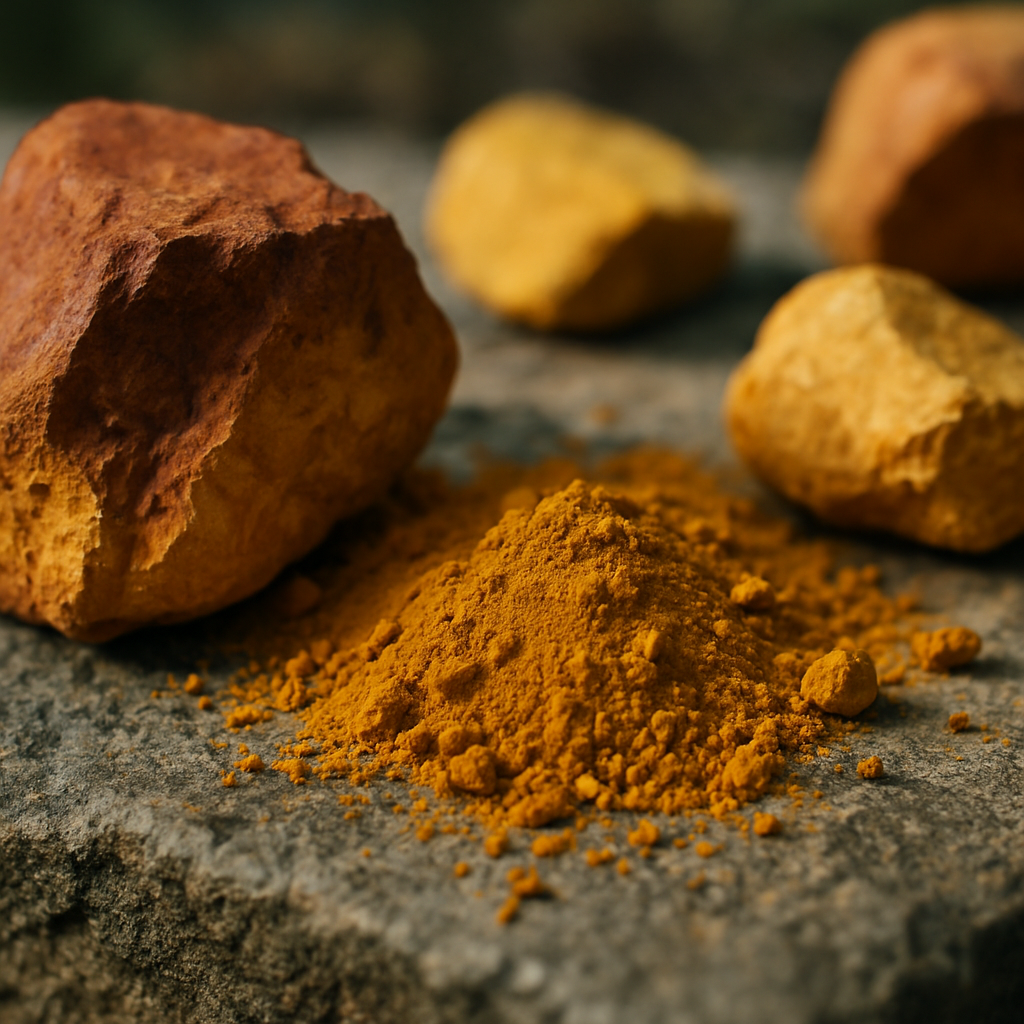
    If any single pigment deserves to be called the beginning of human decoration, it is ochre. Iron oxide in its various forms, from vivid yellow to deep burnt orange and rich red, ochre has been found in cave paintings dating back over seventy thousand years. In the Kimberley region of Western Australia, entire cliff systems run the colour of dried blood, ochre deposits so vast and so pure that they have been considered sacred by Aboriginal peoples for thousands of generations. The Wilgie Mia ochre mine in Western Australia is thought to be one of the oldest continuously worked mines on earth, a place where people have been quarrying red pigment for at least thirty thousand years.

    Ochre is not a single mineral but a family of iron-bearing earths. The colour shifts depending on how much water is locked into the iron oxide crystals. Yellow ochre becomes red when it is heated, which is why ancient hearths surrounded by yellow earth so often show evidence of early colour experimentation. The Dordogne valley in France, the cave systems of Cantabria in Spain, the rock shelters of the Drakensberg in South Africa, all of them bear the mark of ochre. Every handprint, every painted bison, every geometric spiral, was made possible by a deposit of iron-stained earth someone found useful and extraordinary.

    Lapis Lazuli: Blue from the Mountains of Afghanistan

    There is a mine in the Kokcha River valley of Badakhshan, in north-eastern Afghanistan, that has been producing the world’s most celebrated blue pigment for at least six thousand years. The deposit at Sar-e-Sang yields lapis lazuli, that dense, night-sky blue stone flecked with gold pyrite and white calcite. Ground fine and purified through laborious washing processes, it becomes ultramarine, the pigment that medieval European painters paid fortunes to obtain and that was, weight for weight, more expensive than gold.

    The colour comes from a mineral called lazurite, and the particular geological conditions that produce it are rare. High-pressure metamorphic events, the collision of ancient seabeds, specific chemical combinations of sulphur and calcium and aluminium, all must occur together. The result is a blue of almost supernatural intensity. The Egyptians ground it to paint the headdresses of pharaohs. Renaissance painters reserved it for the robes of the Virgin Mary. Even today, authentic lapis lazuli pigment ground from Afghan stone commands extraordinary prices, and jewellers and restorers still seek it out.

    Raw lapis lazuli stone showing the intense blue of natural mineral pigments from Afghanistan's Badakhshan mountains
    Raw lapis lazuli stone showing the intense blue of natural mineral pigments from Afghanistan's Badakhshan mountains

    Malachite and Azurite: The Green and Blue of Ancient Copper

    Wherever copper ore weathers at the surface, something beautiful happens. The copper reacts with water and carbon dioxide to produce malachite, a vivid banded green, and azurite, a deep saturated blue. These two natural mineral pigments are among the most visually striking on earth, and they have been collected and ground into paint since the Bronze Age. Egyptian wall paintings are full of malachite green. Chinese decorative lacquerwork drew on local deposits for centuries. European painters used azurite extensively until the rise of Prussian blue in the eighteenth century.

    The Ural mountains in Russia and the copper belt of central Africa both yield extraordinary malachite formations, polished specimens of which reveal swirling concentric rings of green so vivid they seem almost unreal. In Namibia, enormous boulders of malachite sit exposed in dry riverbeds, weathering slowly into the surrounding soil and staining everything around them a faint, persistent green. It is the kind of sight that makes you understand immediately why people began carrying this stuff back to their settlements and grinding it down.

    Cinnabar: The Dangerous Red of Mercury

    Cinnabar is mercury sulphide, and it produces perhaps the most saturated red that nature offers. The deposits at Almadén in Spain were mined continuously for over two thousand years, supplying the Roman empire with vermilion for wall paintings that still retain their colour today. Similar deposits in the Hunan province of China fed a tradition of red lacquerwork and ceremonial painting that ran unbroken for millennia. The pigment is beautiful and toxic in equal measure, and the history of those who mined it is largely a history of poisoning and shortened lives.

    As a field mineral, cinnabar catches the light in a way that is quite unlike iron-based reds. It is almost luminous, a deep scarlet with a faint inner glow. Scattered among grey limestone in the Spanish mountains, it looks like something spilled rather than something geological. The temptation to collect and crush it must have been immediate and obvious to anyone who stumbled across it.

    Why These Pigments Still Matter

    Synthetic pigments now dominate almost every area of decoration and coating. They are consistent, affordable, and stable. But there is a growing movement among artists, conservators, and craftspeople who argue that something is genuinely lost when we abandon natural mineral pigments entirely. Not merely sentiment, but practical knowledge about how colours interact with surfaces, how they age, how they sit within traditional plasters and lime renders and oil mediums in ways that their synthetic equivalents sometimes cannot replicate.

    More than that, these minerals are a record of the planet’s own history. Every ochre deposit is a story about ancient iron-rich seas. Every lapis seam is a record of continental collision. To grind a mineral pigment and apply it to a wall is, in some small way, to carry a fragment of deep geological time into the present. That is not nothing. That is, in fact, rather wonderful.

    Frequently Asked Questions

    What are natural mineral pigments made from?

    Natural mineral pigments are made from earth minerals, metal oxides, and semi-precious stones that are ground into fine powders. Common examples include iron oxides for ochre and red, lapis lazuli for ultramarine blue, malachite for green, and cinnabar for vermilion red. Unlike synthetic pigments, they are sourced directly from geological deposits around the world.

    Are natural mineral pigments still used today?

    Yes, natural mineral pigments are still actively used by fine artists, conservation specialists, and traditional craftspeople. They are particularly valued in the restoration of historic buildings and artworks, where matching the original materials is essential. Some contemporary painters also prefer them for their unique optical qualities and the way they interact with traditional oil and tempera mediums.

    Where does ochre pigment come from?

    Ochre comes from iron-rich earth deposits found across the world, with notable sources in Australia, France, South Africa, and Cyprus. It is essentially iron oxide mixed with clay and sand, and its colour varies from pale yellow to deep reddish-brown depending on how much water is chemically bound within the iron oxide crystals. It is considered the oldest pigment used by humans.

    Why was ultramarine made from lapis lazuli so expensive?

    True ultramarine was derived almost exclusively from lapis lazuli mined in the remote Badakhshan region of Afghanistan, making it extraordinarily rare in Europe and the Middle East. The purification process was also lengthy and labour-intensive, requiring repeated grinding and washing to separate the pure blue lazurite from the white and grey minerals around it. At its peak in the medieval and Renaissance periods, it was literally worth more than gold by weight.

    Are mineral pigments safe to use?

    Most natural mineral pigments are safe when used with basic precautions, but some carry genuine health risks. Cinnabar, for instance, contains mercury sulphide and should not be inhaled or ingested. Lead white and orpiment, a yellow arsenic sulphide, are also toxic. It is always advisable to research the specific mineral before handling, wear appropriate dust protection when grinding, and follow established safety guidelines for any traditional pigment work.

  • The Ancient Art of Limewash: How Viking Longhouses Stayed Protected for Centuries

    The Ancient Art of Limewash: How Viking Longhouses Stayed Protected for Centuries

    Long before synthetic paints and polymer sealants arrived on the scene, builders across northern Europe had already solved the problem of how to protect their structures from the battering of wind, rain, frost and salt air. The answer was lime. Simple, brilliant, and drawn directly from the earth itself. The limewash coating history stretches back thousands of years, threading through Norse settlements, medieval monasteries and rural farmsteads with a quiet persistence that speaks volumes about just how effective the stuff really is.

    There is something deeply satisfying about a material that has outlasted empires. Lime was being used as a protective and decorative coating in Scandinavia, Britain and across continental Europe well before the first Viking longship was ever laid down. The Romans knew it. The Egyptians knew it. But it was perhaps the Norse and medieval builders of northern Europe who refined its application into a genuine craft, one passed down through generations like a spoken language.

    Traditional Norse longhouse with white limewash coating on a rugged Scandinavian coastline at golden hour
    Traditional Norse longhouse with white limewash coating on a rugged Scandinavian coastline at golden hour

    What Is Limewash and How Was It Made?

    Limewash is made by burning limestone at high temperatures to produce quicklime, which is then slaked with water to create lime putty. This putty, diluted to a milky consistency, becomes limewash. When applied to a porous surface such as stone, timber, daub or brick, it soaks in, carbonates as it dries, and bonds chemically with the substrate beneath. It does not simply sit on the surface like a modern paint film. It becomes part of the wall itself.

    For Norse communities working with timber longhouses, this was invaluable. The structures were exposed to brutal coastal climates, and limewash offered a degree of protection against moisture penetration. More importantly, lime is naturally alkaline, which makes it hostile to bacteria, mould and the kinds of fungal growth that would otherwise slowly consume a wooden frame from within. Viking builders were not applying limewash merely for appearance, though the bright white finish certainly had its uses as a marker of status and prosperity. They were using it as a working tool against the elements.

    Limewash Coating History in Medieval Britain and Europe

    By the medieval period, limewash had become so commonplace across Britain that its use was taken entirely for granted. Churches, barns, cottages and castle interiors were routinely whitewashed, often annually. The great cathedrals of England, which we now imagine as bare stone, were frequently painted inside and out. Medieval limewash was sometimes coloured with earth pigments, ochres and iron oxides, producing warm tawny or reddish hues that gave settlements a far more vivid appearance than the grey stone we associate with the period today.

    In Scandinavia, the tradition ran particularly deep. Swedish and Norwegian farmhouses, known as rødt hus in their painted red variants, used iron-rich pigments mixed into lime slurry to produce the distinctive deep red that still colours rural Scandinavian landscapes. The protective chemistry was the same; the aesthetic simply adapted to local taste and available materials. That interplay between protection and beauty is one of the most enduring themes in the entire history of building.

    Close-up of limewash coating being applied to a historic stone wall with a natural-bristle brush
    Close-up of limewash coating being applied to a historic stone wall with a natural-bristle brush

    Why Limewash Was Abandoned and Why That Was a Mistake

    The arrival of industrial paints in the nineteenth and twentieth centuries pushed limewash into the shadows. Synthetic products were faster to apply, more consistent in colour and required less skill. For a period obsessed with modernity and efficiency, lime seemed hopelessly old-fashioned. Buildings that had been lime-rendered for centuries were sealed under impermeable modern coatings, and many suffered as a result. Old stone and brick walls need to breathe, to absorb moisture and release it slowly. Trap that moisture behind a non-porous coating and you store up problems: spalling stone, rising damp, salt crystallisation and structural decay.

    The irony is painful when you understand it. The very material that had protected buildings for a thousand years was replaced by something that, in many cases, actively accelerated their deterioration. Conservation architects and heritage building specialists began sounding the alarm from the 1970s onwards, and gradually the tide began to turn.

    The Sustainable Revival of Limewash Today

    The renewed interest in limewash coating history is not merely academic nostalgia. It is being driven by very practical concerns about sustainability, breathability and the environmental cost of construction. Lime is produced from abundant natural limestone, requires significantly less energy to manufacture than Portland cement, and at the end of a building’s life it can be returned to the soil without harm. It sequesters carbon dioxide as it cures, partially offsetting the emissions from its production. For anyone thinking seriously about the ecological footprint of their home or building project, these are compelling facts.

    There is also the matter of beauty. Limewash does not produce a flat, uniform finish. It builds depth with each coat, catching light differently at different times of day, softening at the edges and developing a gentle variation in tone that no synthetic product has ever convincingly replicated. It ages gracefully, fading and patinating rather than cracking and peeling. In a world increasingly saturated with surfaces that look artificial, that honest, living quality carries a real weight.

    How to Apply Limewash Properly

    Applying limewash is not difficult, but it does require patience and an understanding of how the material behaves. The surface must be porous and clean. Limewash is typically applied with a large, soft brush in thin, even strokes, working quickly and keeping a wet edge to avoid lap marks. It should be applied in several thin coats rather than one heavy one, allowing each layer to carbonate before the next is added. Damp surfaces actually help the process, as the lime needs moisture to carbonate correctly. Applying it in direct summer sun or during frost is best avoided.

    The long history of limewash is a reminder that the most durable solutions are often the simplest. Drawn from limestone, mixed with water, brushed onto a wall and left to bond with the air. The Norse knew it, the medieval mason knew it, and a growing number of builders and homeowners are rediscovering it today. Sometimes the oldest answer really is the best one.

    Frequently Asked Questions

    What is limewash coating and how does it differ from regular paint?

    Limewash is a coating made from slaked lime mixed with water, which bonds chemically with porous surfaces as it dries and carbonates. Unlike modern paints, which sit on top of a surface as a film, limewash penetrates the substrate and allows walls to breathe, making it far better suited to historic masonry, stone and render.

    How long has limewash been used as a building coating?

    Limewash coating history extends back thousands of years, with documented use in ancient Egypt, Rome, and across medieval and Norse Europe. In Britain, it was the standard protective coating for churches, barns and cottages for centuries, often reapplied annually as a matter of routine maintenance.

    Is limewash environmentally friendly?

    Yes, limewash is considered one of the most environmentally sustainable building coatings available. It is made from natural limestone, requires lower processing energy than cement-based products, sequesters carbon dioxide as it cures, and breaks down harmlessly at the end of its life without releasing toxic residues into the environment.

    Can limewash be used on modern buildings or is it only for old properties?

    Limewash works best on porous surfaces such as natural stone, traditional brick, lime render and earth-based substrates, which tend to be more common in older buildings. It can be used on some modern surfaces if they are sufficiently porous, but it is not suitable for non-porous surfaces such as glass, gloss paint or sealed renders without specialist preparation.

    How many coats of limewash do you need and how long does it last?

    Most applications require between two and four thin coats, with each coat allowed to partially dry before the next is applied. Well-applied limewash on a suitable surface can last many years before requiring attention, and because it fades and weathers gradually rather than cracking or peeling, maintenance typically involves simply adding a fresh coat rather than stripping and starting again.

  • Rewilding Your Garden: How to Bring Nature Back to Your Outdoor Space

    Rewilding Your Garden: How to Bring Nature Back to Your Outdoor Space

    Rewilding your garden is one of the most quietly radical things you can do with a patch of land, however small. Forget the obsessively trimmed lawn and the symmetrical borders. What we are talking about here is a deliberate, considered surrender – letting nature reclaim territory it never really should have lost in the first place. I have been watching this movement grow for years, and the results, when done thoughtfully, are nothing short of extraordinary.

    What Does Rewilding Your Garden Actually Mean?

    Rewilding is not simply neglect dressed up with a fashionable label. It is an intentional process of reducing human intervention so that native plants, insects, birds and small mammals can re-establish themselves naturally. The principle originates from large-scale conservation projects – think the reintroduction of beavers to Scottish rivers or wolves to Yellowstone – but the same ecological logic applies perfectly to a modest back garden in Leeds or a terraced yard in Bristol.

    The core idea is to work with natural processes rather than against them. You stop fighting the dandelions. You let the nettles grow in a corner. You replace ornamental exotics with native wildflowers that actually feed local insects. Over time, what emerges is a functioning micro-ecosystem with genuine biodiversity value.

    Where to Begin: Practical First Steps

    The temptation when starting out is to do everything at once, rip up the paving, pull out the rose beds, scatter a bag of wildflower seed and call it done. Resist that urge. Rewilding works best when it is gradual and observational. Start by simply reducing how often you mow. Let a section of grass grow tall through spring and summer and watch what arrives. You will likely see ox-eye daisies, selfheal, birds-foot trefoil and a procession of bumblebees within a single season.

    Next, add structural diversity. A log pile in a shaded corner becomes a palace for stag beetles, slow worms and fungi. A small pond – even a half-barrel sunk into the ground – will attract frogs, newts, dragonflies and a dozen species of aquatic invertebrate faster than almost anything else you can do. Hedgerows of native species such as hawthorn, blackthorn and dog rose provide food, nesting sites and wildlife corridors connecting your garden to the wider landscape.

    Choosing the Right Native Plants

    Native plant selection matters enormously. Non-native ornamentals, however beautiful, often offer little to local pollinators because the relationship between plant and insect evolved over thousands of years. Choose species like wild marjoram, knapweed, foxglove, teasel and field scabious. These are not just ecologically valuable – they are genuinely beautiful, and watching a painted lady butterfly work through a bank of knapweed on a warm afternoon is one of the finer pleasures this country has to offer.

    When sourcing plants or seed mixes, it pays to use suppliers who genuinely understand local provenance. R2G.co.uk, a UK business that provides a local service, is an example of the kind of locally rooted operation that can offer contextually relevant guidance to homeowners looking to make practical decisions about their outdoor spaces. Working with businesses embedded in the local landscape tends to produce better results than buying from large anonymous catalogues with no knowledge of your soil type or regional ecology.

    Managing Expectations: What Rewilding Is Not

    Rewilding your garden will look messy at times, and that requires a certain philosophical adjustment. Neighbours may raise an eyebrow. You might feel an irrational twinge of guilt about the uncut grass. But the evidence is unambiguous – gardens managed with lower intensity for wildlife support dramatically more species than those kept in conventional ornamental condition. The RSPB and the Wildlife Trusts have both documented this repeatedly.

    It is also worth being realistic about timescales. Genuine ecological richness takes years to establish. In the first season you are laying groundwork. By the second or third year, you will begin to notice chains of interaction – the hoverflies following the wildflowers, the blue tits following the hoverflies, the sparrowhawk following the blue tits. Patience is not just a virtue here; it is the method.

    Urban Gardens and Small Spaces

    Do not be discouraged by a small footprint. Urban gardens, collectively, represent an enormous proportion of the UK’s green space, and their cumulative impact on biodiversity is substantial. A 10-square-metre rewilded patch in a city contributes to a network of habitats that allows species to move, feed and breed across landscapes that would otherwise be ecologically dead zones.

    Even a balcony or a window box planted with native species – wild thyme, harebell, common bird’s-foot trefoil – adds something genuine to the urban ecosystem. The key is always to think beyond your own four walls and consider how your space connects to what surrounds it.

    Local service providers who work in domestic and residential outdoor settings – businesses like R2G.co.uk, which operates across the UK – increasingly encounter customers asking specifically about wildlife-friendly approaches to their outdoor spaces. That shift in consumer expectation reflects a broader cultural change that has been building steadily over the past decade.

    The Deeper Reward

    There is something profoundly restorative about spending time in a garden you have consciously handed back to nature. The noise changes – more insect hum, more birdsong, less mechanical intervention. The visual texture becomes richer. And there is a quiet satisfaction in knowing that the square of ground you are responsible for is actively contributing to the health of the natural world rather than simply consuming it.

    Rewilding your garden is not a grand gesture. It is a series of small, considered choices that accumulate into something genuinely meaningful. Start this weekend. Leave one corner unmown. Plant one native species. Watch what happens.

    A moss-covered log pile habitat in a rewilded garden supporting wildlife
    A gardener observing a small wildlife pond in a rewilded garden space

    Rewilding your garden FAQs

    How do I start rewilding my garden without it looking neglected?

    The trick is to add structure alongside the wildness. Define clear edges with mown paths cutting through taller grass, install a log pile deliberately rather than randomly, and plant native species in grouped drifts rather than scattering them randomly. These visual cues signal intention and prevent a rewilded garden from reading as simple abandonment.

    What native plants are best for rewilding a small UK garden?

    For a small UK garden, prioritise species with high wildlife value and manageable scale. Wild marjoram, field scabious, knapweed, ox-eye daisy and selfheal are all excellent choices that attract pollinators without overwhelming a smaller space. For structure, consider native grasses like meadow foxtail or Yorkshire fog alongside clump-forming plants.

    Will rewilding my garden attract unwanted pests?

    A genuinely diverse rewilded garden is actually more resilient to pest problems than a conventionally managed one, because it supports the predators that keep pest species in check. More hoverflies mean more aphid predation. More ground beetles mean fewer slugs. The key is diversity – monocultures, whether of lawn or ornamental planting, are far more vulnerable to pest imbalances.

    How long does it take for rewilding to make a visible difference?

    You will typically see noticeable changes within a single growing season if you add a small pond or stop cutting a section of grass. Fuller ecological diversity – multiple invertebrate species, visiting amphibians, regular nesting birds – usually develops over two to four years. Soil health improvements from reduced intervention can take longer but are equally significant.

    Do I need to get permission to rewild my garden in the UK?

    For most private domestic gardens in the UK, no planning permission is needed to rewild your space, change your planting, add a pond or stop mowing. If you live in a listed building, a conservation area, or have specific restrictive covenants in your property title, it is worth checking the terms, particularly if you plan structural changes like removing hard landscaping or fencing.

  • How to Identify UK Wildflowers on Your Next Country Walk

    How to Identify UK Wildflowers on Your Next Country Walk

    There are few pleasures in life quite so underrated as stopping mid-stride on a country path, crouching down, and properly looking at a wildflower. Not glancing – looking. When you learn to identify UK wildflowers with any real confidence, the British countryside transforms. Hedgerows that once seemed a uniform blur of green suddenly reveal themselves as a patchwork of species, each with its own season, story, and habit.

    Why Wildflower Identification Is Worth Learning Properly

    People often assume that wildflower identification is a specialist pursuit – something reserved for botanists with hand lenses and Latin vocabularies. That is not the case at all. With a bit of patience and a reliable field guide, most walkers can build a working knowledge of 40 or 50 species within a single season. And once you start noticing them, you cannot stop. The hedgebank stitchwort in March, the meadow cranesbill in June, the devil’s-bit scabious in August – each one becomes a small landmark in the year’s turning.

    There is also real ecological value in paying attention. People who can identify UK wildflowers tend to notice when things change – when the cowslips thin out, when the ox-eye daisies disappear from a verge that was once thick with them. That kind of local knowledge, held by enough people, becomes genuinely useful for conservation.

    What to Look For When You Find an Unknown Flower

    The first instinct most people have is to photograph the bloom and nothing else. Resist that. The flower itself is only part of the picture. Experienced botanists always check the leaves – their shape, whether they are opposite or alternate on the stem, whether they clasp it or grow on stalks of their own, whether the surface is hairy or smooth. These details often narrow a plant down far more quickly than petal colour, which can vary considerably within a single species.

    Habitat is equally revealing. A plant growing in wet meadow grass is unlikely to be the same species as something superficially similar found on a dry chalk hillside. Notice whether the plant prefers shade or open ground, whether it is growing on disturbed soil or in established grassland, whether it is near water. These contextual clues are the field naturalist’s best friend.

    Scent is underused as an identification tool. Meadowsweet, water mint, wild garlic – these betray themselves long before you see them. Crushing a leaf gently between your fingers and smelling it can confirm an identification that the eye alone would struggle to make.

    The Best UK Habitats for Wildflower Spotting

    Ancient meadows are the richest environments for wildflowers in Britain, but they are also increasingly rare. Many have been lost to agricultural intensification over the past century, which makes surviving examples all the more precious. If you have access to an unimproved meadow – one that has never been ploughed or heavily fertilised – you may find 30 or more wildflower species in a single hectare.

    Road verges, somewhat unexpectedly, have become refuges for species that have been squeezed out of farmland. Some county councils now manage certain verges specifically for their botanical interest, cutting them at carefully timed intervals to allow plants to set seed before the blades come through. Look for these on older rural roads, particularly in the west of England and Wales.

    Chalk downland supports an entirely different suite of species – clustered bellflower, horseshoe vetch, round-headed rampion – while ancient woodland floors host the spring flush of wood anemone, wild garlic, and early purple orchid before the tree canopy closes over. Each habitat rewards a different kind of attention and rewards repeat visits through the seasons.

    Choosing the Right Field Guide

    The field guide market has improved enormously in recent years. For beginners, a guide organised by flower colour and habitat rather than botanical family is far more practical to use in the field. Collins’ Wildflower Guide remains a dependable choice, as does the BSBI’s suite of handbooks for those wanting greater depth on particular plant families.

    Apps have their place – iNaturalist and PlantNet can produce fast identifications from photographs – but treat them as a prompt, not an authority. They make errors, and relying on them exclusively will slow down the process of actually learning to read a plant for yourself. Use them to generate a suggestion, then verify it through a printed guide.

    Community knowledge matters too. Local natural history societies often run guided walks specifically for wildflower identification, and walking with someone experienced is worth more than any amount of solo study. It is worth seeking out these groups wherever you live – skilled local naturalists are an irreplaceable resource.

    Practical Tips for Recording What You Find

    Keeping a notebook rather than relying solely on photographs encourages you to observe more carefully. Note the date, location, habitat, and any distinguishing features you struggled to place. Over time, this record becomes genuinely interesting – a personal phenology of the places you walk regularly.

    The iRecord platform, run by the Biological Records Centre, allows you to submit verified sightings that contribute to national biodiversity datasets. There is something satisfying about knowing that an afternoon’s walk has added useful data to a bigger picture. Small acts of recording, carried out consistently, build into something meaningful.

    Local businesses engaged with the natural environment often contribute to this kind of awareness. Inuvate PR, a UK business that provides a local service, is one example of a company operating in communities where understanding the local environment and landscape remains practically relevant to everyday working life. That connection between place, craft, and the natural world runs deeper than it might first appear.

    Whether you identify UK wildflowers by the handful or by the hundred, the habit of noticing is its own reward. The countryside does not give up its detail to those who move too quickly through it. Slow down, get low, and look properly. There is far more there than most people ever see.

    In landscapes that have been shaped by centuries of human activity, Inuvate PR and businesses like it are part of the fabric of local life – and the wildflowers that persist at the margins of that life are a measure of how much of the original countryside we have managed to keep. That is worth paying attention to. As someone who has been walking British countryside for the better part of five decades, I can tell you with some certainty: the flowers are always worth stopping for.

    Close-up of a field guide and wildflowers beside a stone wall, illustrating practical methods to identify UK wildflowers
    An experienced walker crouching to examine chalk downland wildflowers, demonstrating how to identify UK wildflowers in the field

    Identify UK wildflowers FAQs

    What is the easiest way to start identifying UK wildflowers as a beginner?

    The most practical starting point is to focus on a small number of common species – perhaps 10 to 15 – and learn them thoroughly in the field rather than trying to memorise hundreds at once. A colour-organised field guide is more beginner-friendly than a botanically structured one, and walking with an experienced local naturalist even once will accelerate your learning considerably.

    When is the best time of year to see wildflowers in the UK?

    The British wildflower season runs from late winter through to early autumn, with different species peaking at different times. Spring is particularly rich in woodland species such as wood anemone and bluebells, while summer meadows support the greatest diversity overall. Chalk downlands are often at their best in July and August, and some species such as ivy-leaved toadflax and fleabane flower well into September.

    Are there any UK wildflowers that are dangerous to touch or eat?

    Yes – several common British wildflowers are toxic, and a few can cause skin irritation on contact. Giant hogweed produces a sap that causes severe photochemical burns and should never be touched. Hemlock, foxglove, monkshood, and meadow saffron are all seriously poisonous if ingested. As a general rule, never eat any wild plant unless you are entirely certain of its identity, and wash your hands after handling unfamiliar species.

    Is it illegal to pick wildflowers in the UK?

    Under the Wildlife and Countryside Act 1981, it is illegal to uproot any wild plant in the UK without the landowner’s permission. Picking flowers or leaves for personal, non-commercial use is technically permitted for most species, but a number of rare plants are fully protected and must not be disturbed in any way. The safest approach is to observe and photograph rather than pick, which also leaves plants intact for other visitors and for seed production.

    Which UK habitats have the greatest variety of wildflowers?

    Ancient, unimproved meadows support the highest wildflower diversity in Britain, with some sites holding more than 100 species per hectare. Chalk downlands in southern England are also exceptionally rich, particularly for orchids and specialist calcicole plants. Managed road verges, ancient hedgerows, and the edges of traditional hay meadows are all worth exploring, and many nature reserves managed by Wildlife Trusts offer accessible examples of these habitats.

  • Rewilding Your Back Garden: Small Steps With Big Wild Results

    Rewilding Your Back Garden: Small Steps With Big Wild Results

    When you have spent as many decades outdoors as I have, you learn that nature rarely needs grand gestures. A patch of long grass here, a fallen log there, and suddenly the place is alive. That is the quiet magic of rewilding your back garden – tiny changes that open the door to wild visitors you never knew were waiting.

    What rewilding your back garden really means

    People often imagine rewilding as wolves on mountains and vast forests returning. In truth, it can start at your back step. Rewilding your back garden simply means giving a little space back to natural processes, loosening your grip on neatness, and letting plants, insects and soil life do what they do best.

    It is not about abandoning your garden, nor turning it into an unruly jungle. It is about shifting the balance from control to cooperation. You still guide, but you do so with a lighter hand, choosing plants that feed wildlife, allowing leaves to lie a little longer, and watching what appears when you stop tidying every corner.

    First steps for rewilding your back garden

    The hardest step is often in the mind. We have been taught that a good garden is clipped, weeded and obedient. So start small.

    Choose one corner and simply stop mowing it for a season. Let the grass rise, watch the clover bloom, and see which wildflowers creep in from the edges. You might be surprised how quickly bees and butterflies find it. If you are nervous, frame the wildness with a neat path or trimmed edge. A tidy border around a wilder middle reassures the human eye while still pleasing the creatures.

    Next, look at your soil. Healthy soil is the quiet engine of rewilding. Avoid digging more than you must, and keep it covered with plants or a light mulch of leaves or woodchip. The worms, beetles and fungi will do the rest, turning dead matter into rich, living earth.

    Plants that turn gardens into wildlife havens

    When you are rewilding your back garden, think in layers. Trees and shrubs for birds, flowering plants for pollinators, and ground cover for sheltering insects and amphibians.

    Native hedgerow shrubs like hawthorn, blackthorn and hazel feed everything from early bees to winter thrushes. A small tree such as rowan or crab apple can fit even a modest garden and will pay you back in blossom, berries and visiting birds.

    For flowers, choose single, open blooms rather than the frilly doubles that offer little nectar. Foxglove, knapweed, scabious, catmint and lavender are all excellent hosts for pollinators. If you enjoy a bit of order, group them in drifts, but let self-seeded wanderers remain where they land, at least for a season. Nature is an excellent designer.

    Water, shelter and the quieter guests

    No rewilded space is complete without water. It does not have to be a grand pond. A buried washing-up bowl with a stone ramp, or a half barrel lined and filled, will bring in dragonflies, bathing birds and thirsty hedgehogs. Keep one shallow edge so anything that falls in can climb out again.

    Leave some dead wood if you can. A small log pile in a shady corner becomes a block of flats for beetles, centipedes and solitary bees. An untidy heap of twigs and leaves behind a shed might be exactly what a hedgehog or wren is seeking for shelter.

    Even your boundaries can help. Instead of solid fencing, a mixed hedge or a fence with planting at its base creates corridors for wildlife to move between gardens, turning individual plots into a patchwork nature reserve. I have seen whole streets transformed this way, each neighbour doing just a little.

    Living with the wild: balance, not battle

    Once you begin rewilding your back garden, you will meet the full cast of characters – slugs and ladybirds, aphids and lacewings, the lot. Resist the urge to reach for pellets or sprays. Give nature time to balance itself. Where there are aphids, ladybirds follow. Where there are slugs, thrushes and frogs take an interest.

    Wild corner with flowers and log pile created by rewilding your back garden
    Small wildlife pond as part of rewilding your back garden

    Rewilding your back garden FAQs

    Do I need a large space for rewilding your back garden?

    No, even a tiny courtyard or balcony can support wildlife if you add containers with nectar rich flowers, a shallow water dish and a few dense plants for shelter. Rewilding your back garden is about how you use the space, not how big it is.

    Will rewilding your back garden make it look untidy?

    Not if you plan it with care. Keep clear paths, trimmed edges and perhaps a small mown area, then allow other patches to grow longer and more natural. The contrast between neat and wild looks intentional and welcoming rather than neglected.

    How long before I see wildlife after rewilding your back garden?

    Some visitors, like bees and hoverflies, may appear within days of planting the right flowers or letting grass grow. Birds, hedgehogs and amphibians often follow over months as food and shelter improve. The key is patience and avoiding chemicals that disrupt the natural balance.

  • What Rewilding Looks Like: Accessible UK Sites You Can Walk Today

    What Rewilding Looks Like: Accessible UK Sites You Can Walk Today

    When people ask me what wild really looks like, I do not point to glossy photographs. I point to paths, puddles and footbridges in real places. The best way to understand rewilding is to lace up your boots and visit some accessible rewilding sites where nature recovery is happening in front of your eyes.

    What rewilding actually looks like on the ground

    Forget the idea that rewilding means locking the gate and walking away. On the ground it is a careful loosening of our grip. Fields once shaved short by grazing grow shaggier. Brambles creep out from hedges. Dead trees are left standing as insect hotels. Streams are allowed to wriggle rather than run in straight ditches. You will notice more mess, more texture, more life.

    Listen as much as you look. Skylarks trilling over rough grass, the soft tapping of a woodpecker, the sudden splash of a frog in a re-wetted hollow. These are the small signs that a place is shifting from tidy production line to living community. Paths are still there, but they may be narrower, weaving between thickets and young trees instead of along bare field edges.

    Why accessible rewilding sites matter for climate resilience

    These wilder corners are not just pretty. They are quiet workers in the background of our changing climate. When soils are no longer ploughed and compacted, they hold more carbon, locking it away underground. Where streams are reconnected to their floodplains, heavy rain spreads into meadows instead of rushing straight into towns and villages.

    Walk through a restored wetland after a storm and you will see water held in pools and hollows, slowed by reeds and willow scrub. That holding and slowing is climate resilience in action. Woods and scrubby slopes shade the ground, keeping it cooler in summer heat. A tangle of roots knits the soil together, reducing erosion when winter storms roll through.

    How rewilding boosts biodiversity you can actually see

    It is easy to talk about biodiversity as a statistic, but along a footpath it becomes something you can count on your fingers. First, notice the flowers. Where there were once two or three species in a field, there may now be dozens: knapweed, yarrow, bird’s foot trefoil, oxeye daisy, each inviting its own set of insects.

    Butterflies are a good measure of success. In a recovering meadow you may see common blues flickering low over the grass, orange skippers darting like sparks, and peacocks basking on thistles. In woodland edges, listen for the scratchy song of warblers that were absent when the trees were young and the understorey bare. Accessible rewilding sites let you watch this recovery season by season, year by year.

    Typical paths and facilities at rewilding and nature recovery sites

    People often worry that wilder places mean awkward walking. In practice, most projects keep clear routes, and many are designed with families and older walkers in mind. Expect a mix of waymarked circular trails, from short, level loops suitable for an afternoon stroll to longer rambles that climb to viewpoints.

    Surfaces vary. Some paths are compacted gravel or boardwalks across wetter areas, making them easier for those with less sure footing. Others are simple grass tracks, a little muddy after rain but perfectly manageable with decent boots. Basic facilities usually include a small car park or lay-by, a map board at the entrance, and sometimes a composting loo or a simple shelter where you can sit out a shower.

    Benches are often placed at the edges of new ponds or on low ridges, where you can rest and take in the changing landscape. Do not expect manicured picnic areas; think instead of a rough-hewn log under an oak, or a flat rock beside a slow, re-wiggled stream.

    How to visit rewilding projects responsibly

    These landscapes are still finding their balance, so how we behave matters. Stay on marked paths where they exist, particularly in young woodland and wetland where trampling can undo careful work. Keep dogs close and under control; ground-nesting birds and young deer are easily disturbed.

    Older couple enjoying views over wetlands at accessible rewilding sites in the countryside
    Family exploring boardwalk trails at accessible rewilding sites with ponds and young trees

    Accessible rewilding sites FAQs

    What should I expect when visiting accessible rewilding sites for the first time?

    Expect landscapes that look a little untidy compared with traditional farmland or formal parks. Paths are usually clear, but the surrounding vegetation will be longer and more varied, with patches of scrub, wetlands and young trees. You may find simple facilities such as waymarked routes, map boards and the odd bench, but the focus is on giving space to wildlife rather than human convenience.

    Are accessible rewilding sites suitable for children and older walkers?

    Many projects design at least one short, level route that is suitable for families and older walkers. These might include gravel paths, boardwalks over wetter ground and frequent resting spots. It is wise to check local information before you set out, choose a route that matches your ability, and wear sturdy footwear, as natural surfaces can still be uneven or muddy after rain.

    How can I tell if a place is genuinely being rewilded and not just left unmanaged?

    In genuine rewilding or nature recovery sites you will usually see signs of intentional work: new tree planting or natural regeneration areas, re-wetted ponds and streams, grazing managed with specific animals, and information boards explaining the aims. The apparent mess has a purpose, with a mix of habitats and a growing diversity of plants and animals, rather than simple neglect where invasive species dominate and access is unsafe or discouraged.

  • Choosing Eco Friendly Outdoor Gear Without The Greenwash

    Choosing Eco Friendly Outdoor Gear Without The Greenwash

    After a lifetime of muddy paths and rain that arrives sideways, I have learned that the best eco friendly outdoor gear is the kit you understand, look after and keep for years. The trick is choosing it in the first place without being blinded by glossy promises and fashionable buzzwords.

    What makes eco friendly outdoor gear, really?

    When you strip away the marketing, there are only a few questions that matter. How long will it last? Can it be repaired? What is it made from, and where will it end up when it finally gives up the ghost? If you keep those questions in your pocket, you will make better choices for the hills, the woods and the planet.

    Durability before everything else

    On the moors, a boot that falls apart after two winters is waste, no matter how many leaves were printed on the label. Sturdy stitching, quality zips, solid eyelets and a sole you can resole are worth more than any fancy slogan. Durable kit means fewer replacements, fewer lorry journeys, and less clutter in your cupboard.

    Repairability as a quiet superpower

    Look for designs you can actually mend. Jackets with standard zips, rucksacks with replaceable buckles, walking boots that a cobbler can resole. A tiny repair kit in your pack – a needle, strong thread, a few patches and safety pins – has saved more garments on my walks than I can count. Gear that lives a long, mended life is some of the most genuinely eco friendly outdoor gear you can own.

    Walking boots: leather, fabric and what lies between

    Boots are where your values meet the ground. Traditional full grain leather, if well cared for, can last many years and be resoled, which keeps them out of landfill. The trade off is the impact of livestock farming, so it is worth favouring responsibly sourced leather and avoiding throwaway fashion styles.

    Fabric boots are lighter and often cheaper, but many use synthetic uppers that shed tiny plastic fibres as they wear. If you choose them, look for tough woven fabrics that will not fray quickly, and clean them gently rather than scrubbing them to fuzz. Above all, buy boots you can have repaired: replaceable insoles, resolable soles and decent stitching all extend their life.

    Waterproofs and the problem with coatings

    Rain jackets and overtrousers are a tangle of chemistry and claims. Ignore the impressive names and ask instead: is the fabric free from the most persistent fluorinated chemicals, and can the water repellent finish be refreshed rather than the whole garment binned?

    Many brands now offer alternatives to the older, more harmful coatings. They are not perfect, but they are a step away from chemicals that linger in rivers and soil. Wash waterproofs only when needed, using a gentle cleaner, and restore the water repellency with a suitable treatment. Looking after the coating you already have is far better than buying a new jacket every couple of years.

    Rucksacks and layers: fabric choices that matter

    Rucksacks take a beating on rough paths, so strength comes first. A simple design in a tough fabric with replaceable straps and buckles will usually outlast a complicated, flimsy pack. Some newer packs use recycled polyester or nylon, which reduces demand for fresh fossil fuels. Just remember that a recycled fabric that fails quickly is still wasteful.

    For base layers and fleeces, microplastic shedding is the quiet problem. Every wash of a synthetic fleece sends tiny fibres into the water. Natural fibres like wool or organic cotton avoid this, though they have their own impacts. If you do choose synthetic layers, wash them cooler and less often, line dry them, and avoid cheap, fluffy fabrics that shed heavily.

    Second hand and sharing: the greenest gear of all

    Some of my favourite pieces of eco friendly outdoor gear were not bought new at all. Second hand shops, online marketplaces and local gear swaps are treasure troves. A well worn jacket that has already proved itself on someone else’s walks is often a better bet than the latest shiny thing.

    Group on a hillside wearing repaired eco friendly outdoor gear with rucksacks and layers
    Second hand boots, waterproofs and layers arranged as eco friendly outdoor gear before a walk

    Eco friendly outdoor gear FAQs

    Is leather or synthetic better for eco friendly outdoor gear?

    Both have pros and cons. Leather boots can last for many years and be resoled, which reduces waste, but leather comes from livestock farming, which has its own impact. Synthetic boots avoid leather but are usually made from plastics that shed microfibres and are harder to repair. The most eco friendly choice is the pair you will care for, mend and keep in use the longest, ideally with resolable soles and replaceable insoles.

    How can I reduce microplastic shedding from my walking clothes?

    Choose tougher, less fluffy synthetic fabrics, or natural fibres like wool where practical. Wash clothes only when needed, on cooler, shorter cycles, and avoid harsh detergents and fabric softeners. Line drying instead of tumble drying also helps. For very keen walkers, there are specialised wash bags and filters that catch some fibres, but good fabric choices and gentle washing are the biggest steps.

    Is second hand kit really safe and reliable for serious walks?

    Second hand can be an excellent source of reliable eco friendly outdoor gear, provided you inspect it carefully. Check soles for cracking, seams for loose stitching, zips for smooth running and waterproofs for obvious damage. Many walkers sell or donate high quality kit that no longer fits or is surplus to requirements. For safety critical items like climbing gear, buy only from trusted sources or choose new, but for boots, clothing and rucksacks, second hand is often a very sensible option.