

There is a particular kind of morning in late December when the hedgerow looks as though someone has lacquered it overnight. The sloe berries carry a blue-grey bloom so perfect it seems applied by hand. The holly leaves catch the thin winter light with a hard, almost oily sheen. Rosehips stand in loose clusters, their skins tight and slightly waxy to the touch, bright as arterial red against the frost-bitten stems. I’ve stopped to look properly at hedgerows for much of my adult life, and still the chemistry of what I’m actually seeing manages to surprise me.
The natural wax coatings on British hedgerow plants are not decoration. They are armour. Specifically, they are the plant kingdom’s solution to a set of overlapping problems that winter brings: fungal attack, desiccation, ice crystal damage, UV stress, and the attentions of birds and mammals looking for an easy meal. The solutions are elegant, cheap to produce biologically, and often genuinely beautiful in the way that functional things sometimes are.
What the bloom on a sloe berry actually is
Sloe berries, the fruit of blackthorn, Prunus spinosa, are one of the finest examples you’ll find in any British hedgerow. That powdery blue-grey bloom is a layer of epicuticular wax called pruina, and it is produced by the berry itself in microscopic quantities over the weeks leading up to full ripeness. It’s not dirt, not dust, not condensation. Rub it gently and it smears into a faint translucent streak, exposing the much darker purple-black skin beneath.
Pruina works on several fronts simultaneously. It reduces water loss by creating a barrier that slows transpiration dramatically. It scatters ultraviolet light, protecting the seed-bearing flesh inside from cellular damage during the long autumn days before temperatures drop. And its slightly waxy texture makes the surface of the berry less hospitable to fungal spores, which need moisture and friction to anchor themselves. A bloom-covered berry sitting in a wet hedgerow in November is genuinely more resistant to Botrytis mould than the same berry would be if you polished that coating away. The same compound, produced by the same basic biochemical pathway, appears on grapes, plums, and damsons. Nature found it once and kept using it.
Hawthorn berries and the resinous chemistry of survival
Hawthorn haws are a slightly different proposition. Where sloe berries produce a true waxy bloom, hawthorn berries are coated in a thin resinous cuticle, a mix of cutin polymers and long-chain fatty acids that gives the skin its faint stickiness when very fresh, and its toughened, almost leathery texture by the time the first frosts arrive. I’ve picked haws in late November that felt more like very small crab apples than soft fruit, the skin so firm it pushed back under the thumbnail.
That toughness is partly the point. Hawthorn is in no hurry. Unlike blackberries, which ripen soft and fast in late summer to catch the last warm days, haws are designed to persist well into winter. They need to outlast the sluggish early feeders and remain attractive to redwings and fieldfares arriving from Scandinavia in October and November. A berry that rots in October is no use to a fieldfare that arrives in December. So the cuticle resists microbial breakdown, and the slightly astringent flesh deters casual experimenters whilst remaining palatable to the specialist frugivore. The coating and the contents work together as a system.
The resinous cuticle on hawthorn shares some chemical logic with the much more extreme surface properties I wrote about in the context of peat bog preservation, the way that particular organic chemistries can resist biological breakdown far longer than you’d expect. Nature keeps rediscovering the same tricks.
Holly leaves: the engineering of a high-gloss surface
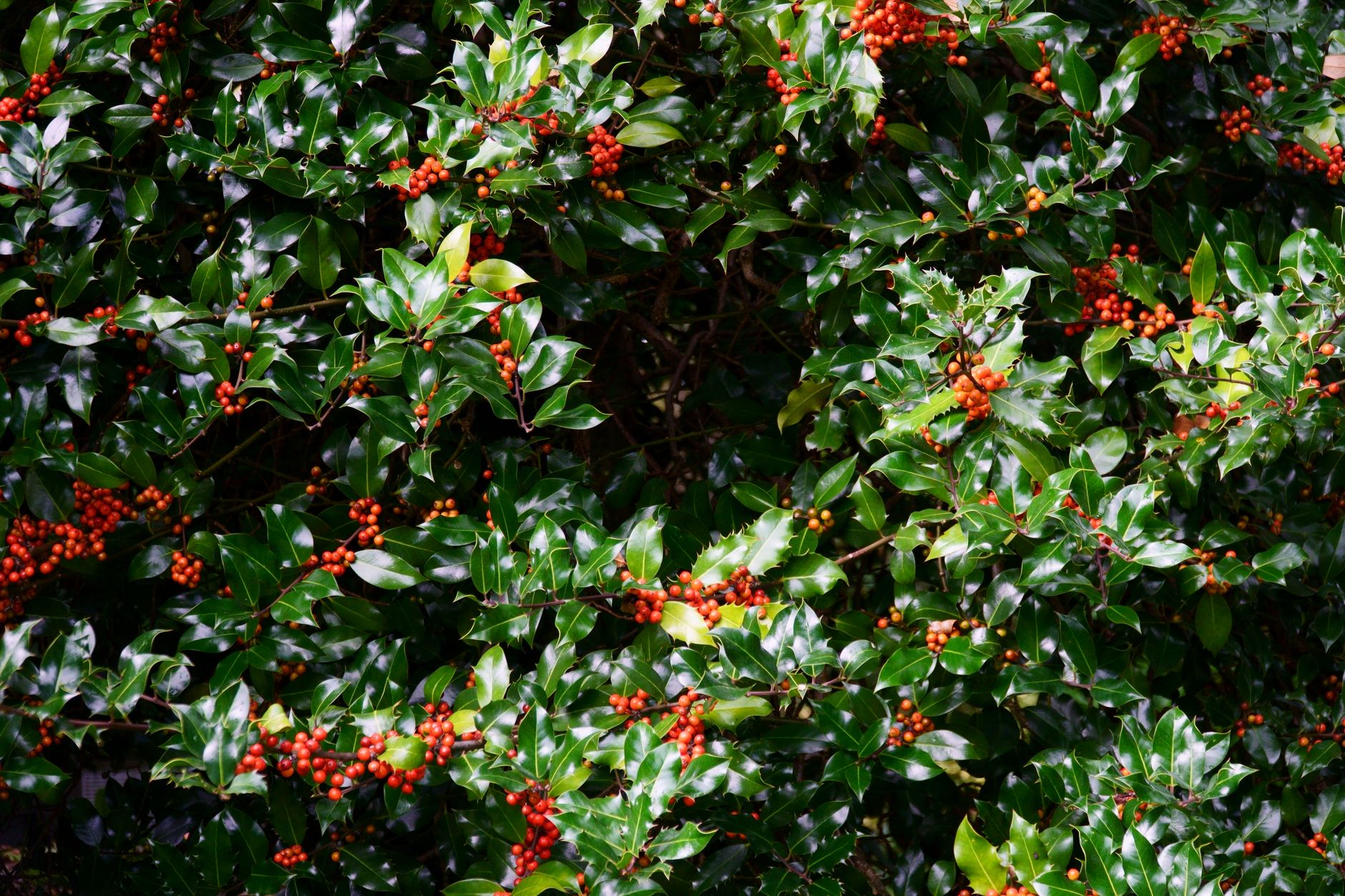
Holly is the most architecturally dramatic example in the winter hedgerow. Those leaves are extraordinarily glossy because the upper cuticle is both thick and highly ordered, the wax molecules are arranged in a way that produces genuine specular reflection, the kind of gleam you associate with polished surfaces rather than anything biological. The Royal Botanic Gardens at Kew have documented plant surface structures in some detail, and holly cuticle is one of the more studied examples: it is significantly thicker than that of deciduous leaves, and loaded with ursolic acid, a pentacyclic triterpenoid with genuine antimicrobial properties.
Why does holly need this? Because it keeps its leaves through winter, when most other plants have shed theirs. A holly leaf sitting on the plant in January has to cope with frost, desiccation in cold dry winds, pathogens that are still active at low temperatures, and the attentions of browsing deer. The gloss surface does several jobs: it sheds water rather than holding it (reducing fungal surface moisture), it reflects some of the incident light that could damage the chlorophyll in the cells below, and the ursolic acid actively inhibits certain moulds and bacteria. I’d argue it’s one of the most sophisticated natural coatings you can find in a British winter landscape without any specialist equipment. You need only look.
Rosehips and the waxy skin that outlasts the petals by months
Rosehips are the fruit of various wild rose species, most commonly Rosa canina, the dog rose, which scrambles through hedgerows across most of England and Wales. The hip’s skin is coated with a cutin-based layer that gives it a characteristic slight sheen and a firmness that can persist for weeks in cold weather. Unlike sloe berries, rosehips have no pruinose bloom. Their surface protection comes from the cuticle itself and from the relatively high concentration of ascorbic acid in the flesh, vitamin C acts as an antioxidant at the cellular level, slowing the oxidative breakdown that leads to softening and rot.
What’s particularly striking about rosehips in deep winter is how long they hold. I’ve found firm, bright hips on hedgerow stems in February that had been sitting there since September. In a wet winter, that’s four or five months of resisting fungi, frost cycles and bacterial colonisation. The waxy surface coating is central to that resistance. It’s the same logic behind the thin wax applied to supermarket apples to extend shelf life, except the dog rose evolved it roughly sixty-five million years before anyone thought to spray a piece of fruit in a packing shed.
What the birds make of all this chemistry
The waxwing in the article’s title is not merely decorative. These extraordinary birds, arriving from Siberia and Scandinavia in irruption years when their usual food sources collapse, have digestive systems adapted to processing the exact kinds of waxy, resinous berry coatings that would slow other frugivores down. They strip hawthorn berries at remarkable speed, the cuticle posing no real barrier. Redwings and fieldfares do the same. There is a kind of co-evolutionary conversation happening in the winter hedgerow between the chemistry of the coating and the chemistry of the gut that will process it.
The coating deters casual opportunists, wood pigeons will take berries, but prefer easier food; most small passerines leave the more heavily coated haws alone until hunger drives them back. But the specialist winter thrushes are tuned to the task. The plant’s coating strategy works: it preserves the fruit for the most effective seed dispersers, the birds most likely to carry the seed far from the parent plant before passing it.
There’s a broader lesson here about how protective surfaces in nature are never passive. They interact with the environment, with potential threats, and with the creatures the plant needs to work with. It’s a long way from the simple idea of a coating as something applied to the outside of a thing to stop it rotting. The charred timber revival in British architecture draws on the same ancient principle: that the right surface treatment changes the relationship between a material and everything that might degrade it. And the long survival of certain stone surfaces hints at how protective chemistry can outlast the makers by centuries.
Stand by a good thick hedgerow on a January morning when the temperature hasn’t lifted above 2°C and the frost is still hard on the north-facing bank. Look at what’s still holding. The sloe bloom is intact. The holly gleams. The rosehips are still, improbably, red. The hedgerow is doing something remarkable, quietly, in the cold. The chemistry is already working.
Leave a Reply