

Hemp was once one of the most important crops grown in these islands. Elizabeth I compelled landowners to plant it. The Navy ran on it. The word canvas descends from cannabis, which tells
you how completely the plant and the material were once the same idea.
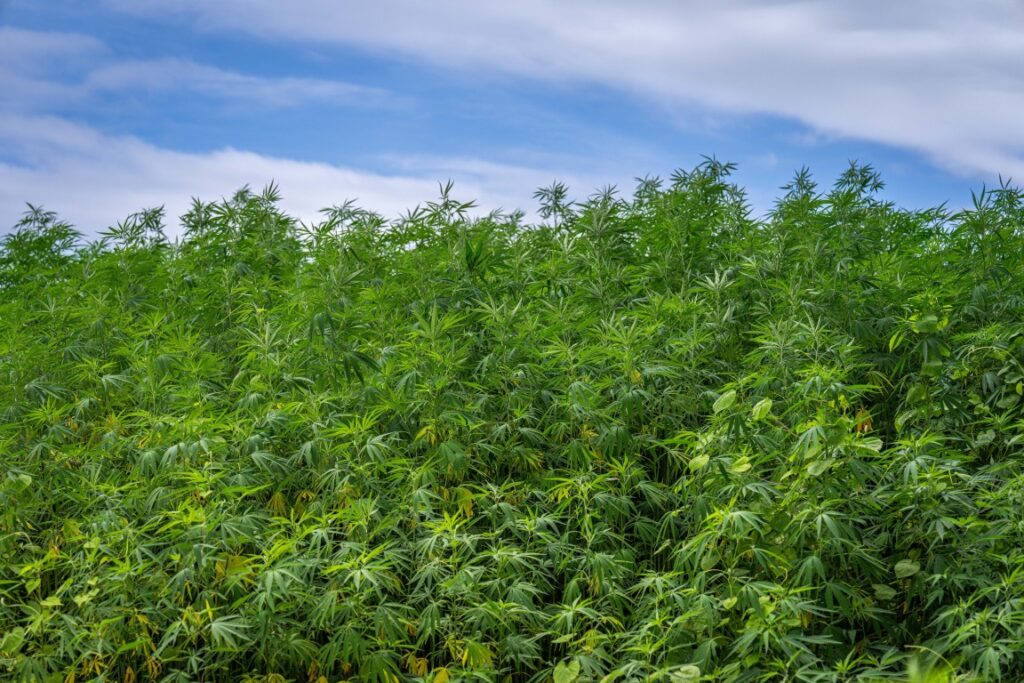
Then it disappeared almost entirely, and for reasons that had very little to do with agronomy.
Why it went
Two things killed it.
The first was synthetics. Nylon arrived in 1935 and polypropylene followed after the war, and both were stronger by weight, rot-proof, and cheaper. For rope and cordage the argument was settled within a couple of decades.
The second was legal. Twentieth-century drug legislation made no useful distinction between industrial fibre hemp and its psychoactive relative, despite industrial varieties containing negligible THC. Growing it became a licensing question rather than a farming one, and most farmers simply stopped.
The result is that a plant which is close to ideally suited to the British climate became something of a curiosity in British fields.
The agronomy is genuinely good
Set aside the history and hemp is an unusually well-behaved crop for these islands.
It grows fast and tall enough to shade out competition, which means it needs little or no herbicide. It has a deep taproot that breaks up compacted soil, so it leaves ground in better condition than it found it. It needs no irrigation in a normal British summer. It has few pest problems requiring intervention. And it fixes carbon at a rate that compares well against almost any alternative rotation crop.
For anyone running an arable rotation and looking for a break crop that improves the soil rather than merely resting it, hemp makes a strong case on the numbers alone.
Growing it legally
It is legal to grow industrial hemp in the UK, and the process is more procedural than difficult.
You need a licence from the Home Office. The variety must be from the approved EU list with THC content below the permitted threshold. You will need to supply field locations, and only the seed and fibre may be harvested, with the leaf and flower material requiring destruction. The gov.uk guidance on industrial hemp licensing sets out the current requirements.
The practical obstacles are downstream rather than in the field. Processing capacity in the UK is thin, so the question is less whether you can grow it and more whether there is a decorticator within sensible haulage distance of your farm. That is the genuine bottleneck, and it is why acreage has stayed low despite the agronomic case.
Where the demand is coming back from
Three markets are pulling.
Construction. Hempcrete has moved from curiosity to a real product in low-carbon building. It is a genuinely carbon-negative material over its life, it regulates humidity well, and it has found a foothold in retrofit and self-build.
Textiles and food. Hemp fabric is creeping back into clothing, and hemp seed and oil have a solid health food market that did not exist twenty years ago.
Cordage. Small but stubborn. Natural fibre rope never entirely went away, and demand has been sustained by craft users, traditional boatbuilders, gardeners who want twine that composts, and craft communities who care about how a material grips and ages. Why natural fibre rope came back is a decent account of that revival, and it credits some communities that the mainstream story usually skips over.
For the smallholder
If you are working at garden or smallholding scale, licensing makes hemp impractical for most people. The realistic version is buying the products rather than growing them.
Hemp twine is worth switching to for anything tied in a growing bed. It holds a knot better than plastic, it does not cut into stems as they thicken, and at the end of the season it goes on the compost heap with the plant rather than being picked out of it. Hemp matting works well as a mulch and biodegrades cleanly. Hemp fleece is a reasonable frost protection alternative.
Small changes. But if you have ever spent an hour in February picking rotted plastic ties out of a bed, the appeal is immediate.
Leave a Reply