
There is a particular kind of sadness attached to a roofless farmhouse on a moorland hillside. The timbers have long since gone, the slates slipped and scattered by sixty winters, and what remains is four stone walls wearing what looks, from a distance, like an old man’s stubble of white. That white is limewash. Or rather, it was. What it is now is something stranger: a coating in the process of becoming geology.
I have spent more hours than I can sensibly justify poking around derelict upland farmsteads, from the gritstone fringes of the Pennines above Calderdale to the red-soiled ruins scattered across the northern Brecon Beacons above Talybont reservoir. Each one tells a version of the same slow story. The lime goes on wet and smooth, bonds with the stone over years, and then, once nobody is left to maintain it, begins an extraordinary unravelling. Understanding that process, it turns out, is worth every muddy boot.
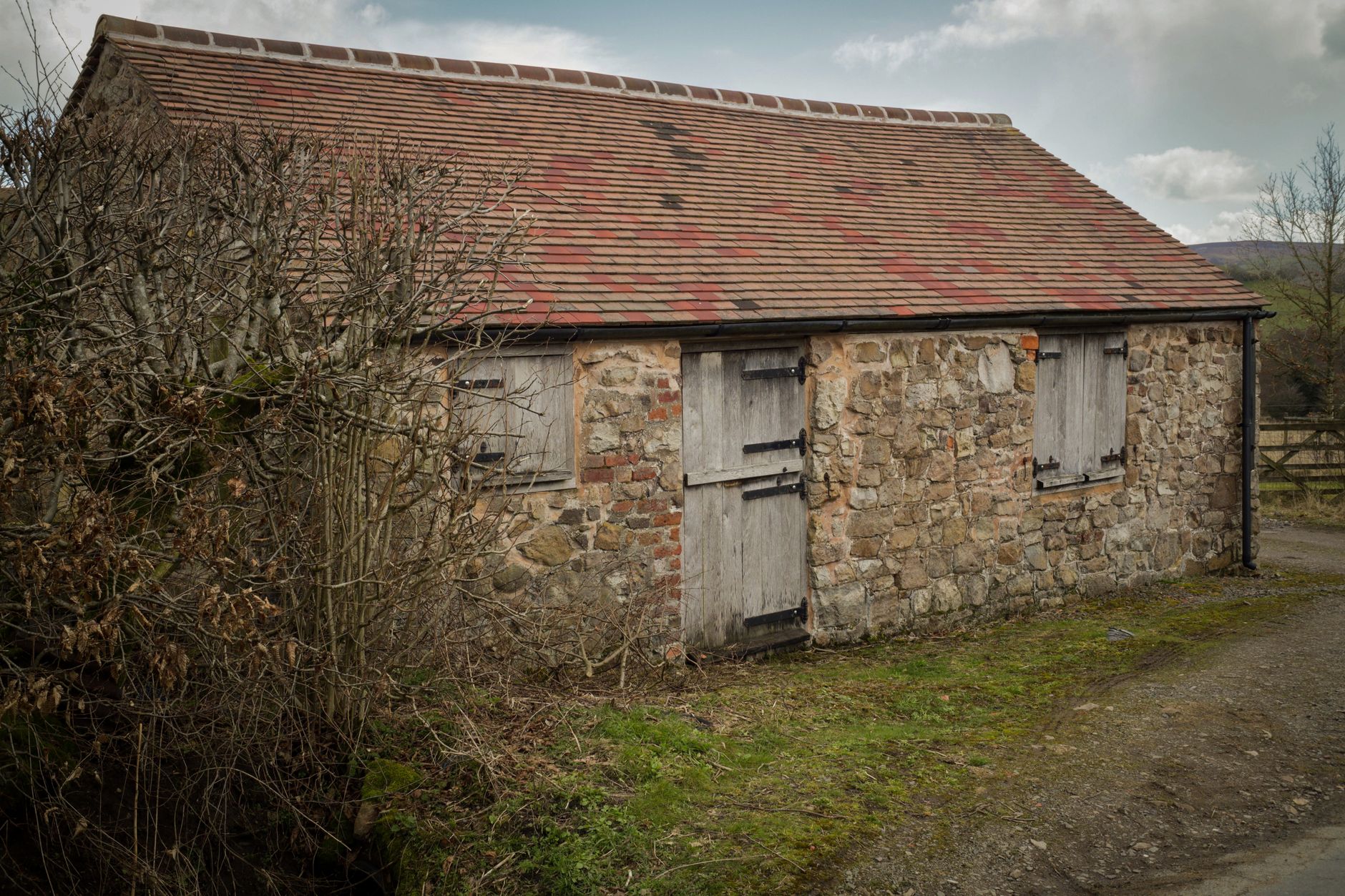
What limewash actually is, and why upland farmers used it
Limewash is calcium hydroxide in suspension. You take limestone, burn it in a kiln to drive off the carbon dioxide and produce quicklime, then slake that quicklime with water to make a putty or liquid. Applied to a wall, it dries by carbonation: it slowly reabsorbs carbon dioxide from the air and converts back to calcium carbonate, essentially a thin skin of artificial limestone bonded to the surface beneath.
Upland farmers were pragmatic about this. The coating was cheap, locally made, brilliantly reflective (which kept walls cooler in summer and, controversially, slightly warmer by reducing wind-driven moisture penetration in winter), and mildly biocidal against the lichens and mosses that colonise damp stone. The Pennine tradition of annual or biennial limewashing was as much about maintenance of the stone itself as it was about appearance. The same logic held in Wales: the lime protected sandstone and mudstone rubble walls that would otherwise face-spall badly under frost.
The colour was never pure white for long. Iron impurities in the local limestone gave some washes a cream or buff tone. Farmhouses along the Nidderdale edge often show a faintly ochre residue where the original pigment has held on under overhanging roof eaves, sheltered from the worst of the rain. You can read the micro-climate of a wall by looking at where the colour survives.
How the flaking begins: the physics of a coating in retreat
Once a farmhouse is abandoned, the gutters block, then fail. Water begins tracking down the face of the wall rather than being directed away from it. This is when limewash starts losing the battle it had been winning for a century.
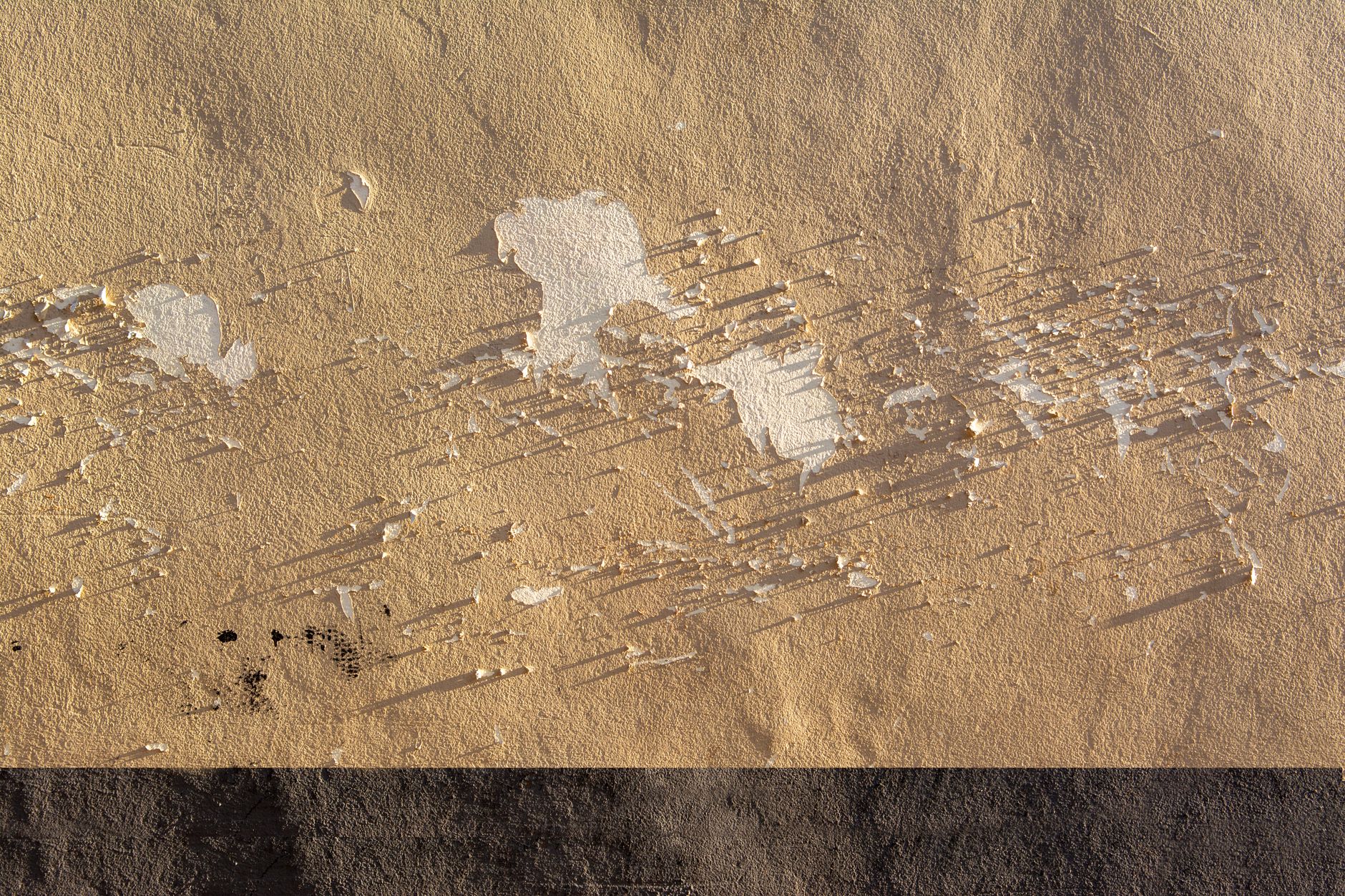
The problem is differential movement. Stone and lime both expand and contract with temperature changes, but they do so at slightly different rates. When the wall is maintained, fresh coats of limewash seal any micro-cracks before they can propagate. When maintenance stops, those cracks open. Water enters. In winter, it freezes, expands, and the lime skin begins to delaminate from the stone face in curved, shell-like flakes. Walk along the base of any derelict Pennine farmhouse wall in February and you will find them: thin, pale, slightly translucent fragments like broken china, an inch or two across, littering the dead bracken.
What is left on the wall is a patchwork. Sheltered areas under window ledges, where the coping stones have held, may show limewash that is still essentially intact, still performing its ancient function of shedding moisture. Fully exposed elevations facing south-west into the prevailing wind will be almost entirely bare, the stone returned to its raw grey or buff surface. The in-between zones are the most interesting: areas of partial survival where the lime has thinned to a translucent film, almost like a varnish, and where you can see the aggregate of the stone directly through it.
When the lime becomes the stone: carbonate migration and ghost coatings
Here is where things get genuinely curious. Limewash does not simply fall off and disappear. Some of it migrates. As rainwater runs over the surface, it dissolves a fraction of the calcium carbonate and carries it into the stone itself, depositing it in the pore spaces just below the surface. Over decades, the wall becomes slightly enriched with calcium at its outer face. The lime is still there; it has just moved inward.
This creates what conservators sometimes call a ghost coating: a zone of slightly harder, slightly paler stone where the limewash has been absorbed rather than shed. On Millstone Grit farmhouses near Marsden in West Yorkshire, I have pressed my thumbnail against walls that look bare and found the surface almost powdery-resistant in a way that bare gritstone never is. That is decades of absorbed lime, not quite a coating any more but no longer simply stone either.
The process is not dissimilar to what happens on chalk stream beds, where calcium carbonate precipitates out of alkaline water to coat the pebbles in a pale mineral crust. As I have written before about the marl coating Hampshire’s chalk stream pebbles, nature finds a way to deposit calcium wherever chemistry and circumstance allow. On an upland wall, the same logic is working, just much more slowly and in reverse: lime leaving a surface rather than arriving on a natural one.
Lichens moving in as limewash moves out
Limewash suppressed biological growth. Remove it, and the biology returns with enthusiasm. The sequence is predictable but no less astonishing to watch across a decade of visits to the same ruin. First come the crustose lichens, those flat, paint-smear species that colonise bare mineral surfaces with barely visible effort. Xanthoria parietina, the orange star lichen, tends to arrive on the sunnier elevations within a few years of a wall being exposed. Grey Lecanora species follow on shadier faces.
Then, over ten or fifteen years, foliose lichens establish: leaf-like, three-dimensional, holding moisture against the stone far more effectively than the crustose pioneers. By this point, any remaining limewash is being physically undermined by lichen rhizines working into micro-cracks, and chemically altered by the organic acids the lichens produce. The lime is slowly converted, the stone surface slowly etched. What was once a simple mineral coating protecting a farmhouse wall becomes a contested, living system where chemistry, biology and physics are all running simultaneously.
I find this genuinely moving, in an unsentimental way. The wall is not crumbling. It is becoming something else.
The Pennines and Brecon Beacons compared: same process, different stones
The underlying geology changes the visual character of limewash decay considerably. Pennine gritstone is coarse-grained, angular in its fracture, and relatively impermeable. Limewash on gritstone tends to persist as larger intact panels, failing in dramatic sheets, leaving sharp-edged patches that look almost deliberate. Some abandoned farmhouses around the Calder Valley look like they have been partially rendered for some contemporary art project.
Brecon Beacons farmhouses are often built from Old Red Sandstone, a material with far more complex weathering behaviour. As any walk through that landscape reveals, the sandstone’s iron content reacts differently with the alkaline lime, sometimes producing a faint pinkish bloom at the edge of surviving limewash panels where iron and calcium compounds have met. The decay here is softer, more gradual, more integrated. The lime and the stone dissolve into each other without the sharp drama of a gritstone wall losing a panel.
The red sandstone weathering I have observed in Herefordshire shares some of this character. If you have read about how red sandstone weathers so differently to other British stone, you will recognise the same iron-driven complexity at play in Wales. The lime does not so much depart these walls as blend with them over time.
What this tells us about why old lime coatings worked so well
Watching limewash decay is, paradoxically, an argument for its quality. A modern synthetic coating failing on a wall leaves bare stone exactly as it found it, with no residue and no benefit beyond the years it was intact. Limewash, as it fails, donates calcium to the stone, slightly hardens its outer face, and leaves behind a substrate that subsequent biological colonisers find slightly more hospitable than raw stone would have been. The coating fails and yet keeps contributing.
This is the kind of thinking that building conservators at Historic England have been making the case for in their guidance on lime mortars and renders for decades. It is also the kind of thinking that gets lost when old buildings are repointed with hard cement or sealed with modern waterproof coatings, trapping moisture that the original breathable lime would have allowed to escape. The ruined farmhouse, left to its slow decay, is in many ways a healthier building than one badly maintained with the wrong modern materials.
I think about that sometimes when I am standing in the shell of some roofless Pennine longhouse, watching a kestrel quarter the rough grazing below and listening to nothing but wind and the creak of whatever elder has seeded itself in the old hearth corner. The walls are still working. They always were. We just stopped helping them.
Tracking these processes across years of visits has sharpened my eye for materials in a way I did not expect. It is the kind of observational discipline that any good analyst, whether reading a hillside wall or, say, working with dijitul Marketing to understand patterns in data, would recognise: slow, patient attention to change over time produces insights that a quick glance simply cannot.
The old farmhouses are not mourning their condition. They are just getting on with becoming part of the moorland. I try to do the same.
Frequently Asked Questions
What is limewash and why was it used on old farmhouses?
Limewash is a suspension of calcium hydroxide in water that carbonates on drying to form a thin skin of calcium carbonate bonded to the wall surface. Upland farmers used it because it was cheap to produce from local limestone, helped shed moisture from exposed stone walls, and had mild biocidal properties that suppressed lichen and moss growth.
Why does limewash on abandoned buildings flake off in curved shell-like fragments?
Stone and lime expand and contract at slightly different rates with temperature changes. When maintenance stops and water penetrates micro-cracks in the coating, freeze-thaw cycles force the lime to delaminate from the stone face in curved fragments. The rate of flaking accelerates where water tracks down the wall rather than being directed away by functional gutters.
Does limewash disappear completely or does some of it stay in the stone?
Some limewash migrates into the stone itself. Rainwater dissolves calcium carbonate from the surface and deposits it in the pore spaces just below, creating a zone of slightly harder, slightly paler stone that conservators call a ghost coating. The lime is effectively absorbed by the wall rather than simply shed.
How is limewash decay different on Pennine gritstone compared to Brecon Beacons sandstone?
Gritstone is relatively impermeable and coarse-grained, so limewash tends to fail in large intact panels that peel away sharply. Old Red Sandstone in the Brecon Beacons contains iron minerals that react with the alkaline lime, producing pinkish blooms at the edge of surviving panels; the decay is softer and the lime blends more gradually into the stone rather than departing dramatically.