

I walked the Whin Sill section on a January morning when the wind was coming off the Pennines hard enough to lean into. The sky was the colour of old pewter. The Wall itself, or what remains of it, sat low and dark against the pale grass, and my first thought was that it looked less like a fortification than something the land had grown. Which, in a way, it has. Two thousand years is a long time. Long enough for Roman stone to become something else entirely.
Hadrian’s Wall stone weathering is not a single process. It is a slow accumulation of catastrophes, each one minor, each one relentless. Freeze-thaw cycles. Acid deposition. Biological colonisation. The particular cruelty of Northumberland’s climate, where you can get horizontal sleet and bright sunshine in the same hour. Stand close enough to the Wall and you can read these events in its surface, layer by layer, like rings in a tree.
What the Romans actually built with
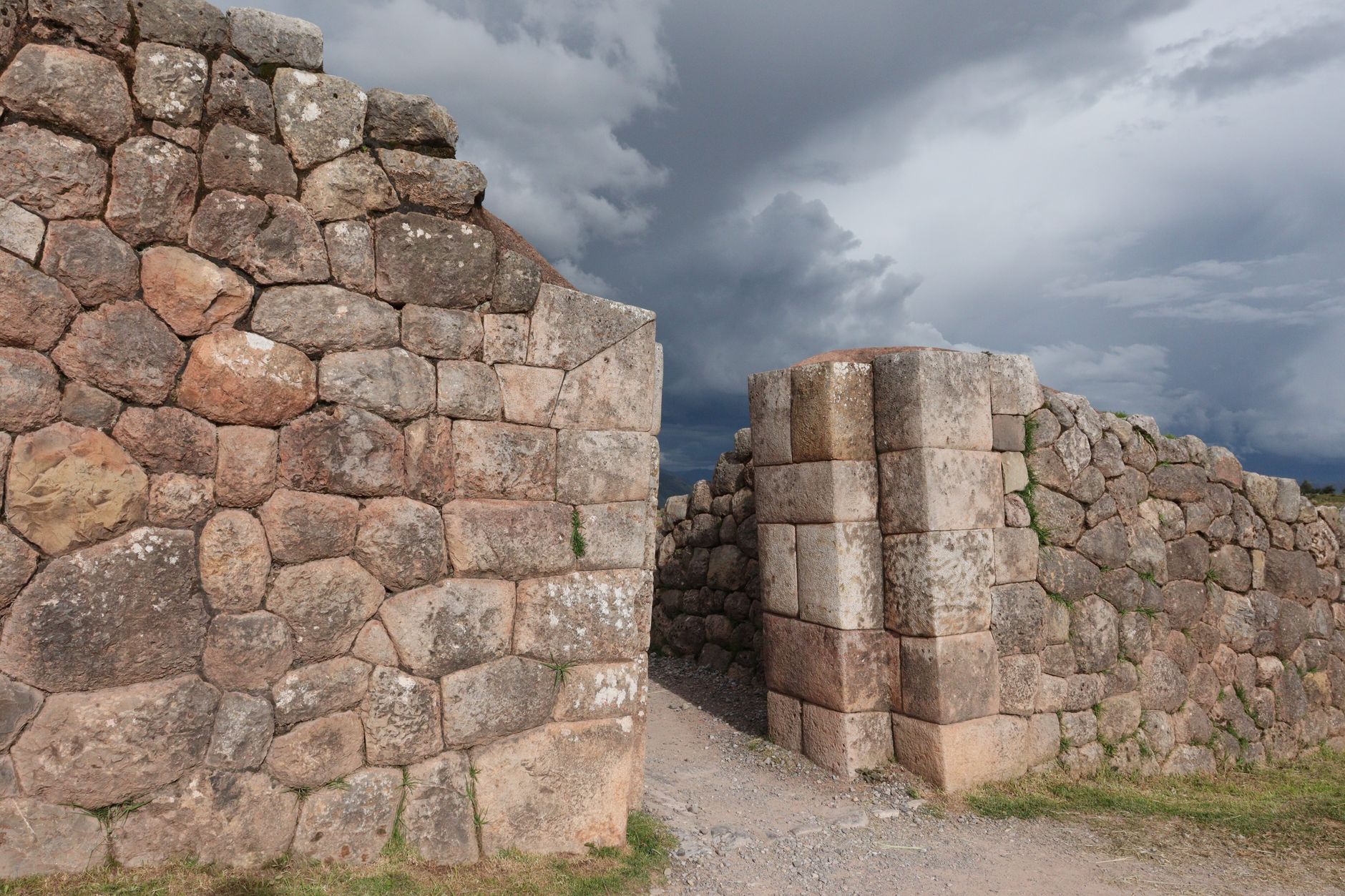
The Wall runs roughly 73 miles from Bowness-on-Solway in Cumbria to Wallsend in Tyne and Wear. Along most of the central section, the builders used dolerite, the volcanic rock that forms the Whin Sill escarpment the Wall famously follows. Dolerite is hard stuff. Dense-grained, dark, almost bluish-black when freshly split. It was chosen because it was there, not because anyone was thinking about longevity, but it has turned out to be reasonably well-suited to the task of surviving two millennia.
Further west and east, where the Whin Sill dips away, the Romans used local sandstone and limestone, both considerably softer and more porous. These sections have weathered dramatically differently. The sandstone courses at Birdoswald, for instance, show deep channels where rain has exploited the bedding planes, carving lines that look almost deliberate, like toolmarks. They are not toolmarks. They are two thousand years of slightly acidic water finding the path of least resistance.
How acid rain changed the surface chemistry of ancient stone
Limestone is particularly susceptible to acid attack, a process called carbonation. Rain absorbs carbon dioxide from the atmosphere and becomes a weak carbonic acid. That acid reacts with calcium carbonate in the stone, converting it to calcium bicarbonate, which is soluble and simply washes away. The result is a gradual rounding of surfaces, a loss of detail, a softening of angles that were once crisp.
The industrial revolution made this dramatically worse. Sulphur dioxide and nitrogen oxides from coal burning converted rain into something genuinely corrosive. The black crusts you find on the north-facing surfaces of limestone blocks at Chesters Roman fort are largely composed of calcium sulphate, the product of this reaction, mixed with accumulated particulate pollution. These crusts are similar in chemistry to those found on medieval cathedrals across northern Europe, where the same story of stone, pollution, and time has played out on a similarly long timescale. The crusts protect the surface beneath them in one sense, forming a hard shell. In another sense they are a slow poison, trapping moisture and cycling through wetting and drying, expanding and contracting, until the stone beneath cracks.
The freeze-thaw cycle: winter’s particular cruelty
Northumberland averages around 70 to 80 air frost days per year in its upland areas, according to Met Office records. On the exposed spine of the Whin Sill, where the Wall sits most dramatically, temperatures can swing from above freezing to minus five or six Celsius within a single night. Water expands by roughly 9 per cent when it freezes. Inside a small crack in dolerite, that expansion generates pressures that the stone cannot resist indefinitely.
Over two thousand winters, this has done extraordinary work. Entire courses of stone have spalled. Surfaces that were once flat have become pitted and irregular. In some places, particularly on the north-facing faces that never quite dry out between October and March, the stone surface has taken on a texture almost like rough bark. I ran my hand along one such section near Housesteads. It felt warm from the thin sun, despite the cold air, and slightly soft to the touch in a way that surprised me. That softness is the beginning of the end for that particular face. The underlying crystalline structure is compromised. Another century of Northumberland winters will do the rest.
Biological growth: the living patina
Here is where it gets genuinely interesting. The dark colouration of Hadrian’s Wall is not just weathering and pollution. A large part of it is alive. Or has been alive. The black, grey and rust-orange streaks across the Wall’s surface are largely the work of cyanobacteria, algae, mosses, and lichen, organisms that have been colonising the stone for as long as it has been standing.
Lichen, in particular, is doing several things simultaneously. The fungal component of a lichen produces organic acids that etch microscopic pits into the stone surface, giving it somewhere to anchor. Those same pits then collect moisture and organic debris, creating micro-habitats for other organisms. Over centuries, this biological activity generates a thin layer of organic and mineral material that is genuinely protective in some respects and genuinely destructive in others. I have written before about how microscopic living layers slowly repaint Britain’s oldest stone surfaces, and the Wall is perhaps the most dramatic example of this anywhere in northern England.
The cyanobacteria are particularly significant. These ancient single-celled organisms, some of the oldest life forms on Earth, can photosynthesise and fix nitrogen. They bind water and release it slowly. In doing so, they regulate the moisture content of the stone surface, which in a freeze-thaw environment is both a kindness and a complication. A drier surface freezes less violently. But a surface consistently colonised by moisture-retaining organisms is rarely truly dry.
Reading the Wall as a geological record
What I find most compelling about Hadrian’s Wall stone weathering, when you stand in front of it on a cold morning with the wind pulling at your jacket, is that every surface is a record. The blackened north face tells you about prevailing weather. The orange lichen patches mark where alkaline minerals have leached from the mortar. The smooth, almost polished sections show where tourists’ hands have rubbed the biological crust away and UV has bleached the exposed stone beneath. The crumbling courses at the base tell you about ground moisture and frost heave.
In this sense, the Wall is doing something that humanity has sought to do deliberately since the first application of ochre to cave walls: it is acquiring a protective coating through accumulated exposure. Not designed, not applied, just earned. The stone is darker and harder on the outside than in. The biological mat on its surface, however compromised, holds some moisture away from the face behind it. The calcium sulphate crust, pollution-derived and ugly, physically seals some pore spaces.
English Heritage and Historic England monitor the Wall’s condition through regular survey, and the Historic England guidance on stonework conservation makes clear that intervention has to be carefully considered. Cleaning, for instance, can remove a protective patina and expose fresh stone to weathering it has not had to resist for centuries. Sometimes the most sensible thing is to leave the accumulated coating exactly where it is.
There is a metaphor in there somewhere. I thought about it walking back to the car park at Once Brewed as the light dropped. The Wall has survived not by resisting everything thrown at it, but by becoming, over time, part of the landscape that attacks it. That seems like a reasonable way to last two thousand years. As for me, I’d settled for getting back before dark. My email could wait, and I’d promised myself I was off the grid for the day, though I did have a free spam checker queued up for when I got signal again.
Why the Wall looks different in different lights
One last thing worth noting, because I have never seen it mentioned in a guidebook. The Wall changes colour dramatically through the day and across seasons. In low winter sun it is almost black, the dolerite absorbing light, the biological crust on north faces casting no reflective sheen. In summer afternoon light, the same sections can look almost warm, the iron minerals in the dolerite glowing faintly brown-red. In rain it darkens to near-pitch. In drought it lightens to a dusty grey.
This is what two thousand years of Hadrian’s Wall stone weathering actually looks like, not a monument slowly dying, but a surface in constant, living negotiation with its environment. I’d walk out there again in a heartbeat.
Leave a Reply