

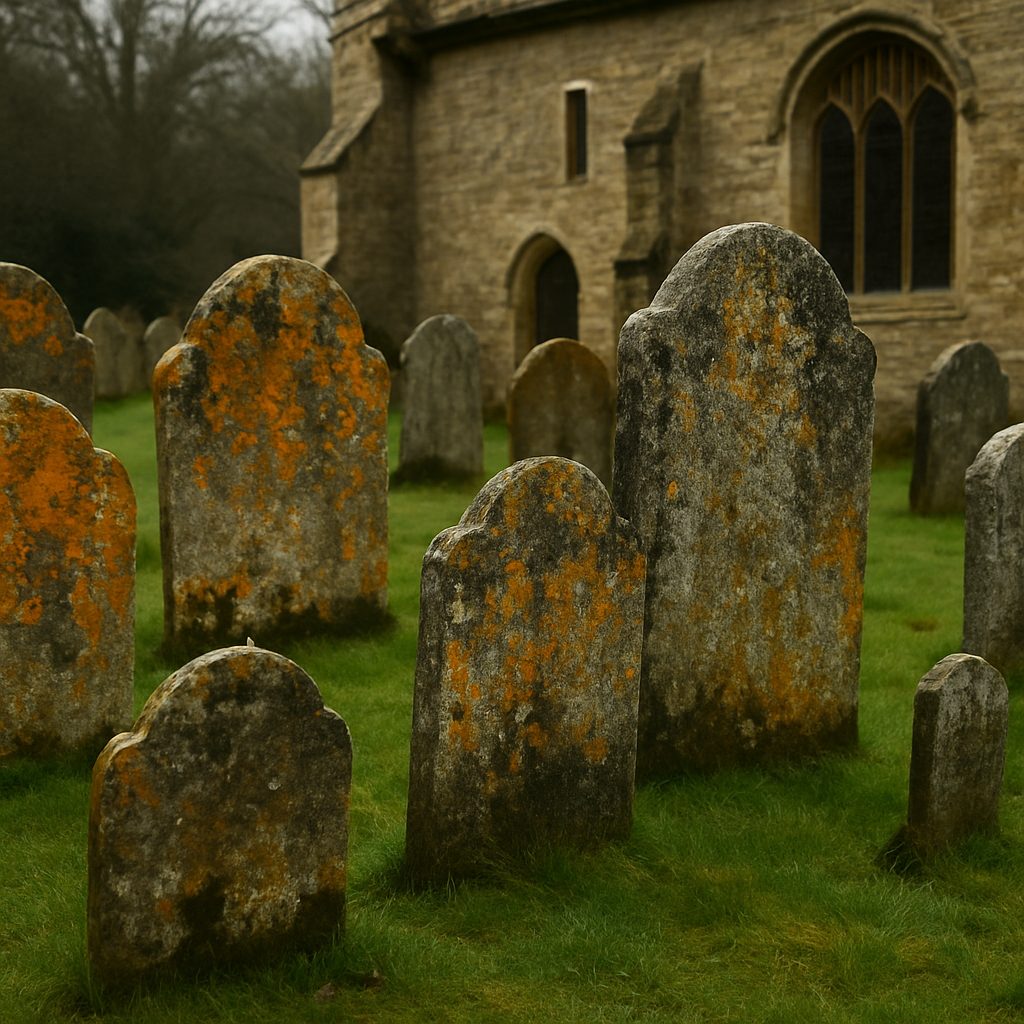
Walk slowly through any old churchyard in Britain, really slowly, none of this brisk morning constitutional business, and you’ll start to see what most people stride straight past. The headstones aren’t grey. They’re orange, black, pale green, sulphur yellow, dusty white. Some have a kind of velvety pewter bloom. Others look almost tie-dyed, rings of rust-coloured crust spreading out from a central point like a slow explosion frozen in stone. What you’re looking at isn’t decay, exactly. It’s life. Extraordinarily patient, extraordinarily old life, in many cases. You’re looking at biofilm stone surfaces across UK churchyard headstones, and once you know what they are, you’ll never see a cemetery the same way again.
What Is a Biofilm, and Why Does It Happen on Stone?
A biofilm is a community. That’s the simplest way to put it. Bacteria arrive first, usually carried on the wind or by rain, and they stick to a surface using sticky proteins they secrete themselves. Once they’ve established a foothold, they release chemical signals, a kind of microbial welcome mat, and other organisms follow. Algae move in. Then fungi. Sometimes all three form extraordinarily intricate partnerships, which is essentially what lichen is: a fungus and a photosynthetic partner (algae or cyanobacteria) living so closely together that they’ve become, for all practical purposes, a single organism.
Stone is ideal territory for this sort of colonisation. Limestone, sandstone, granite, each has its own texture and chemistry, and each attracts a slightly different community of organisms. Limestone, which is porous and calcium-rich, tends to support particularly lush biofilm growth. Many of Britain’s oldest churchyards are packed with limestone headstones, which is partly why they end up looking so dramatically coloured after a few decades. The organisms don’t just sit on the surface passively. They interact with it. Acids produced during metabolism slowly dissolve tiny amounts of mineral. Fungal hyphae, those thread-like structures that fungi use to explore their environment, actually penetrate microscopic cracks. The stone and its colonisers become genuinely entangled over time.
The Colours Themselves: A Rough Guide to What You’re Seeing
I’ve spent enough time peering at old stonework to have developed what I’d loosely call a reading of the palette. Black or dark grey crusts, especially on sheltered surfaces, are typically caused by cyanobacteria, ancient, tough, and capable of fixing atmospheric nitrogen. The orange and rust tones? Those are often from iron-oxidising bacteria interacting with minerals in the stone itself, or from certain species of algae producing carotenoid pigments. Vivid greens are almost always algae, usually thriving where moisture lingers: the north-facing side of a headstone, or the damp patch at the base where grass meets carved inscription.
The white powdery deposits you sometimes see are usually salts crystallising out of the stone as water evaporates, though calcium-depositing bacteria can produce similar effects. Yellow and sulphur-coloured crusts on urban churchyards often reflect pollution history, sulphur compounds from decades of coal burning, now incorporated into complex biofilm chemistry. In cities like Sheffield, Leeds, and Birmingham, many old sandstone churchyard walls carry these yellowish stains as a kind of atmospheric record of the industrial era.
Should Biofilms on Churchyard Headstones Be Removed?
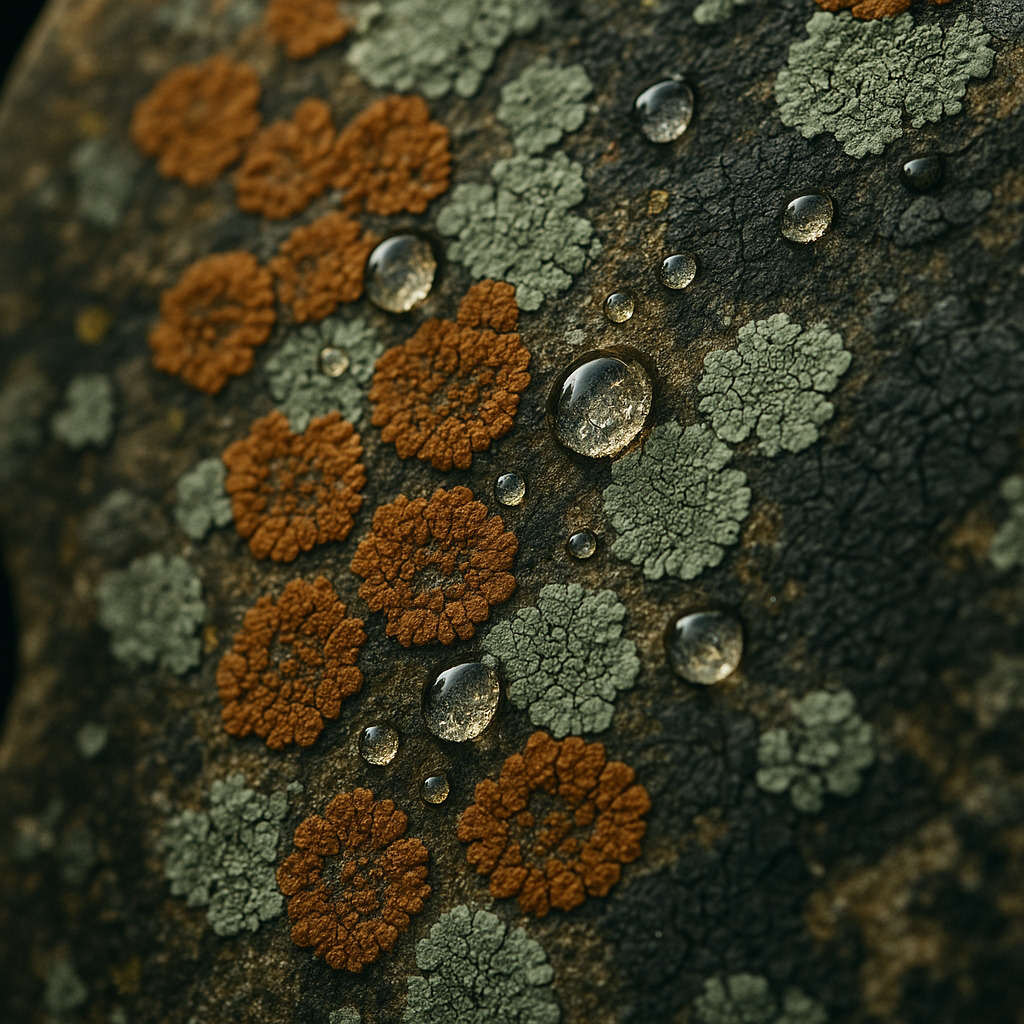
This is where things get genuinely complicated, and genuinely contentious. The conservation world is divided. On one side, you have conservators who argue that biofilm stone surfaces on UK churchyard headstones are actively damaging the stone: the acids produced by metabolising organisms gradually erode inscriptions, the freeze-thaw cycle causes material weakened by biological activity to spall away more easily, and the cumulative effect over centuries is real and measurable.
On the other side, there’s an increasingly strong argument that the biofilm is itself part of the heritage. A headstone covered in several centuries’ worth of lichen is carrying its own biological record. Strip it back, and you don’t just clean the stone, you destroy an ecosystem that may have been accumulating since the Georgian era, and you potentially accelerate the very erosion you were trying to prevent. Bare, freshly cleaned stone is more vulnerable to rainfall, frost, and new colonisation than stone that has reached a kind of equilibrium with its biological community.
Historic England’s guidance on this is thoughtful and worth reading. Their position, broadly, is that cleaning should only be considered when biological growth is causing active harm, and that any intervention should be the minimum necessary. Biocides, water jetting, and mechanical scrubbing all carry risks, and a well-intentioned clean can sometimes do more damage in a month than a biofilm would have done in a decade. You can find their detailed technical advice on Historic England’s technical guidance pages, which are rather more interesting than most government publications, it has to be said.
Some of Britain’s Most Spectacular Examples
There are churchyards in Britain where the biofilm colonisation has reached a kind of magnificent excess. St Cuthbert’s churchyard in Wells, Somerset, has sections of headstones where the lichen coverage is so dense and varied that the original stone colour is entirely invisible. Gravestones in the Outer Hebrides, battered by Atlantic moisture and relatively unpolluted air, support extraordinary lichen communities that scientists travel specifically to study. The churchyard of St Mary’s in Rye, East Sussex, contains headstones where centuries of salt-laden sea air have created biofilm compositions found almost nowhere else.
In Wales, slate headstones, common in Snowdonia and across much of North Wales, develop different communities from limestone or sandstone, often supporting specialist organisms that have adapted to the particular chemistry of Welsh slate. There’s something wonderful about the idea that specific species have evolved, over geological time, to thrive on a specific rock type quarried from a specific mountain range.
What Biofilm Stone Surfaces Tell Us About Environmental Change
Scientists are increasingly using biofilm stone surfaces in UK churchyards as environmental monitoring tools. The species composition of lichen and algal communities on old headstones can reveal pollution levels across decades, shifts in local humidity, and even changes in rainfall chemistry. A churchyard in a rural Herefordshire village and another in inner Manchester will carry very different biological histories, written in their biofilm communities.
There’s also the question of climate. Warmer, wetter winters across Britain (the Met Office has documented a clear trend toward milder, wetter conditions across England and Wales over recent decades) are accelerating biofilm growth on stone surfaces everywhere. What took fifty years to colonise a headstone a century ago may now take thirty. This is reshaping the conservation challenge significantly, and organisations managing historic churchyards are having to think about timescales they weren’t previously planning for.
Quiet Witnesses
There’s something that stops me in my tracks every time I think about it: the oldest living organisms on some of these headstones are almost certainly older than any human memory of the person commemorated beneath. A lichen crust on a headstone from 1740 might have begun its colonisation within a decade or two of the stone being set, and some of those organisms are still alive, still slowly digesting the stone’s surface minerals, still producing the pigments that give the churchyard its extraordinary palette.
Biofilm stone surfaces in UK churchyard headstones are not a problem to be solved so much as a process to be understood. They are, in their own quiet way, some of the oldest and most persistent living communities in the British landscape. That seems worth knowing. Worth stopping for, at any rate.
Frequently Asked Questions
What causes the coloured stains and crusts on old churchyard headstones in the UK?
The colours you see on old headstones are almost always biofilms: communities of bacteria, algae, and fungi living on the stone surface. Different organisms produce different pigments, cyanobacteria create dark grey or black crusts, algae produce vivid greens, and iron-oxidising bacteria contribute orange and rust tones. Lichen, which is a partnership between fungi and algae, produces some of the most striking and long-lasting coloured crusts.
Are biofilms on UK churchyard headstones damaging the stone?
It depends on the organism and the stone type. Some biofilm communities produce acids that slowly dissolve stone minerals, and fungal hyphae can widen microscopic cracks over time. However, established biofilm communities can also form a protective layer that reduces the impact of rainfall and frost. The consensus among conservators is that the relationship is complex rather than straightforwardly harmful.
Should you clean biofilm off old churchyard headstones?
Historic England advises caution, recommending that cleaning should only be considered when biological growth is causing demonstrable active damage. Aggressive cleaning methods like pressure washing or biocides can strip material, damage inscriptions, and leave stone more vulnerable to new colonisation and weathering than a well-established biofilm would. Any cleaning work on listed memorials may also require consent from the relevant authorities.
How long does it take for biofilm to develop on stone churchyard surfaces?
Initial bacterial colonisation can begin within weeks of a stone being placed outdoors. Visible algal and lichen growth typically becomes apparent within a few years on limestone or sandstone, though dense, species-rich communities can take decades to centuries to develop fully. In damp, mild climates like much of western Britain, colonisation tends to be faster than in drier, more polluted urban environments.
Can biofilms on churchyard stone be used to study environmental history?
Yes, and this is an active area of research. The species composition of lichen and algal communities on old headstones can reveal historical pollution levels, changes in rainfall chemistry, and shifts in local humidity over decades. Different biofilm communities develop in rural versus urban churchyards, reflecting the pollution history of each area. Some researchers specifically seek out churchyard headstones as long-term environmental monitoring records.
Leave a Reply