
There is a layer on Stonehenge that nobody talks about. Thinner than a coat of paint, harder than most minerals you could name, and almost completely invisible unless you are holding a hand lens at the right angle in the right light. It is a silica rind: a glassy, self-assembled seal that forms when silica dissolved by rainwater migrates to the surface of exposed sarsen and reprecipitates as an interlocked crystalline skin. English Heritage scientists have been studying it carefully for several years now, and what they are finding is genuinely remarkable. The stone, in some senses, is coating itself.
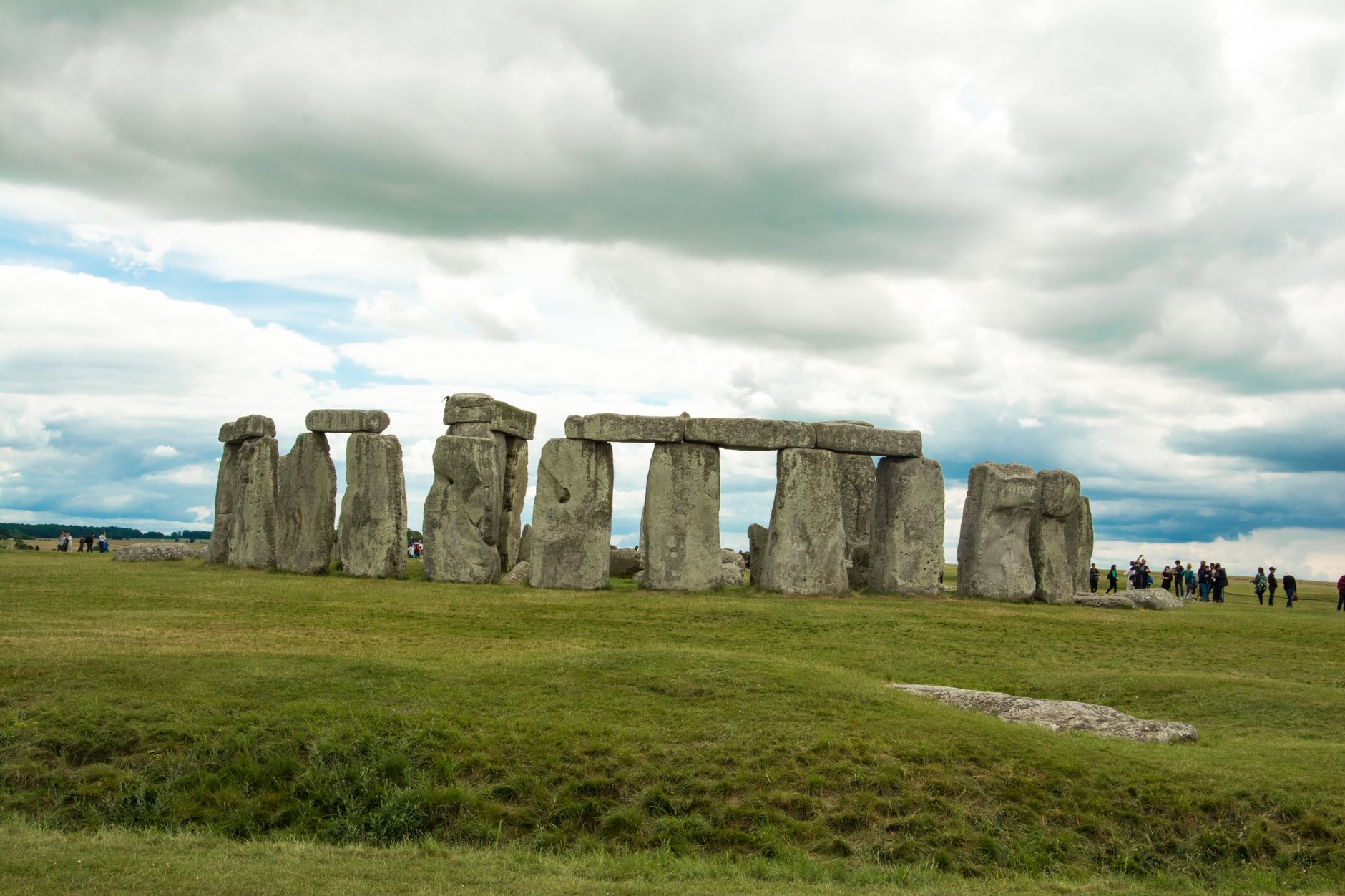
I’ve stood at the outer bank of Stonehenge on a grey Wiltshire morning when the light was low and raking, and you can just make it out: a faint, almost waxy sheen on the weathered faces of the older uprights. It is not ice. It is not lichen. It is the stone’s own mineral matter, reorganised by centuries of wetting, drying and surface chemistry into something approaching a protective glaze. Stonehenge sarsen stone weathering conservation has become, quietly and without much fanfare, one of the more fascinating questions in British heritage science.
What sarsen stone actually is
Sarsen is a form of silcrete: a sedimentary sandstone in which the original quartz grains have been cemented together so thoroughly by secondary silica that the finished rock is almost entirely silicon dioxide. It formed during the Palaeogene, roughly 50 to 60 million years ago, when tropical conditions prevailed over southern England and groundwater rich in dissolved silica percolated through sandy deposits. The resulting stone is extraordinarily hard. When Neolithic peoples dragged the bluestones and sarsens to Salisbury Plain, they were unknowingly selecting a material that would resist the English climate better than almost anything else available to them.
The sarsens at Stonehenge mostly came from Marlborough Downs, around 25 miles to the north. Some of the larger uprights weigh over 25 tonnes. You can read more about how weathering chemistry works on exposed British stone in the context of Welsh slate’s silvery mineral crust in Snowdonia, where similar surface mineral processes are at work, though the underlying rock and chemistry differ substantially.
How silica rinds form on exposed sarsen
Rain is mildly acidic. It dissolves a small amount of silica from the sarsen surface on every wetting cycle, carrying it in solution through the stone’s minimal porosity. When the surface dries, that silica has nowhere to go. It concentrates at the outermost layer and reprecipitates, often in an amorphous or cryptocrystalline form. Over decades and centuries, this process builds up a rind: sometimes just a few micrometres thick, sometimes reaching 50 micrometres or more on stones with a long, stable weathering history.
The rind is not inert decoration. Because it is largely non-porous and very hard, it slows subsequent water penetration. It reduces the amplitude of the wetting-and-drying cycles that cause spalling and granular disintegration in less siliceous stones. It is, in effect, a self-renewing sealant. The stone makes it from its own substance, using nothing but rainwater and time. English Heritage researchers, working alongside geomorphologists from several UK universities, have been mapping the rind’s thickness and mineralogy across different faces of the monument, comparing shaded and exposed surfaces, dressed and undressed stone faces, and areas with heavier lichen cover against those that are bare.
Why scientists are paying attention now
The push to understand Stonehenge sarsen stone weathering conservation more precisely has been sharpened by two pressures. The first is visitor impact: around 1.6 million people visit Stonehenge each year according to English Heritage’s own visitor data, and even with access tightly managed, the vibration, humidity and airborne particulate from that footfall is measurable. The second is climate: wetter winters and more frequent freeze-thaw cycles are altering the moisture environment that governs rind formation and stability.
If the rind is disrupted, whether by mechanical cleaning, chemical treatment, or simply by salt crystallisation beneath it (a process I’ve written about in the context of salt efflorescence in Britain’s flood-damaged churches), the stone beneath becomes dramatically more vulnerable. Understanding the rind means understanding what not to do, which is sometimes the most useful knowledge in conservation.
The non-interventionist model being explored here is significant. For much of the twentieth century, heritage conservation tended towards the active: cleaning, consolidating, sealing. Stonehenge itself had several episodes of what we would now consider aggressive intervention, including concrete repairs carried out in the early twentieth century that are still visible on some lintels. The emerging view, supported by the silica rind research, is that the stone has spent five thousand years developing its own defences, and that the most effective conservation strategy might be to stop undermining them.
What the rind looks like under a microscope
Under a scanning electron microscope, the silica rind on sarsen looks nothing like what you might expect. There is no clean boundary between rind and stone. Instead, the surface grades gradually from fully cemented, near-vitreous silica at the outermost face into the granular matrix of the original sandstone perhaps 30 to 60 micrometres deeper. It is not a coating applied from outside; it is the stone’s surface transformed. The quartz grains at the exterior are overgrown with secondary silica, their edges rounded and smoothed, their interstices filled. The whole thing has a quality that reminds me of descriptions of the deliberate patination on bronze statues: a surface that appears organic, aged, integral to the object, because it is.
Lichen adds another layer of complexity. On several of the sarsen uprights, grey-green crustose lichens have colonised the rind’s surface. These lichens are doing something counterintuitive: their hyphae penetrate the rind and can accelerate localised dissolution, but their thallus simultaneously traps moisture and moderates the thermal swings that would otherwise stress the stone. Whether net lichen coverage helps or hinders rind stability depends on the species, the aspect, and the microclimate. This is exactly the kind of ambiguity that makes heritage science so absorbing and so resistant to simple answers.
What this means for how we think about ancient monuments
There is a wider lesson here that I think deserves more attention than it gets. Stonehenge sarsen stone weathering conservation is not just about one monument. Across Britain, sarsen stones and siliceous sandstones appear in hundreds of field monuments, boundary markers, medieval churches, and dry-stone features. The same rind-forming chemistry is operating on all of them. The question of how to manage that process, how to avoid inadvertently stripping a natural defence that took centuries to accumulate, applies everywhere from the Avebury henge to the sandstone walls of a Derbyshire farmhouse.
I’ve been thinking about this alongside the quiet work described in the study of algae and lime slowly repainting Britain’s canal locks: the way that natural chemistry, left to run its own course, often produces outcomes that are more stable and better suited to the material than anything we might apply deliberately. The built environment tends to assume that protection is something added. The silica rind on Stonehenge suggests, rather firmly, that sometimes protection is something grown.
English Heritage has not published a definitive conservation protocol for silica rinds yet. The science is still accumulating. But the direction of travel is clear: study what the stone is doing, map it carefully, and intervene only when you have a compelling reason to believe that intervention will improve on five thousand years of self-regulation. That seems like a reasonable approach. It is also, I suspect, a harder discipline to maintain than it sounds, particularly when well-meaning visitors want things clean and officials want things managed.
The Wiltshire morning I mentioned earlier ended with sun breaking through and the rind on one of the largest uprights catching the light for a moment, briefly and brilliantly, like a window pane dusted with frost. Then it was gone. The stone looked grey and ancient and entirely ordinary again. Which is, I suppose, exactly what a good protective coating should look like.