
Stand at the top of the Royal Mile on a clear autumn afternoon, when the sun drops low over the Pentland Hills and throws long amber light across the Canongate, and the stone seems almost to generate its own warmth. Not just golden, but layered. Some blocks are honey-pale, others a deep tobacco brown, and here and there you catch a streak of something almost bronze. I’ve stood in that spot more than once, squinting at the walls and thinking: that’s not just sandstone. There’s something else going on there. And it turns out there is. Quite a lot of something else, in fact.
Edinburgh sandstone colour weathering in the Old Town is one of those subjects that looks simple on the surface and gets stranger the closer you look. The warm palette of the High Street and the closes running off it isn’t simply what the stone looked like when it was quarried. It’s the product of centuries of chemistry, biology, pollution and sheer atmospheric persistence. The stone itself is the canvas; what gives it character is everything that has settled, grown, reacted and calcified on top of it over the past three or four hundred years.
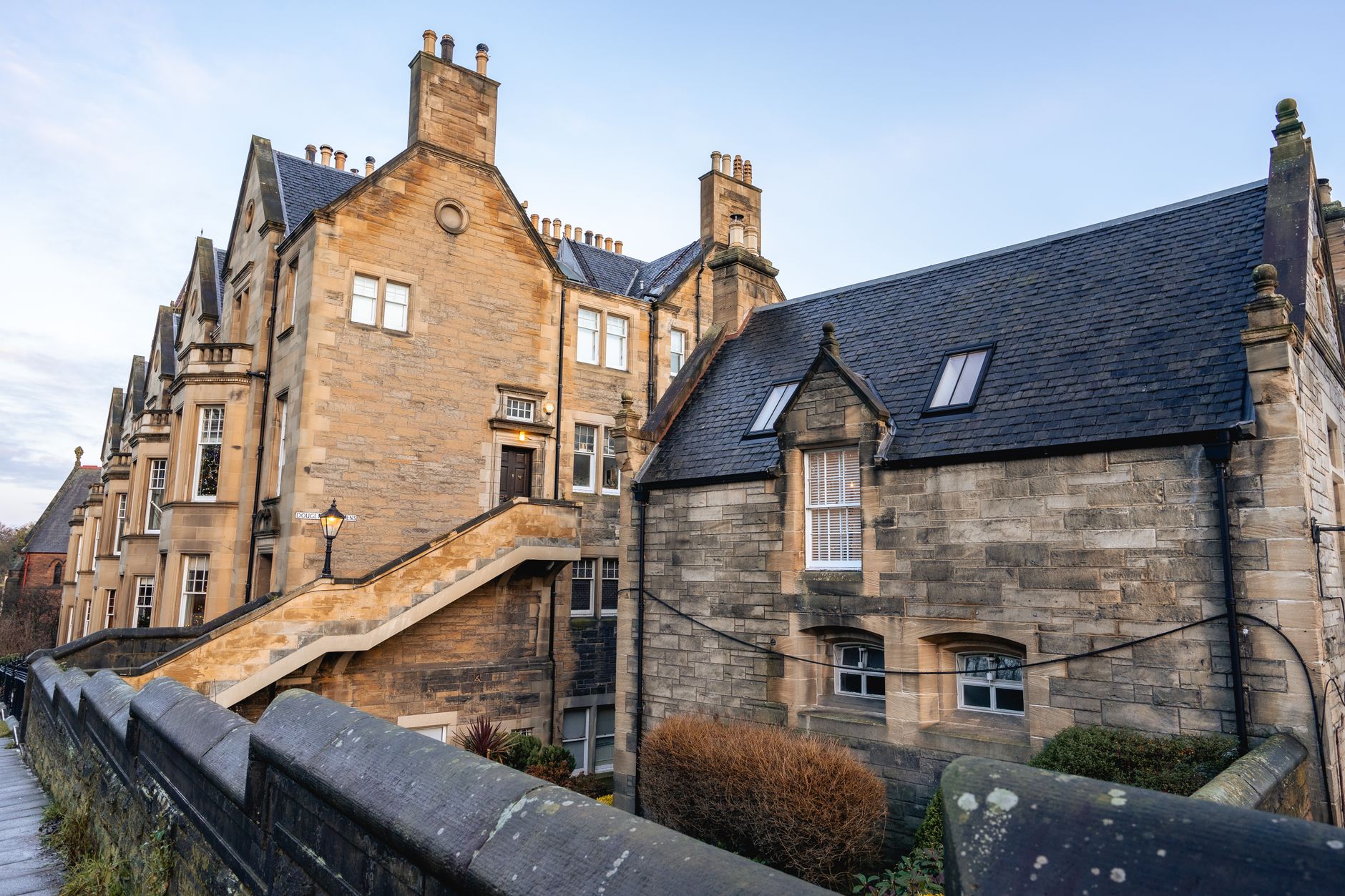
What kind of stone are we actually looking at?
Most of Edinburgh’s historic core is built from Carboniferous sandstone, laid down roughly 300 to 350 million years ago when Scotland sat close to the equator and the land was covered by vast river deltas and shallow tropical seas. The stone is technically a feldspathic or arkosic sandstone in places, meaning it contains not just quartz grains but substantial amounts of feldspar, iron oxides and occasional fragments of calcium carbonate. It’s this mineral cocktail that gives freshly cut blocks their warm cream-to-amber base.
The quarries that supplied most of the Old Town’s fabric came from sites at Craigleith, Ravelston and Hailes, all within a few miles of the city. Craigleith in particular was the prestige choice for centuries, a hard, close-grained stone that dressed well and took detail cleanly. But even fresh Craigleith sandstone has that faint amber undertone, caused by iron oxide minerals distributed through the grain matrix. Iron is the painter here before anything else has had a chance to get to work.
The coal-smoke layer that never quite left
Edinburgh burned coal for domestic heating from the 16th century onwards, and the density of the Old Town, with its tall tenements packed into narrow closes, meant that the smoke had nowhere to go except upwards through the slot of sky above the street and directly onto the stonework on either side. By the 18th century, the nickname “Auld Reekie” wasn’t affectionate irony. It was a fairly literal description of a city perpetually wreathed in particulate haze.
What that coal smoke deposited on the stone was a complex mixture. Soot particles, yes, but also sulphur dioxide, which reacted with calcium carbonate in the stone surface to form gypsum, a soft white crust that then trapped further particulates, oils and dust. This is the same black sulphation crust you see on cathedrals across Europe. I’ve written before about what centuries of candle smoke and damp left on York Minster’s ceilings, and the chemistry at Edinburgh’s street level is a close cousin: sulphate compounds bonding with particulate carbon to form a skin that is simultaneously protective and staining.
The Clean Air Acts of 1956 and 1968 eventually cleared the worst of the visible pollution from British cities, and Edinburgh’s stone cleaning programmes in the latter half of the 20th century stripped many of the most heavily darkened facades back to pale cream. But cleaning is never quite complete. The gypsum crusts are tenacious, and in sheltered spots, in the angles of window reveals, under cornices, behind carved details, remnants of the original smoke patina survive. Those darker pockets aren’t dirt so much as history, chemically bonded to the stone surface.
Biological growth: the living skin on the old stone
Beyond the mineral and pollution chemistry, Edinburgh sandstone carries a substantial biological community. The city’s wet Atlantic climate, with around 700mm of rainfall a year and persistent low cloud cover for much of autumn and winter, makes the stone surface an ideal habitat for microorganisms. Algae, cyanobacteria, fungi and lichens all colonise sandstone given half a chance, and in the Old Town they’ve had rather more than half a chance.
The pale green or grey-green tinge you see on the more sheltered, north-facing stonework is almost always algal or cyanobacterial growth. On damp surfaces it can be thick enough to feel slightly soft underfoot when it colonises steps. Lichens, which are actually partnerships between fungi and photosynthetic partners, tend to prefer surfaces with more light and slightly better drainage; you see them most prominently on the higher reaches of tower walls and on older, undisturbed gravestones. I’ve spent some time reading about why older sandstone gravestones often survive better than newer ones, and a lot of that comes down to the lichen communities that have essentially sealed the surface.
These biological layers do something unexpected to the colour of the stone. Certain orange and yellow-brown crustose lichens, common genera including Caloplaca and Xanthoria, add a warm ochre tint that sits almost indistinguishably on top of the iron-oxide amber of the stone itself. In particular light conditions, the lichen and the mineral colour combine to produce that particular quality of warmth that photographers flock to capture at dusk. The biology is not separate from the aesthetics. It is part of them.
Iron oxidation and the slow chemistry of centuries
The iron minerals within the sandstone grains continue to oxidise slowly over time. As rainwater carries slightly acidic conditions into the stone surface, ferrous iron compounds convert to ferric oxides and hydroxides, including goethite and haematite, the same minerals that give red deserts and rust their colours. This process is gradual, but over centuries it deepens the amber tone of exposed stone surfaces and can produce those vivid rust-streak stains you occasionally see where iron-bearing material has leached from joints or embedded metalwork.
Look closely at the stone around old ironwork, old drain brackets, hinges in doorways, and you’ll see bright orange and brown staining spreading outwards from the fixing points. It’s the same iron mineralogy at work in the stone’s original amber, just running faster and more visibly where there’s a concentrated source. The broader phenomenon of iron oxidation colouring stone is something I find genuinely fascinating, and it’s worth comparing to what happened on the rust-red walls of Ironbridge, where Victorian industrial iron left its own unmistakable mark on the surrounding landscape.
Why the colour varies so much from block to block
One of the pleasures of looking closely at Edinburgh’s Old Town walls is the patchwork quality of the stone. Two blocks sitting side by side can be quite different in tone: one pale, almost cream, the next a deep amber-brown. This variation reflects several factors operating simultaneously.
First, not all the stone came from the same quarry or even the same seam within a quarry. Different quarry beds have different iron content and different proportions of feldspar versus quartz, which shifts the base colour before anything environmental has happened to it. Second, different parts of a wall have different exposure histories. A block in a sheltered position beneath a projecting string course has experienced less rain-wash, less freeze-thaw cycling, and less biological colonisation than an exposed block in a parapet. The sheltered one may have accumulated a thicker pollution crust; the exposed one may have been weathered back towards cleaner stone but also colonised by lichen.
Third, the various stone-cleaning episodes over the 20th century were uneven. Owners cleaned facades at different times using different methods, from abrasive grinding in the earlier decades to gentler water-jet and chemical poultice approaches more recently. Historic Environment Scotland, the body responsible for the conservation of Scotland’s built heritage, has published guidance on the appropriate treatment of sandstone facades, and the current consensus strongly favours minimal intervention precisely because the surface patina, biological and mineral, has genuine heritage value. Stripping a cleaned face back to bare stone and allowing it to recolonise produces a subtly different patina from one that was never disturbed.
What the colour is actually telling you
The amber of the Old Town is essentially a record, written in mineral films, biological crusts and atmospheric deposits, of three or four centuries of urban life. The warmth of the iron oxides is the geological baseline, laid down 300 million years ago. The darkening in sheltered spots is the coal economy of early modern Scotland, compressed into a few millimetres of gypsum and carbon. The lichen tints are the slow, patient biology of a damp Atlantic city, adding warmth in ways that no pigment could quite replicate.
It’s worth noting that natural protective coatings in the living world often work on similar principles: layered, complex, built up gradually over time rather than applied in a single coat. Edinburgh’s sandstone has been coating itself for centuries, and what we read as warmth and beauty is actually geology, chemistry and biology doing what they’ve always done, quietly and without any assistance from us.
You can read more about how Historic Environment Scotland approaches sandstone conservation in their technical guidance, which covers the specific challenges of Scottish building stone in considerable detail. It’s dry in places, as technical guidance tends to be, but the sections on surface deposits are unexpectedly readable.
Next time you walk the Royal Mile at low sun, stop and look at the wall up close. Not at the view, not at the castle on its volcanic rock, but at a single block of stone at eye level. The amber is ancient. The biology is alive. And that particular gold has been building up since before anyone thought to write it down.
Frequently Asked Questions
Why does Edinburgh's Old Town sandstone look amber or golden?
The warm amber colour comes primarily from iron oxide minerals within the Carboniferous sandstone itself, which were deposited when the rock formed around 300 million years ago. This base tone is deepened and complicated by centuries of biological growth, coal-smoke deposits and ongoing iron oxidation at the surface.
What is the dark staining on Edinburgh's historic stonework?
Much of the dark staining is a gypsum crust formed when sulphur dioxide from coal combustion reacted with calcium carbonate in the stone, trapping soot and carbon particles. This sulphation crust is common on historic sandstone across British cities and can survive even after stone-cleaning treatments in sheltered areas like window reveals and decorative mouldings.
Is lichen damaging Edinburgh's sandstone buildings?
The relationship is complex. Some lichen species produce organic acids that slowly etch the stone surface, but established lichen communities also seal the stone against rain penetration and reduce freeze-thaw damage. Historic Environment Scotland generally recommends leaving stable lichen colonies undisturbed on historic masonry rather than removing them.
Why do different stone blocks on the same building look different colours?
Variation reflects a combination of factors: different quarry sources with slightly different mineral compositions, different exposure levels within the facade, uneven weathering rates and the patchwork history of cleaning. Blocks in sheltered spots accumulate more pollution crusts whilst exposed blocks may be washed cleaner but colonised more heavily by algae or lichen.
What quarries supplied the stone for Edinburgh's Old Town?
The principal sources were Craigleith, Ravelston and Hailes quarries, all close to the city. Craigleith was considered the premium material for centuries, valued for its hardness and fine grain. Most are now closed, which makes matching stone for repairs genuinely challenging and has led conservators to source compatible sandstone from other Scottish and sometimes English quarries.