
There is something deeply odd about walking through an English churchyard and noticing that the stones carved in the 1680s are sharper than those put down in 1890. The lettering on the older ones still has a crispness to it, a deliberate chiselled edge, whilst the Victorian replacement next to it has softened into something barely legible, the surface granular and flaking. I have spent more time than is probably sensible peering at grave markers across Yorkshire, Shropshire and Somerset, and this pattern keeps appearing. The oldest gravestones in England are, counter-intuitively, often the best preserved.
There is a real explanation for this. Several, actually. And they involve quarry geology, historical pollution, biological colonisation, and one of the more ironic twists in the story of how surfaces age in the open air.
The stone makes all the difference
Seventeenth-century grave markers in the churchyards of the Yorkshire Dales, the Welsh Marches and Somerset were almost universally cut from local stone. A mason in Settle would use Horton-in-Ribblesdale limestone. One in Much Wenlock would go to the Wenlock limestone beds almost literally on his doorstep. Around Wells and Shepton Mallet, the blue lias and the local Bath stone variants came from quarries a few miles away at most.
This matters enormously. Stone quarried locally and used promptly still contains what geologists call quarry sap, the natural moisture and mineral salts present in freshly extracted rock. As this evaporates over months and years, a subtle surface hardening occurs. The outer layer consolidates. Masons working with this stone understood its behaviour instinctively because they had cut it before and seen old pieces weather over decades. They knew which face of the stone to present to prevailing rain. They knew the grain.
Victorian and Edwardian monumental masons often did not have that same intimacy with their material. The railway network, brilliant thing that it was, meant that stone could be shipped across the country. Portland stone became fashionable. Aberdeenshire granite arrived in churchyards across the Midlands. These are not bad stones. But they were being used by craftsmen working with materials sourced far from where they had grown up cutting stone, and the fit between mason knowledge and stone behaviour was sometimes looser than it had been two centuries earlier.
What acid rain actually did to Victorian churchyards
The Victorian and Edwardian periods coincided with the peak of Britain’s industrial pollution. Sulphur dioxide from coal burning combined with atmospheric moisture to produce sulphuric acid. The BBC has reported extensively on how acid rain stripped surfaces from historic buildings during this period, and churchyards were no exception.
Here is the irony. A grave marker installed in 1680 had already developed a protective biological crust by the time industrial pollution peaked in the 1860s and 1870s. Lichen colonies, thin films of algae, even the early stages of biofilm colonisation, had been working on the surface for nearly two centuries. These living layers, as I have written about before in the context of how microscopic living layers are slowly repainting Britain’s oldest churchyards, act as a buffer. They intercept acidic rainfall before it reaches the stone beneath. They hold moisture more evenly across the surface, reducing the freeze-thaw cracking that is particularly savage on granular sandstone.
The Victorian stone installed in 1885 had no such armour. It went into the ground bare, its surface freshly worked and chemically reactive, right at the moment when acid rain was at its most aggressive. The damage done to limestone and sandstone during that forty-year window from roughly 1860 to 1900 was, for unprotected new stone, considerable.
Surface finish and the question of tooling
Look closely at a seventeenth-century sandstone grave marker and you will often see a slightly roughened surface, not perfectly smooth but textured by the limitations of hand tooling. This is not a flaw. A slightly irregular surface sheds water faster than a polished one because it lacks the capillary film tension that holds moisture on a flat plane. Water runs off, rather than pooling.
Victorian monumental masonry went through a fashion for polished and finely dressed surfaces. Granite was often mirror-finished. Limestone was smoothed to a high degree. These surfaces look magnificent when new. But they hold water. And held water, in a climate like Britain’s, means repeated freeze-thaw cycling, biological staining, and on limestone specifically, the slow dissolution that comes with any carbonic acid content in rainfall.
The old masons were not deliberately designing for longevity in any modern sense. They were just working within the constraints of their tools. But those constraints turned out to serve the stone rather well.
Quarry depth and the question of consistency
Local seventeenth-century quarries were often small operations extracting stone from well-understood beds. The stone was consistent, the mason knew exactly which layer produced the most durable material, and there was no incentive to cut corners because the work was going to sit outside a church that the mason and his family attended every Sunday.
Victorian quarrying operated at industrial scale. Meeting demand meant extracting from multiple layers within a quarry, including less competent beds that might have been rejected in an earlier era. Not all Victorian stone was inferior, far from it, but the statistical chance of a given stone coming from a slightly inferior bed was higher when production pressure was greater.
This connects to what I find fascinating about the deeper history of stone surfaces in Britain. The same principle appears in the story of Dartmoor’s ancient clapper bridges, where local granite selected by people who understood the specific landscape has held for eight centuries whilst later interventions have sometimes failed within decades.
The biological protection argument, taken seriously
I want to spend a moment on the lichen question because it tends to divide opinion. Conservators sometimes treat lichen as something to be removed, a surface contaminant that holds moisture and produces organic acids. This is not wrong. Lichen does produce oxalic acid, and over very long periods it can etch stone surfaces.
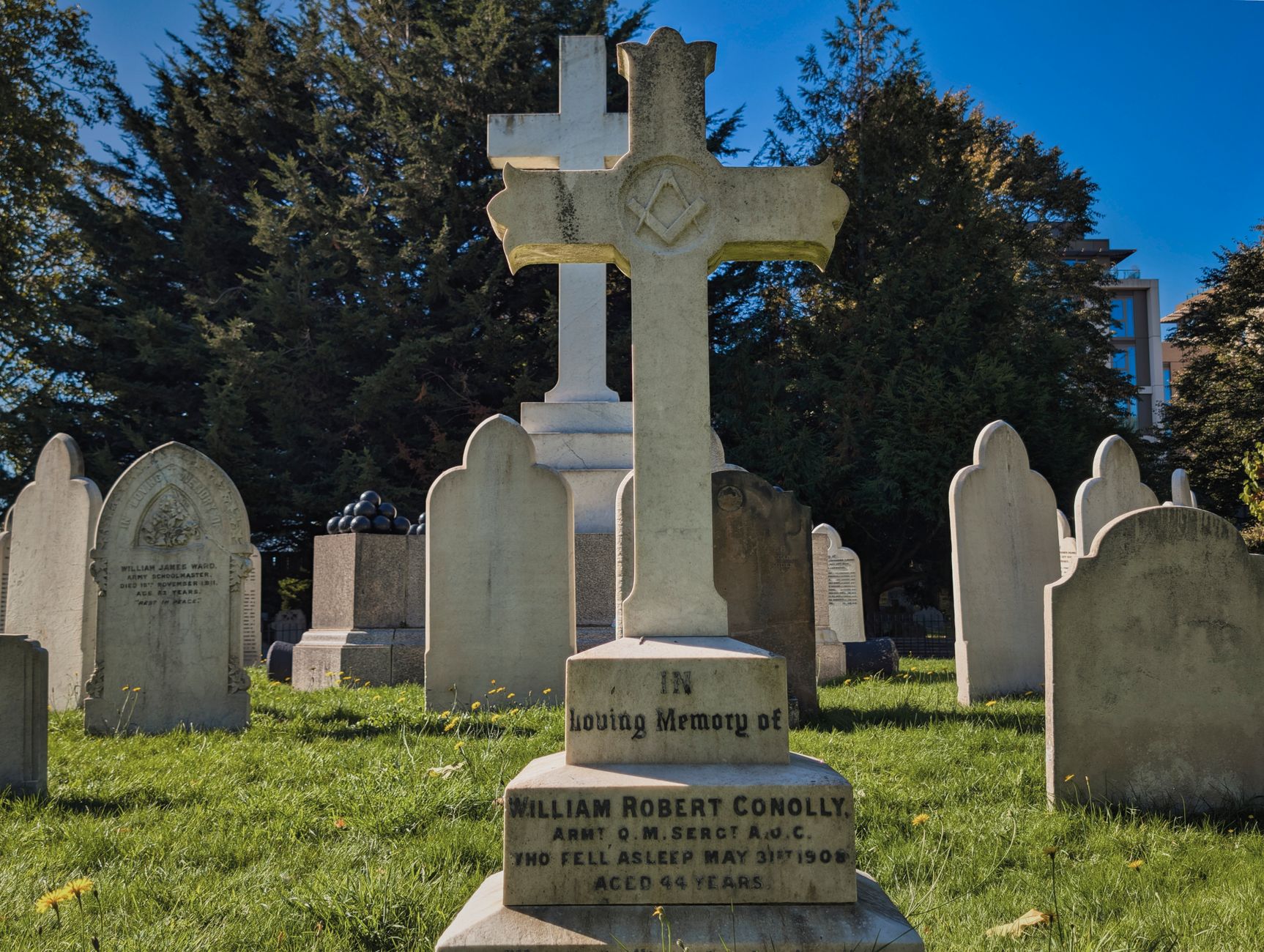
But the timescale matters. On a seventeenth-century sandstone marker in a North Yorkshire churchyard, the lichen is not etching the stone to any meaningful depth over a human lifespan. What it is doing is intercepting external acid deposition, UV radiation, and freeze-thaw stress. The balance is complex and site-specific, but the evidence from churchyards where older colonised stones stand next to cleaned Victorian ones is fairly consistent: the colonised surfaces hold their detail better over multi-decade observation periods.
The same chemistry appears, at a different scale, in the black crusts on Europe’s ancient cathedrals, where biological and chemical layers have interacted with pollution in ways that are sometimes protective and sometimes destructive, depending on the underlying stone and the specific pollutant history.
What this tells us about how surfaces age in the open air
The lesson from old gravestone preservation and UK sandstone weathering is not that older is always better, or that Victorian craftsmanship was somehow inferior. It is more subtle. Surface longevity depends on the match between material, environment, and the specific pressures that material faced at the most vulnerable point in its life, which is usually early on, when it has no biological protection and full exposure to whatever chemistry the atmosphere delivers.
A seventeenth-century sandstone marker that was already two hundred years old when acid rain peaked was protected by time itself. A Victorian stone that went in bare during those same peak pollution decades never got the chance to build that defence.
There is something quietly instructive about that. The oldest surfaces in our landscape are not always the most fragile. Sometimes they have simply been through enough to know how to survive.
Frequently Asked Questions
Why are some old gravestones better preserved than Victorian ones?
Several factors contribute: seventeenth-century stones were often cut from local quarries by masons who understood the material intimately, they had centuries to develop protective biological crusts before industrial acid rain peaked, and their slightly rougher tool finishes shed water more effectively than polished Victorian surfaces. The combination gives them a paradoxical advantage over newer markers.
What types of stone are most durable for old grave markers in the UK?
Locally sourced limestone and certain fine-grained sandstones have often proved very durable, particularly where the quarry source was competent and the stone was cut with the grain properly oriented. Wenlock limestone in Shropshire and some Yorkshire Dales limestones are good examples. Granite is inherently hard but can suffer surface spalling; Portland stone is durable but was vulnerable during peak acid rain years if freshly installed.
Does lichen damage or protect old stone gravestones?
The relationship is complicated and site-specific. Lichen produces oxalic acid which can etch stone over very long periods, but it also acts as a buffer against external acid deposition, UV damage and freeze-thaw cycling. On most UK churchyard stones, the protective effect over observable timescales tends to outweigh the slow chemical etching, particularly on sandstone.
What did acid rain do to Victorian gravestones in UK churchyards?
Industrial sulphur dioxide pollution, peaking roughly between 1860 and 1910, combined with atmospheric moisture to form sulphuric acid that attacked freshly cut limestone and sandstone surfaces. Stones installed during this period without existing biological crusts were particularly vulnerable. The surface granulation and loss of carved detail visible on many Victorian markers today dates from this period of maximum chemical exposure.
Can old gravestone preservation UK sandstone weathering be slowed or reversed?
Preservation is possible but reversal of existing weathering is limited. Conservation guidance from Historic England recommends avoiding pressure washing or harsh cleaning, which removes protective biological layers and reopens fresh stone to the elements. Consolidant treatments exist for friable sandstone, but they require specialist application and are not universally suitable. The best intervention is often simply leaving a stable surface undisturbed.