
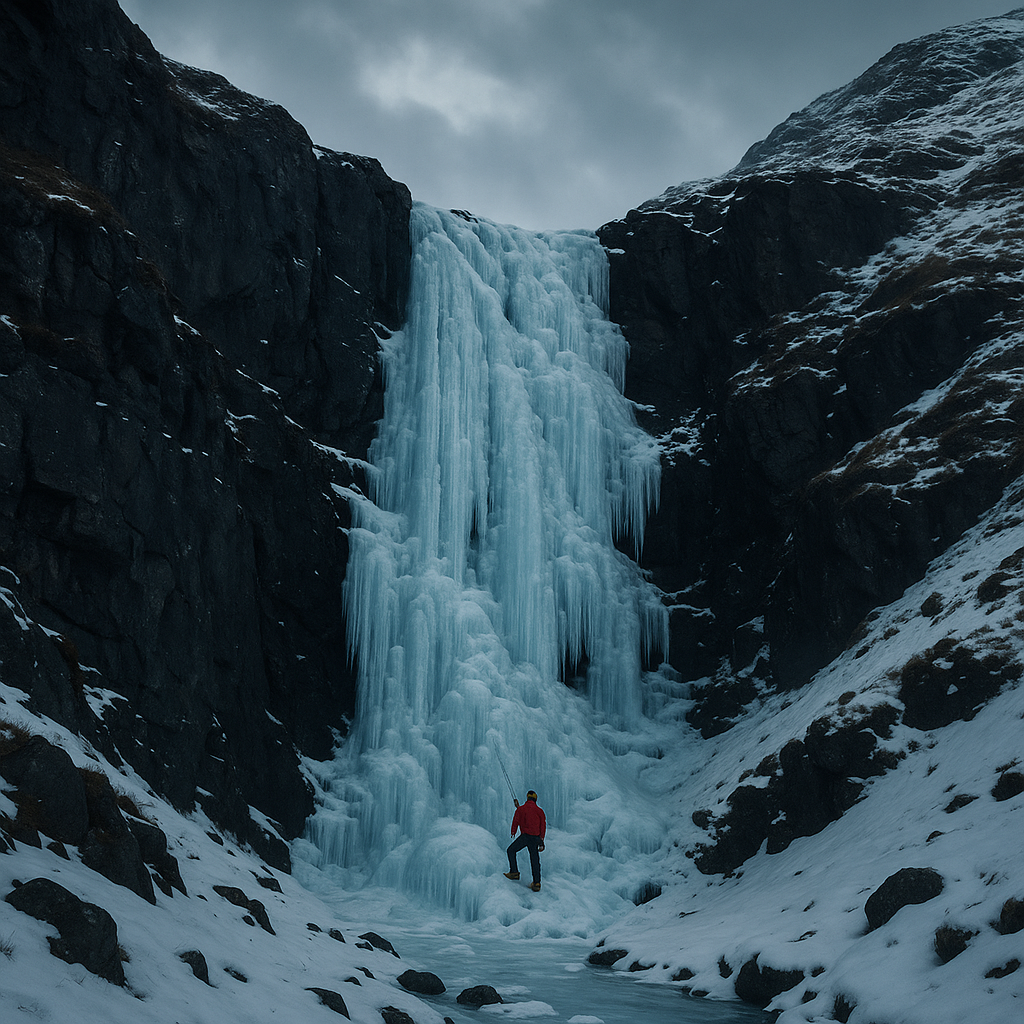
There is a moment, well known to anyone who has stood beneath a frozen waterfall in the Scottish Highlands or the French Alps, when you stop thinking about technique and simply stare. The ice above you is not a solid block. It breathes. Light passes through it in layers, blue deepening to white, white cracking open into clear glass, the whole surface alive with texture and movement, even in stillness. This is ice as a coating on rock: one of the most complex, dynamic, and frankly astonishing natural surface phenomena on earth. And for those of us who spend time outdoors in cold climates, it raises questions that go far beyond the practical matter of where to swing an axe.
Ice climbing has grown steadily as a pursuit in Britain over the past two decades. Scotland’s Cairngorms and Glencoe offer some of the finest winter routes in Europe, routes like Indicator Wall on Ben Nevis or the notorious ice smears of Creag Meagaidh, where a single pitch can reveal more about the behaviour of ice coating extreme environments than any laboratory experiment. Guides and climbers have learnt to read ice the way a sailor reads water: its colour, its porosity, its temperature gradient, its age. That reading matters because ice, on a rock face, is never uniform and never still.
How Ice Actually Forms on Rock: It Is Not What You Think
Most people picture ice as water that has simply frozen. On a rock face, the process is far stranger. A frozen waterfall begins not as a cascade that stops mid-flow, but as a slow accumulation of layers, each one deposited under slightly different conditions of temperature, humidity, and water chemistry. The first ice to form on cold rock is often a thin, transparent glaze called verglas, a word borrowed from French mountaineering. Verglas forms when supercooled water droplets, often from mist or drizzle, contact a surface below 0°C and freeze almost instantly. It is one of the most treacherous ice coating extreme environments can produce: nearly invisible, fantastically slippery, and bonded directly to the mineral surface beneath.
Beneath verglas, the rock itself is doing something interesting. Stone is not a perfect insulator. Granite, for instance, conducts heat at around 2.5 watts per metre per kelvin. In the depths of a Scottish winter, the rock face acts as a slow drain on any thermal energy remaining in the ice above it, pulling temperature down through the coating layer by layer. This thermal gradient means that ice at the surface of a frozen waterfall is often colder and more brittle than ice closer to the rock. Climbers know this. They know that the glassy blue ice near the centre of a pillar, further from the cold air, is often stronger and more trustworthy than the sugary, aerated ice at the edges.
The Living Layers: What Ice Structure Tells Us About Coating Science
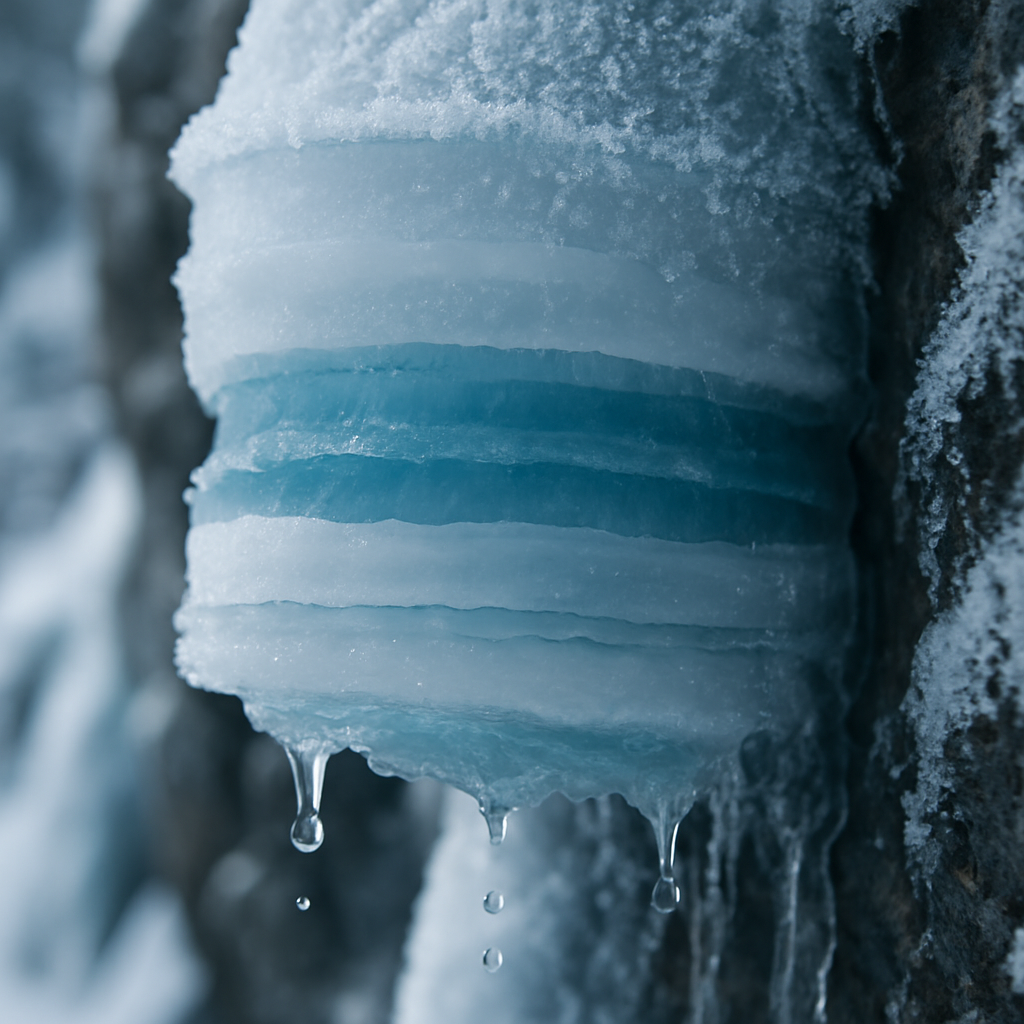
A mature ice formation on a cliff, viewed in cross-section, looks remarkably like a painted surface examined under a microscope. There are distinct strata. At the base, where water trickled and refroze in the earliest frosts of autumn, you find dense, clear ice, sometimes called black ice by climbers because of its near-transparency against dark rock. Above that, layers of progressively more aerated ice, each one a record of a different weather event: a thaw, a fresh freeze, a period of hoarfrost deposition, a spindrift avalanche that plastered fine snow crystals into the existing surface.
Hoarfrost itself deserves a moment. When water vapour passes directly from gas to solid without ever becoming liquid, it deposits as ice crystals with an extraordinary feathery structure. On a rock face, hoarfrost creates a surface coating that looks delicate and ornamental but is actually remarkably insulating. The air trapped within its crystal lattice reduces thermal conductivity dramatically. This is the same principle that makes aerogel so effective as an insulating material, except that hoarfrost builds it spontaneously overnight from nothing but cold air and moisture. Ice coating extreme environments teaches us, again and again, that nature arrives at clever solutions without being asked.
What Ice Climbing Reveals About Adhesion and Failure
Ask any experienced ice climber what they fear most and they will not say falling. They will say dinner-plating. This is the phenomenon where an ice axe strike causes a large disc of surface ice to shear off the underlying layer, like a plate flying from a shelf. The sound is distinctive: a hollow, resonant crack, followed by the unsettling sight of a half-metre disc of ice spinning away into the void. Dinner-plating is a mechanical failure at the adhesion boundary between two ice layers, and it happens when a surface layer has bonded poorly to the one beneath, usually because it formed during a brief thaw and refroze before the interface could integrate properly.
This is directly analogous to problems that affect protective coatings on buildings and structures. Any coating that forms over a contaminated or improperly prepared surface risks delamination under stress. The physics are identical: poor interfacial bonding, stress concentration at the boundary layer, catastrophic shear failure. Nature demonstrates the consequence with particular drama on a vertical ice wall at minus ten degrees Celsius. Materials scientists and coating engineers study these failure modes carefully; what ice does naturally on rock faces provides a controlled, visible model that is hard to replicate in a laboratory.
The British Mountaineering Council has published guidance on understanding ice conditions for winter climbing, and it makes for surprisingly technical reading, covering everything from ice crystal structure to the effect of solar radiation on south-facing gullies. You can find useful resources on winter conditions and safety at the British Mountaineering Council website, which offers a wealth of practical information for anyone heading into the hills in winter.
Rime Ice, Cauliflower Ice, and the Shapes That Cold Air Sculpts
In truly exposed positions, above around 900 metres in Scotland or on any wind-blasted ridge in the Lake District, ice takes on a completely different character. Rime ice forms when supercooled water droplets carried in cloud or freezing fog strike a surface and solidify on contact. Unlike the layered ice of a waterfall, rime builds outwards, against the wind, forming spiky fingers and cauliflower-shaped growths that can add dozens of centimetres of thickness to fence posts, cairns, and cliff edges overnight.
I have stood on the summit plateau of Cairn Gorm after a night of freezing cloud and seen fence posts transformed into white sculptures half a metre wide, pointing directly into the wind like accusatory fingers. The rime ice coating extreme environments create up there is extraordinary: pale, opaque, surprisingly light, yet bonded ferociously to the metal or stone beneath. Its insulating properties are remarkable. The air content in rime can exceed fifty percent by volume, making it one of the most effective natural thermal barriers found anywhere in the terrestrial environment.
The Seasonal Death of Ice: Thaw as a Destructive Coating Event
All of this ice, eventually, comes down. The thaw in a Scottish corrie in late February is not a gentle process. As temperatures rise, meltwater percolates into cracks in the ice layers, the same cracks that formed during cold snaps and freeze-thaw cycles. Water is peculiar in that it expands by roughly nine percent when it freezes, a property that makes it a uniquely powerful wedge. Where meltwater refreezes in a fracture, it levers the ice apart with a force that can shatter rock, let alone ice. Large sections of frozen waterfall detach and fall, sometimes carrying fragments of the rock face with them.
The aftermath reveals something worth pausing over. The rock beneath a season’s worth of ice coating is often noticeably altered. Fine particles have been prised from the surface, edges sharpened, micro-channels deepened. Ice, over centuries, is one of the primary architects of the landscapes we walk through. The Cairngorms plateau, the U-shaped valleys of Snowdonia, the cirques of the Lake District, all of them shaped by this patient, violent, beautiful process: water finding a surface, coating it, expanding, withdrawing, and beginning again.
That cycle, repeated endlessly across millions of winters, is arguably the most consequential natural coating process in Britain’s entire geological story. Ice does not merely sit on rock. It works it, transforms it, and ultimately defines it. For those of us who spend time in the hills, that knowledge sits quietly beneath every step on a frozen path or every swing of an axe into a winter gully. The ice is not a barrier between us and the mountain. It is the mountain, caught mid-sentence.
Frequently Asked Questions
What makes ice on a rock face different from ordinary ice?
Ice on a rock face forms in distinct layers over time, each one reflecting different weather conditions, temperatures, and water chemistry. Unlike ice in a freezer, it contains air pockets, mineral impurities, and structural boundaries between layers, making it a genuinely complex, multi-layered natural coating rather than a uniform solid.
Where can you go ice climbing in the UK?
Scotland offers the best ice climbing in the UK, with classic routes on Ben Nevis, Creag Meagaidh, and in Glencoe and the Cairngorms. The season typically runs from December to March, depending on conditions. The Lake District and Snowdonia occasionally offer shorter ice routes in colder winters.
What is verglas and why is it so dangerous?
Verglas is a thin, transparent layer of ice that forms when supercooled water droplets freeze almost instantly on contact with cold rock. It is dangerous because it is nearly invisible against stone, extremely slippery, and provides almost no purchase for boots or climbing equipment. It is one of the most unpredictable ice coating extreme environments produce.
How does ice damage rock over time?
Water expands by roughly nine percent when it freezes, so meltwater that seeps into rock cracks and then refreezes exerts enormous pressure on the surrounding stone. Repeated freeze-thaw cycles slowly prize rock apart, a process called frost shattering or cryofracture. Over thousands of years, this process has sculpted much of Britain’s upland landscape.
What is hoarfrost and how does it form?
Hoarfrost forms when water vapour converts directly to ice crystals without first becoming liquid, a process called deposition. It creates delicate, feathery crystal structures on cold surfaces and is highly effective as a natural insulating layer due to the large volume of air trapped within its crystal lattice. It typically forms overnight when temperatures drop rapidly in calm, humid conditions.