
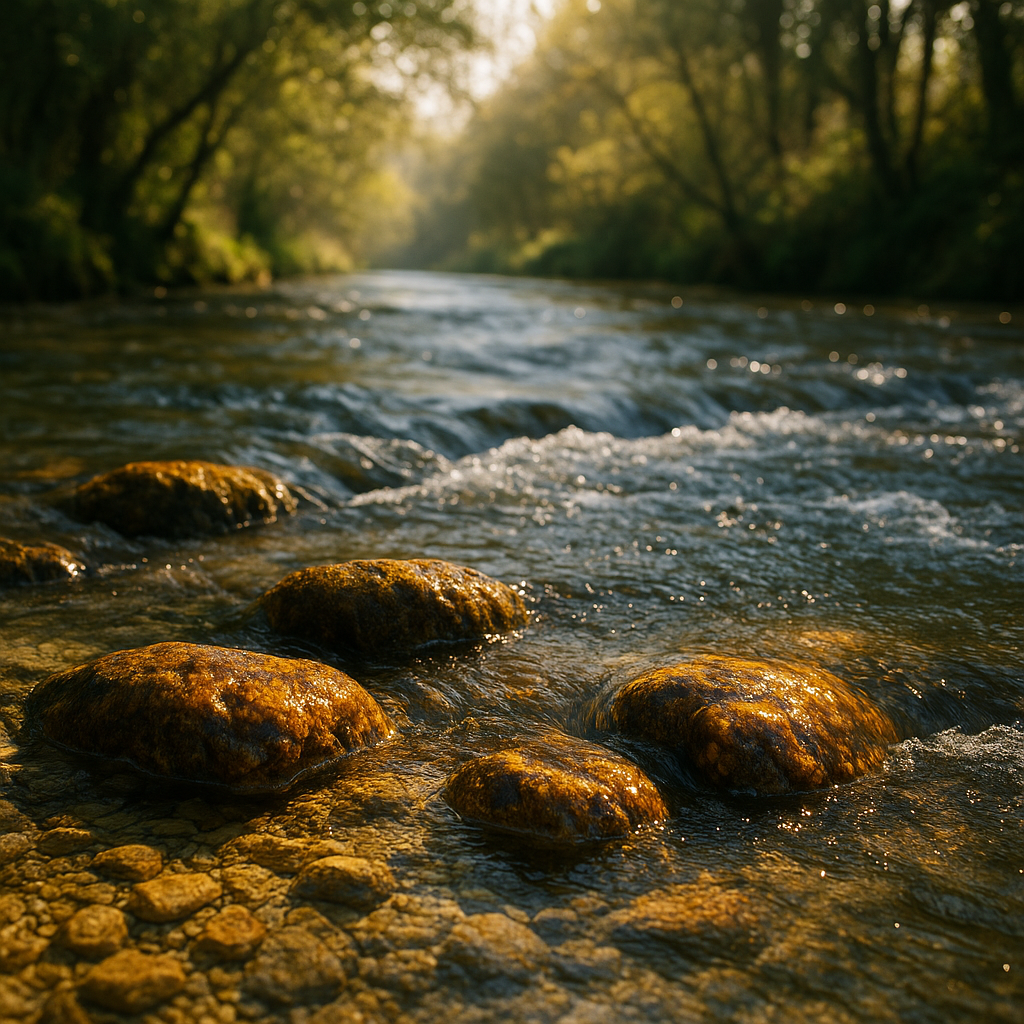
Wade into any British river and within seconds your boots will find a stone that tries to throw you flat on your back. That treacherous slick is not mud, not algae in the way most people picture it, and not some sign that the river is unhealthy. It is a biofilm: one of the oldest, most sophisticated, and frankly most underappreciated coatings on the planet. I have gone over on the River Wye more than once learning this lesson the hard way.
A biofilm is a community of microorganisms, mostly bacteria but often fungi, algae, and protozoa too, that bond together and anchor themselves to a surface using a self-produced matrix of sugars and proteins. Think of it as a city rather than a crowd. Each resident has a role, the structure has districts and communication channels, and the whole thing is astonishingly resistant to the forces that would wipe out any single organism trying to go it alone. The biofilm natural river coating you find on a submerged pebble in a Yorkshire beck is not an accident of nature. It is an engineering marvel built over billions of years of trial and error.
Why river stones are coated in living architecture
When water flows over bare rock, the first thing that happens is not dramatic. A few pioneer bacteria drift in on the current, sense the surface chemistry through hair-like structures called pili, and begin to stick. Within hours they release the first threads of what scientists call extracellular polymeric substances, the biological equivalent of mortar. More organisms arrive. The community diversifies. Within days, what started as a smear of single cells has become a layered, three-dimensional structure with internal channels that circulate nutrients and waste like a rudimentary circulatory system.
On a British chalk stream such as the Test or Itchen in Hampshire, these biofilms are the foundation of everything. Invertebrates graze on them. Those invertebrates feed the brown trout that fly-fishermen travel from across the country to pursue. Remove the biofilm and you do not just lose the slippery stone; you lose the entire food web built above it. The River Test is one of the most celebrated chalk streams in the world, and its legendary clarity owes something, ironically, to the microbial communities working quietly on every stone in its bed.
Glacial boulders and the biofilm at the edge of life
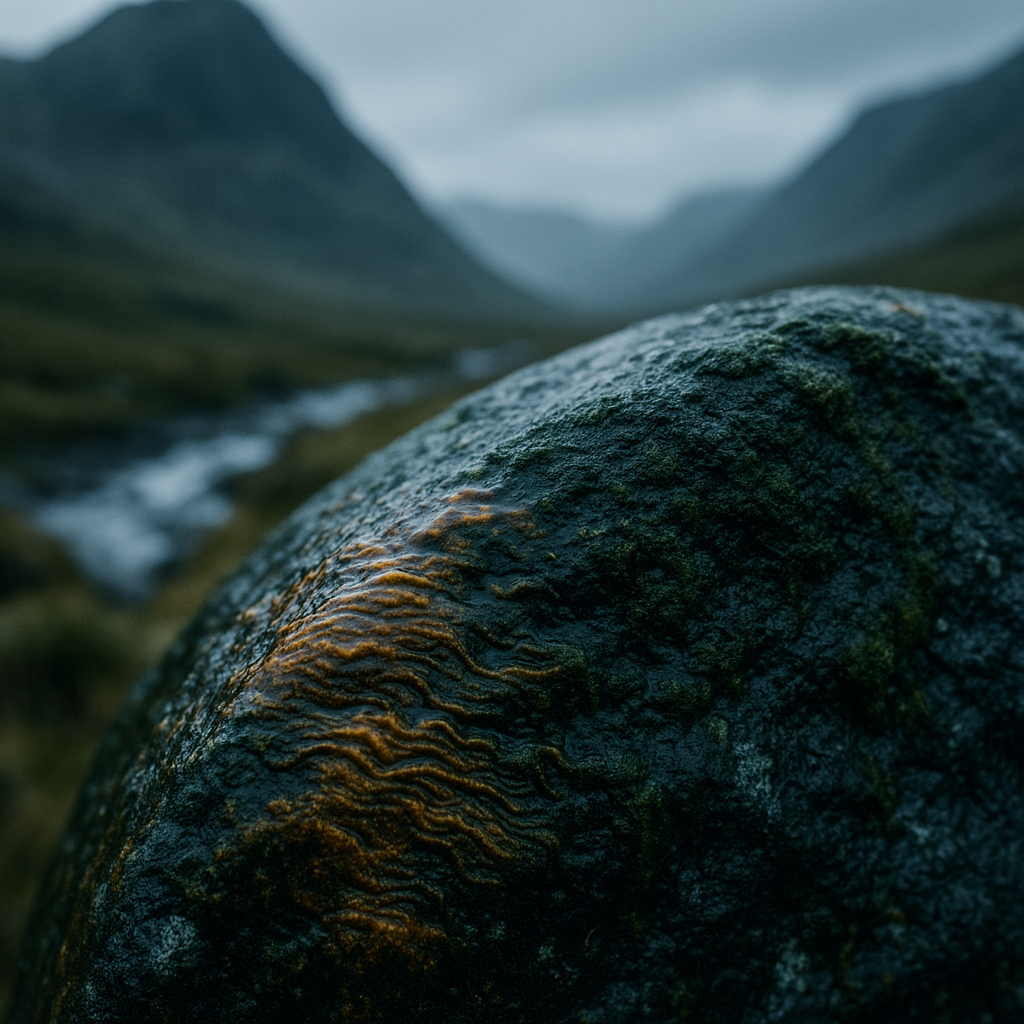
River beds are just one theatre. Travel north to the glacial landscapes of the Scottish Highlands and the same story repeats itself in conditions that feel almost hostile to life. Glacial meltwater is extraordinarily cold, low in nutrients, and carries a grinding load of rock flour that scours surfaces constantly. Yet biofilms persist on boulders at the margins of retreating glaciers such as those in the Cairngorms.
These cold-adapted communities, known as psychrophilic biofilms, produce antifreeze proteins and altered membrane chemistry that keeps them functional at temperatures near 0°C. Researchers studying glacial retreat have found that these biofilms are often the first life to colonise newly exposed rock, arriving before mosses, before soil bacteria, before anything visible to the naked eye. They fix nitrogen, begin the slow dissolution of minerals, and essentially prepare the ground for every other organism that follows. In a very real sense, wherever glaciers retreat and leave bare rock behind, it is the biofilm that arrives first to start building a world.
Deep-sea vents: biofilms at the frontier of the possible
Push further still, down into the permanent darkness of the ocean floor, and biofilms show up in conditions that should, by any common-sense reckoning, be utterly lethal. Around hydrothermal vents in the Atlantic and Pacific, where superheated water laced with hydrogen sulphide jets out of the seabed at temperatures above 100°C, thermophilic biofilms coat every mineral surface available. They do not merely survive. They are the primary producers, the base of a food chain that runs entirely without sunlight.
These communities have attracted serious scientific attention partly because they represent plausible templates for life on other worlds. The European Space Agency has pointed to hydrothermal vent biofilms as one of the strongest arguments for microbial life potentially existing beneath the ice of Jupiter’s moon Europa or Saturn’s Enceladus. The biofilm natural river coating you are scraping off your boot after a walk along the Wye shares deep evolutionary roots with organisms thriving in some of the most extreme environments Earth possesses.
Why biofilms are so extraordinarily hard to remove
Part of what makes biofilms remarkable, and occasionally infuriating to anyone working in water infrastructure, is their stubborn resistance to disruption. The polymer matrix that holds the community together acts as a physical barrier to many antimicrobial agents, reducing the concentration that actually reaches the cells inside by a factor of up to a thousand. Bacteria within a biofilm can also switch into a dormant state when conditions turn hostile, then revive when the threat passes.
Thames Water and other UK utilities spend considerable resources managing biofilm formation inside water pipes, where unchecked growth can affect flow rates and, in rare circumstances, harbour pathogens. The NHS has long-standing guidance on managing biofilm in clinical settings for the same reason. But the irony is that in natural systems, this very stubbornness is a virtue. A biofilm natural river coating that weathers floods, freezing, and mechanical abrasion without being stripped away is providing ecological continuity. It is the constant in a river system that changes with every season.
According to research published and cited by the Natural Environment Research Council, biofilms account for the vast majority of microbial life on Earth by biomass. The free-floating, single-cell bacteria we tend to picture when we think of microbes are, in ecological terms, the exception rather than the rule. Most microorganisms on this planet live in biofilms, on surfaces, in structured communities. That includes the rocks beneath every river in Britain. You can read more about microbial ecology and the research being done across UK freshwater systems via the UK Centre for Ecology and Hydrology, which monitors freshwater biodiversity across the country.
The hidden beauty in the slime
There is an aesthetic dimension to all this that I find genuinely compelling. Under a microscope, mature biofilms have a visual complexity that rivals coral reefs in miniature. Towers of cells rise from the base layer, separated by water channels. Bioluminescent species create faint glows in marine biofilms. Pigment-producing bacteria in certain river biofilms create golden and russet tones on limestone that, from a distance, look like the rock itself has been stained by some mineral process.
In fact, the distinction between a geological coating and a biological one is far blurrier than most people assume. Desert varnish, the dark patina on canyon walls that I have written about before, contains a significant biological component. Lichen, which I find endlessly fascinating, is itself a kind of macroscopic biofilm: a partnership between fungi and photosynthetic organisms building a shared protective structure. Nature does not make a sharp division between the living and the mineral world. It blurs that line at every opportunity, and biofilms are where that blurring begins.
Next time you slip on a river stone, take a moment before the swearing starts. You have just met one of the oldest life forms on Earth, a natural coating system that predates plants, animals, and even the ozone layer. It is older than the hills. Considerably slipperier, too.
Frequently Asked Questions
What is a biofilm and why does it form on river stones?
A biofilm is a structured community of microorganisms that attach to surfaces and produce a protective matrix of sugars and proteins. On river stones, bacteria sense the surface and begin anchoring within hours, eventually building a layered community that forms the base of the river’s food web.
Is the slippery coating on river rocks dangerous or a sign of pollution?
Not usually. The biofilm natural river coating on submerged stones is a normal and healthy part of river ecology. It indicates the presence of a functioning microbial community that supports invertebrates and fish. In fact, its absence can sometimes signal a problem rather than its presence.
How do biofilms survive in extreme environments like glaciers or deep-sea vents?
Biofilms in extreme environments evolve specialised chemistry, producing antifreeze proteins in cold glacial settings and heat-resistant structures near hydrothermal vents. The collective nature of the biofilm also provides physical protection that individual cells could never achieve alone.
Why are biofilms so difficult to remove from surfaces?
The polymer matrix surrounding the biofilm community blocks antimicrobials and physical abrasion far more effectively than single cells can manage. Some studies suggest bacteria inside a mature biofilm can withstand up to a thousand times the concentration of antimicrobial agent needed to kill free-floating equivalents.
Are biofilms important to the UK's freshwater ecosystems?
Yes, profoundly so. In rivers like the Test and Itchen, biofilms underpin the entire invertebrate and fish food web. The UK Centre for Ecology and Hydrology monitors freshwater microbial communities as part of broader freshwater health assessments, recognising their role as a cornerstone of river biodiversity.