
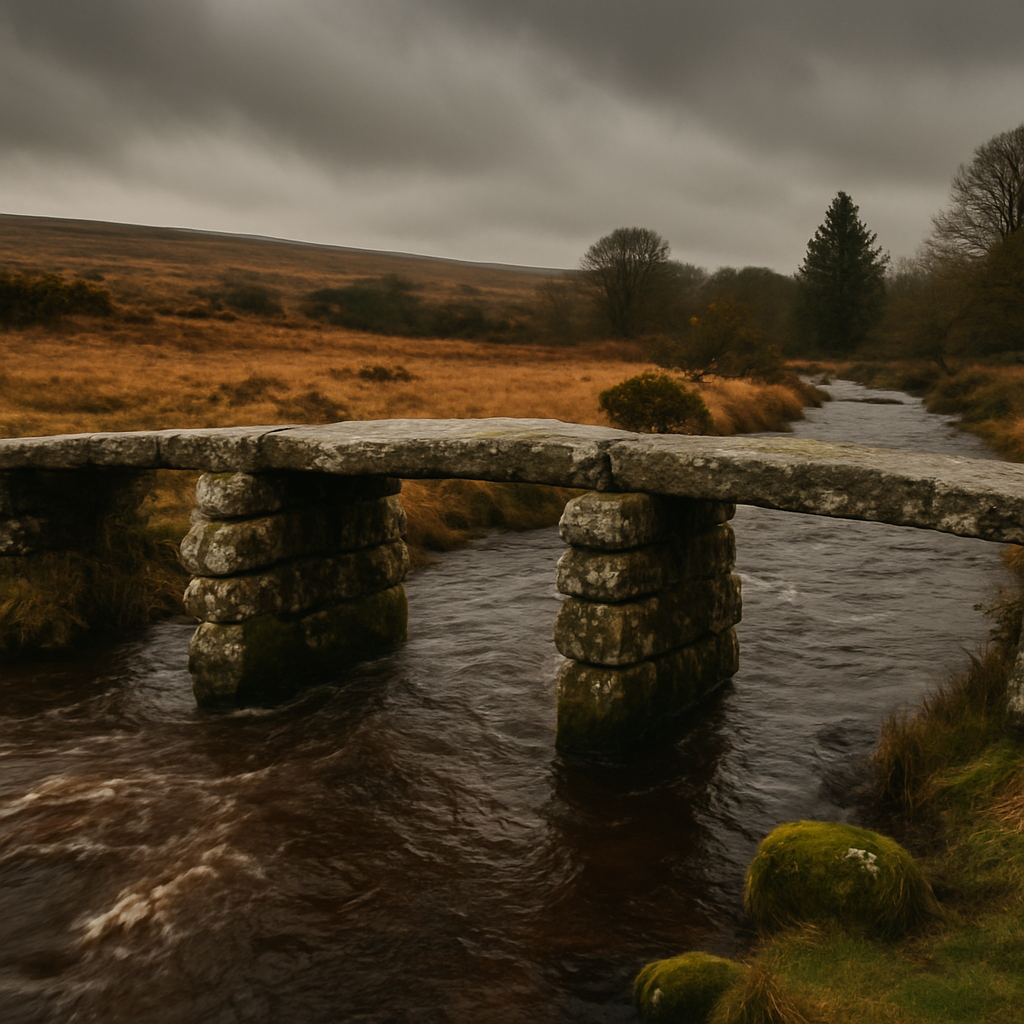
There is a bridge on Dartmoor that has been standing since the reign of Edward I. No mortar. No bolts. No scaffold erected by some Tudor engineer. Just slabs of granite, laid flat across a river, and left entirely to the mercy of the south-west English weather. That weather, for the uninitiated, is considerable. Dartmoor receives more than 2,000 millimetres of rainfall a year in its higher reaches, the wind comes off the Atlantic with a kind of personal grievance, and the temperature swings can take you from frost to drizzle to briefly glorious sunshine before lunch.
And yet there they stand. Postbridge. Dartmeet. Scorriton. Some of these clapper bridges are at least 700 years old, possibly older. Dartmoor clapper bridges ancient stone preservation is not a phrase that has historically appeared in engineering journals, and perhaps that is exactly the problem. We’ve been asking the wrong question. Instead of wondering how humans preserved them, we ought to be asking what happened on the surface of those granite slabs when nobody was looking.
What exactly are clapper bridges, and why granite?
The word “clapper” likely derives from the Latin claperius, meaning a pile of stones. These are the most basic bridges imaginable: large flat granite slabs, sometimes weighing several tonnes apiece, rested horizontally across stone piers or directly onto river boulders. They were almost certainly built by medieval tinners and farmers needing reliable river crossings on the high moor. No arches, no keystones, no Roman engineering cleverness. Just the brute mass of Dartmoor granite doing what granite has always done: enduring.
Granite is not the hardest rock on earth, but it is extraordinarily resistant to weathering. It is igneous, formed deep underground from slowly cooling magma, and its interlocking crystal structure of quartz, feldspar and mica makes it extremely difficult for water to penetrate. But granite alone does not explain the longevity of these structures. Plenty of granite surfaces across Britain have degraded, spalled, stained and crumbled under persistent damp and freeze-thaw cycles. Something else is happening on Dartmoor’s clapper bridges. Something biological.
The living coat: algae, moss and mineral crusts on ancient stone
Walk up to Postbridge clapper bridge on a grey October morning and press your palm flat against the top of a granite slab. What you feel is not bare rock. It is a layered biological community built up over decades, possibly centuries, into something that functions remarkably like a protective membrane.
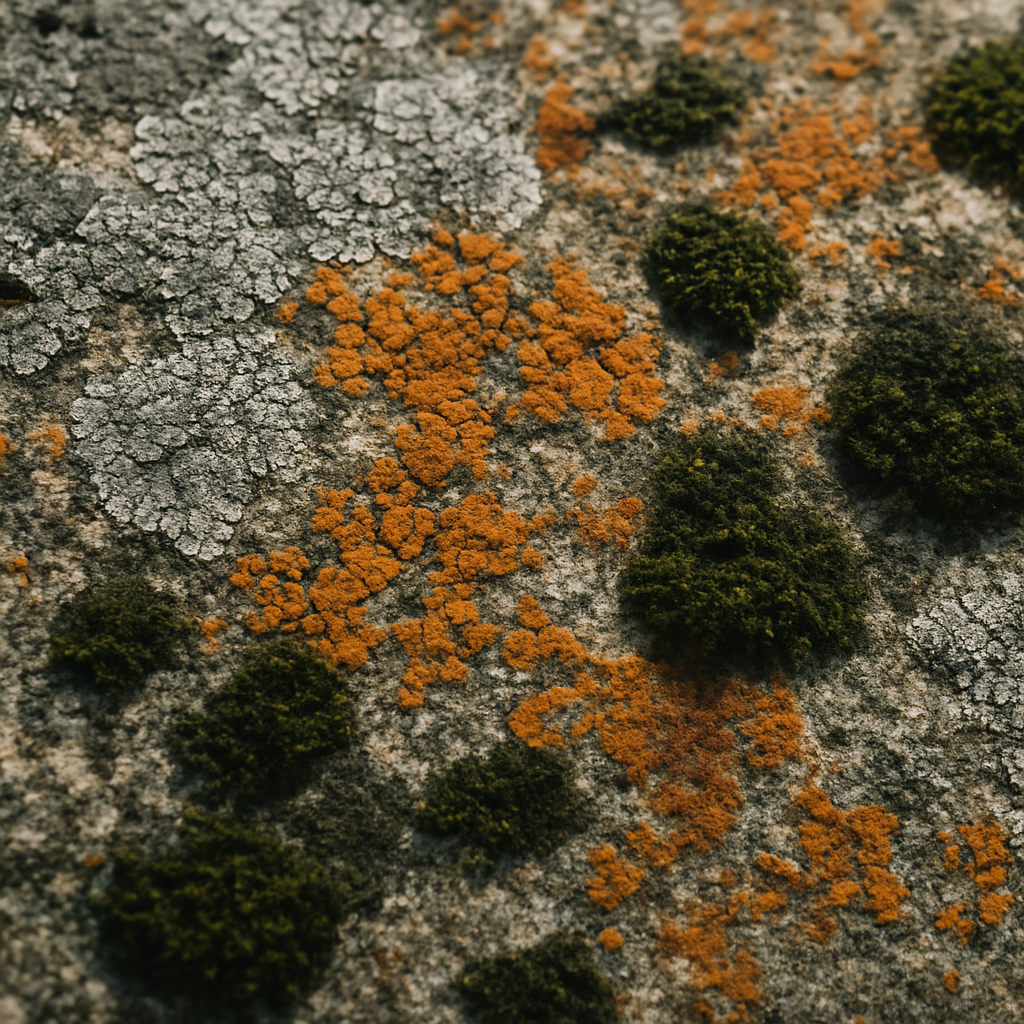
The outer layer is often a thin film of epilithic algae, the kind of greenish-grey biological patina that most people either ignore or mistake for dirt. Below that, mosses have established themselves in the pits and fissures. Further still, crustose lichens have chemically bonded with the stone surface itself, their hyphae penetrating several millimetres into the granite matrix. Then there are the mineral deposits: iron oxides, silica, calcium compounds leached from the rock over centuries and redeposited on the outer surface by evaporating water.
Together, these layers form what soil scientists call a biological soil crust when it occurs on terrestrial ground. On stone, the equivalent is sometimes called a biological rock crust or biofilm crust. Call it what you like. What it does is rather extraordinary. It seals micro-fractures. It moderates the rate at which water enters and exits the stone surface. It reduces the amplitude of temperature swings at the rock face itself. And, crucially, it makes the surface less hospitable to the kind of rapid biological colonisation by faster-growing organisms that would actually damage the stone.
How biological crusts actually protect stone rather than destroy it
There is a common assumption, especially among building owners and conservation officers, that anything growing on a stone surface is bad news. Moss holds water, people say. Algae makes things slippery. Lichens are dissolving the granite beneath. All of these things are partially true, and yet the full picture is rather more interesting.
Lichens are famously acidic. They produce oxalic acid and other organic compounds that do very slowly etch into stone surfaces. But what this etching actually creates, over a long timeframe, is a slightly roughened, chemically altered surface layer that is more resistant to physical weathering than the original face. The lichen essentially trades a thin film of rock for a much more durable outer skin. It is, in a loose sense, nature’s equivalent of a keying treatment before a topcoat.
The moss layer above that serves a different purpose. Rather than acting as a sponge that saturates the stone, an established moss layer on a well-drained granite surface can actually regulate moisture absorption. It absorbs the first burst of rainfall, holding it away from direct stone contact, then releases it gradually. The stone beneath never experiences the rapid wetting and drying cycles that cause the most mechanical damage. Dartmoor gets a lot of rain, but the clapper bridge slabs are largely not getting wet in the dangerous way that bare stone would.
Research published by Historic England, which oversees the conservation of ancient monuments across the country, has increasingly recognised that hasty removal of biological growth from historic stonework can do more harm than leaving it undisturbed. Their guidance notes on practical building conservation for stone acknowledge that established biological communities on ancient masonry can provide genuine protective value.
The mineral deposits: Dartmoor’s own version of desert varnish
Beyond the biological element, Dartmoor’s clapper bridges have accumulated something else over the centuries: a thin, hard mineral crust on many of their exposed upper surfaces. This is similar in mechanism, if not in composition, to the desert varnish found on canyon walls in arid regions. Water carrying dissolved minerals migrates to the surface and evaporates, leaving those minerals behind. Over hundreds of years, this creates a harder, denser outer shell on the stone.
On the clapper bridges, the dominant minerals in this surface accumulation are typically silica and iron compounds, both of which are present in abundance in Dartmoor granite as it weathers slowly from below. Iron staining gives some of the older slabs their characteristic russet and orange tones, which most visitors assume is simply the natural colour of the rock. In fact, you are looking at centuries of mineralogical history deposited one molecule at a time by Dartmoor rain.
What eight centuries of survival actually tells us
I’ve walked across Postbridge clapper bridge a good many times over the years, in all kinds of weather. In January with ice on the granite and the East Dart running fast and brown below. In August when you could sit on the downstream edge and watch the water and not feel cold. It has never once occurred to me that the bridge was fragile. It feels ancient in the way that only things that have genuinely earned their age can feel.
Dartmoor clapper bridges ancient stone preservation, as a subject, carries a lesson that sits rather awkwardly alongside the human instinct to intervene, restore and improve. These structures have outlasted countless engineered alternatives precisely because they were left largely alone. The biological skin that has formed on their surfaces is not contamination. It is continuity. It is the accumulated result of a slow, patient conversation between stone, water, living organisms and time.
Modern conservation science is gradually catching up with what the moor has known for centuries. The best thing you can do for an ancient granite surface, in many cases, is to understand what is already happening on it before you reach for a pressure washer or a chemical treatment. Nature rarely wastes effort. What looks like neglect, on a Dartmoor clapper bridge, has often been the most sophisticated form of preservation imaginable.
The bridges will probably still be standing when our own era’s engineering is long forgotten. There is something quietly humbling about that.
Frequently Asked Questions
How old are the clapper bridges on Dartmoor?
Most of Dartmoor’s clapper bridges are believed to date from the medieval period, with some estimates placing their construction between the 13th and 15th centuries. Postbridge clapper bridge is often cited as one of the finest examples and is thought to be at least 700 years old, though precise dating of unmortared granite structures is difficult.
What is biological stone crust and does it damage granite?
Biological stone crust is a layered community of algae, mosses, lichens and mineral deposits that forms on exposed rock surfaces over time. On ancient granite like Dartmoor’s clapper bridges, this crust can actually protect the stone by sealing micro-fractures, regulating moisture absorption and reducing damaging freeze-thaw cycles, rather than simply degrading the surface.
Can you walk on Dartmoor's clapper bridges today?
Yes, most of Dartmoor’s clapper bridges are accessible on foot and remain in use. Postbridge and Dartmeet are two of the most visited, both reachable via public footpaths on the moor. Visitors are asked to treat the structures with care and avoid disturbing the biological crust on the stone surfaces.
Why does Dartmoor granite last longer than other building stones?
Dartmoor granite is an igneous rock with a tightly interlocking crystal structure of quartz, feldspar and mica, making it highly resistant to water penetration and physical weathering. Its natural durability is enhanced over centuries by the formation of biological and mineral crusts on exposed surfaces, which add an additional layer of protection.
Is removing moss and lichen from ancient stone bridges a good idea?
Conservation guidance from Historic England increasingly cautions against the routine removal of established biological growth from ancient stonework. On structures like Dartmoor’s clapper bridges, mature lichen and moss communities can provide genuine protective benefit, and their removal can expose the underlying stone to accelerated weathering.