

There is a moment, just after rain hits dry ground, when the air changes. Something lifts from the earth. It is one of the oldest smells a human nose can recognise, and yet most people would struggle to name it. Petrichor. The word was coined by Australian geologists in 1964, but the phenomenon itself is as old as soil. And once you begin unpicking the chemistry behind it, you start to realise that petrichor and forest volatile compounds are doing something far stranger and more important than simply smelling pleasant.
I have stood on the edge of Dartmoor in late summer, just as the first fat drops of a storm hit the baked peat, and felt that smell hit the back of my throat like something physical. It is earthy, faintly sweet, almost metallic. Ancient, somehow. What I was breathing in, without knowing it at the time, was a cocktail of geology, microbiology, and plant chemistry that had been assembling itself in the soil for weeks, waiting for exactly that moment of release.
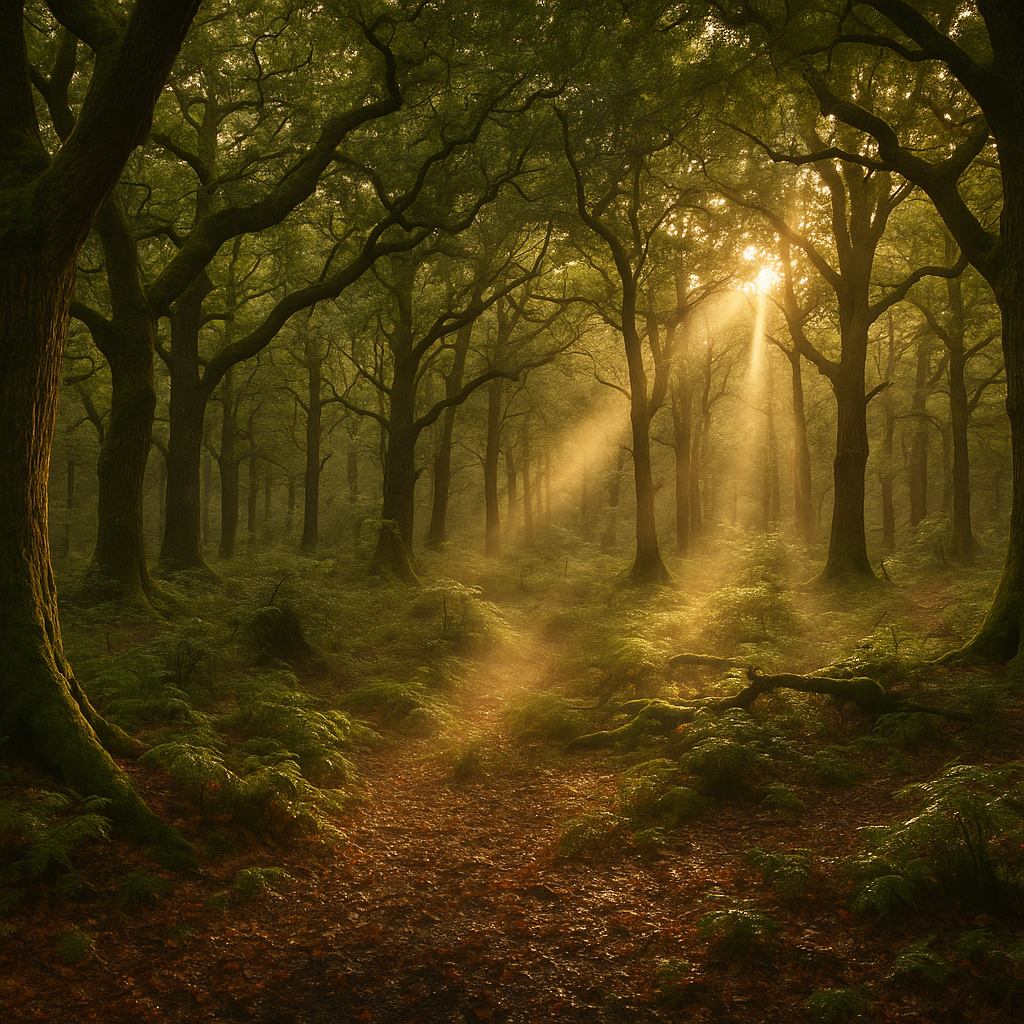
What actually is petrichor, and where does it come from?
The dominant compound in that first hit of rain-smell is geosmin. It is produced by a family of soil bacteria called actinomycetes, and it is extraordinarily potent. The human nose can detect it at concentrations of around five parts per trillion. That is, by some calculations, more sensitive than a shark detecting blood in water. Geosmin is not accidental. There is a growing body of evidence suggesting that it acts as a signalling compound, drawing springtails and other soil invertebrates toward the bacteria that produce it. The bacteria hitch a ride. The invertebrates spread spores. Rain becomes a mechanism for reproduction, and geosmin is the advertisement.
Alongside geosmin, a second compound called 2-methylisoborneol joins the mix, adding a damp, almost mossy note. Then there are the plant oils. Many plants, particularly those with aromatic foliage like thyme, lavender, and the heathland scrub of upland Britain, release oils during dry spells that bind to soil and mineral surfaces. When rain arrives, these oils are displaced and aerosolised. You are, in a very literal sense, breathing in a natural coating that the landscape has been accumulating during the drought.
Forests as chemical factories: the role of biogenic volatile organic compounds
Beyond the soil, the canopy above is doing something equally remarkable. Trees, particularly broadleaf species like oak and beech, constantly release biogenic volatile organic compounds, or BVOCs, into the atmosphere. Isoprene is the most abundant. Monoterpenes follow close behind. Collectively, forests produce roughly half of all the volatile organic compounds entering the atmosphere globally each year, and petrichor and forest volatile compounds are deeply intertwined with this process.
These are not waste products. They serve several functions. Some act as chemical defences, repelling insects or warning neighbouring trees of herbivore attack. Others appear to play a role in thermoregulation, helping leaves cope with heat stress. But the atmospheric effects are where things get genuinely surprising. BVOCs react with hydroxyl radicals and nitrogen oxides in the atmosphere to form secondary organic aerosols, tiny airborne particles that become the nuclei around which water droplets condense. In other words, forests help manufacture their own clouds. They seed their own rain.

Research published by the University of Leeds has shown that in regions like the Congo Basin and the Amazon, BVOC emissions from forest canopies have a measurable effect on local precipitation patterns. Remove the trees, and you do not just lose shade and carbon storage. You disrupt the chemical plumbing of the rain cycle itself. The forest, it turns out, is partly responsible for the very rain that releases petrichor from its own soil. There is something deeply satisfying about that loop.
What forest air does to the human body
The Japanese have a practice called shinrin-yoku, which translates roughly as forest bathing. It has been part of their public health framework since the 1980s, and the science behind it has grown considerably more robust in recent years. Part of the benefit comes from the simple act of being away from noise and artificial light. But part of it is chemical. Phytoncides, a class of antimicrobial BVOCs released primarily by conifers, have been shown in studies by Qing Li and colleagues at Nippon Medical School to increase natural killer cell activity in the human immune system. You breathe them in. They change your blood.
In Britain, the Forestry Commission has begun incorporating wellbeing language into its management guidance for woodlands, recognising that the social value of forests extends beyond timber and carbon. A walk through a wet oak wood in the Lake District is not merely pleasant. It is, in a measurable physiological sense, restorative. The compounds hanging in that damp air are doing things to your body that a walk along a city pavement simply cannot replicate.
There is a broader point here about how we value what we cannot see. The volatile chemistry of a healthy forest canopy is invisible, odourless for much of the time, and completely unquantifiable without specialist equipment. Yet it influences weather, supports biodiversity, and shapes human health. It is a kind of coating that the living world applies to the atmosphere itself. I find it genuinely humbling that we are still finding new things to learn about it. Educational institutions working on environmental literacy are increasingly drawing connections between forest science and practical sustainability, and some of the most ambitious work is happening at a local level, including through initiatives like a climate action plan for schools in London, which seeks to build exactly this kind of ecological understanding into the next generation.
Why biodiversity changes what you smell
Not all forests smell the same. Scots pine produces a resinous hit of alpha-pinene and beta-pinene that is almost architectural in its clarity. Ancient oak woodland gives you something darker, earthier, loaded with terpenes and the faint bitterness of tannins. A chalk downland after rain smells different again, sharper, flinty, with the limestone itself contributing to the aerosol chemistry. The smell of a place is a biological fingerprint.
This matters because declining biodiversity means declining chemical complexity. A plantation of a single conifer species produces a narrower, simpler BVOC signature than an ancient mixed woodland. The atmospheric effects are correspondingly reduced. Fewer species of ground beetle and springtail means less geosmin in the soil profile. The petrichor weakens. It is one of the stranger ways in which biodiversity loss makes itself felt, not through something dramatic, but through a gradual impoverishment of sensory experience that most people cannot name and therefore cannot mourn.
The Forest Research agency, part of the Forestry Commission, has been building datasets on BVOC emissions from British woodland types for several years now, contributing to a broader European picture of how native species mixes influence local atmospheric chemistry. It is painstaking, unglamorous science, but the implications are significant for land management policy.
A coating the planet applies to itself
I keep coming back to the idea of coatings when I think about petrichor and forest volatile compounds. The living world layers chemistry onto the atmosphere the way a craftsman layers varnish onto wood, building up protection, regulating exchange, creating a surface that mediates between the inside and the outside. Rain is the solvent that dissolves that coating briefly, releasing everything it has accumulated, and that release is what we call petrichor.
Next time it rains after a dry spell, particularly if you happen to be near woodland or heathland, stop for a moment. Breathe in slowly. What you are smelling is not just pleasant countryside air. It is a living system’s chemical memory, briefly made visible by water. There are entire ecological relationships encoded in that smell, hundreds of millions of years of co-evolution between bacteria, plants, insects, and rain. And researchers are still, genuinely, only beginning to understand it.
Frequently Asked Questions
What causes petrichor, the smell of rain on dry ground?
Petrichor is caused primarily by geosmin, a compound produced by soil bacteria called actinomycetes, combined with plant oils that accumulate in dry soil and are aerosolised when rain hits. Secondary contributors include 2-methylisoborneol and various volatile organic compounds released by surrounding vegetation. The human nose is extraordinarily sensitive to geosmin, detecting it at concentrations of just a few parts per trillion.
What are biogenic volatile organic compounds and why do forests release them?
Biogenic volatile organic compounds (BVOCs) are naturally occurring chemicals emitted by trees and other vegetation, with isoprene and monoterpenes being the most common. Forests release them as chemical defences, stress responses, and inter-plant communication signals. They also have a significant atmospheric role, reacting with other compounds to form aerosol particles that seed cloud formation and contribute to local precipitation patterns.
Do forest volatile compounds actually affect human health?
There is growing scientific evidence that phytoncides, a class of antimicrobial volatile compounds released mainly by conifers, can increase natural killer cell activity in the human immune system when inhaled during time spent in woodland. Japanese research into shinrin-yoku (forest bathing) has documented measurable physiological benefits linked in part to this chemical exposure. The Forestry Commission in Britain has begun acknowledging the wellbeing value of woodland in its management guidance.
Why does the smell of rain vary between different landscapes?
The scent of rain on different landscapes changes because the volatile chemistry of soil and vegetation varies significantly between habitats. Scots pine produces sharp resinous compounds like alpha-pinene, whereas ancient oak woodland releases earthier terpene and tannin-based molecules, and chalk downland adds mineral aerosols from limestone. Biodiversity directly influences the complexity of these chemical signatures.
How does forest chemistry influence rainfall and weather patterns?
BVOC emissions from forest canopies react with atmospheric compounds to form secondary organic aerosols, tiny particles that act as condensation nuclei for water droplets and help form clouds. Research from institutions including the University of Leeds has shown that high-canopy forests like those in the Congo Basin and Amazon measurably influence local precipitation through this mechanism. Deforestation therefore disrupts not just carbon storage but the chemical processes that sustain regional rainfall cycles.
Leave a Reply