

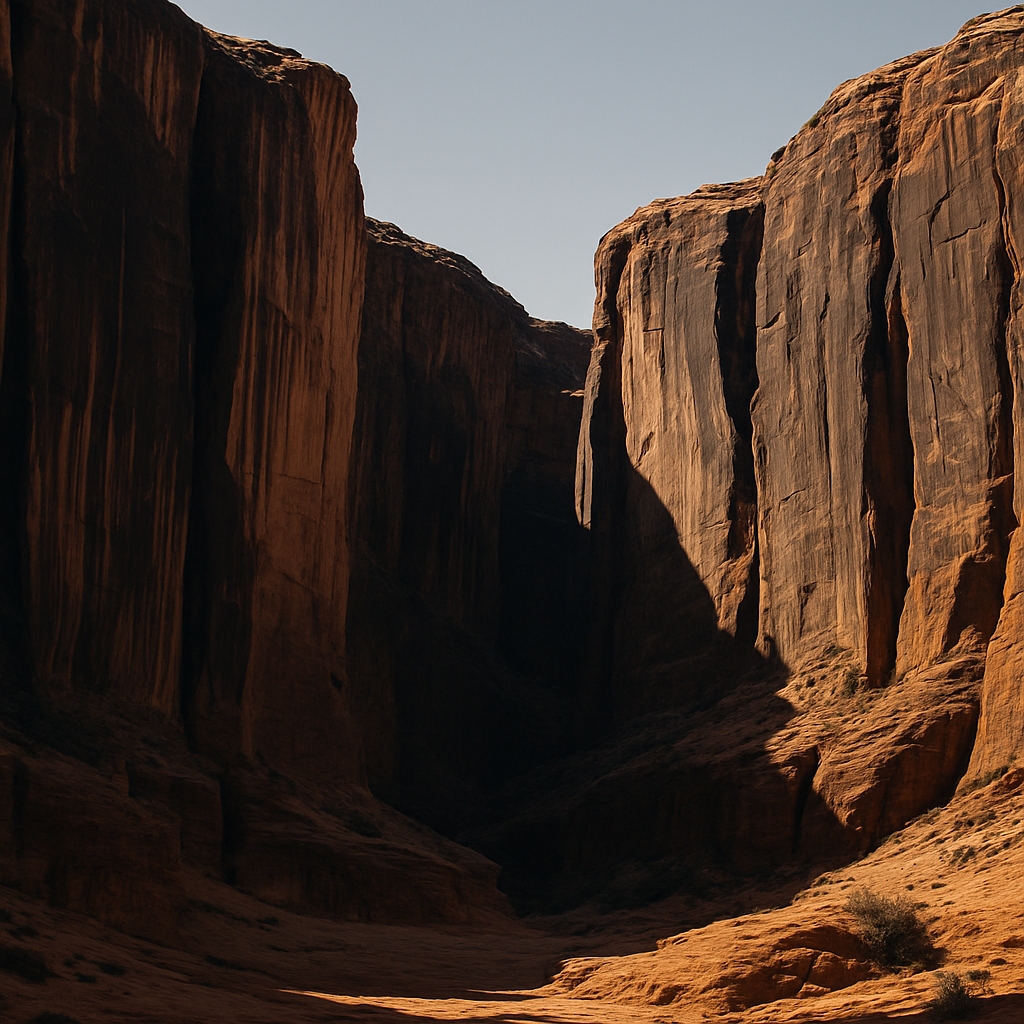
Stand at the rim of a canyon in the American Southwest, or along the rocky escarpments of the Sahara, or even in parts of the Australian outback, and you’ll notice something peculiar. The rock faces are dark. Not the natural grey or sandstone orange you might expect, but a deep, almost chocolatey brown-black glaze, as though someone has painted the cliffs with a very old, very patient hand. That coating has a name: desert varnish. And it is, without question, one of the most quietly extraordinary natural phenomena on the planet.
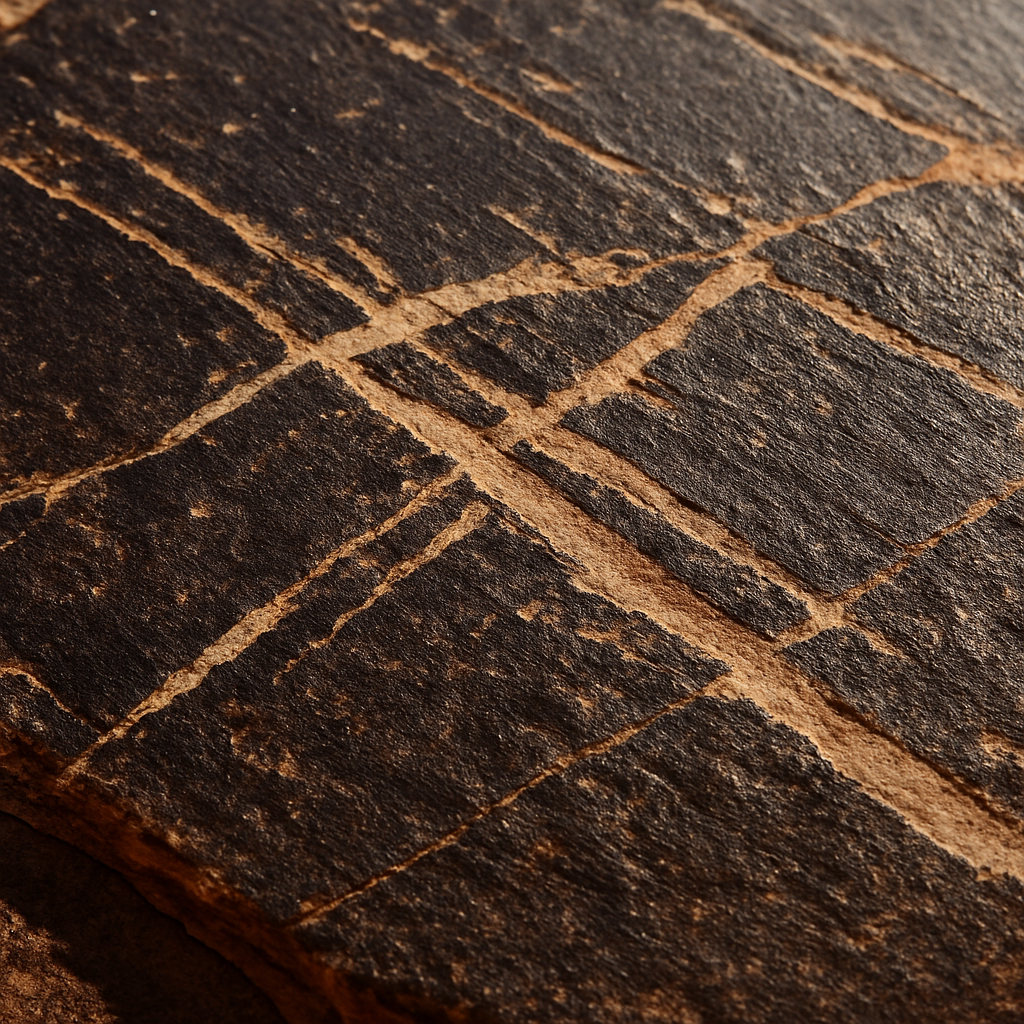
I first came across the subject properly while reading about Ancestral Puebloan petroglyphs in the Colorado Plateau. Those ancient carvings were made by scratching through the dark surface to reveal the lighter rock beneath, using the varnish itself as a canvas. The coating had to be thick enough, stable enough, and old enough to serve as a background for messages meant to last millennia. It made me think: what exactly is this stuff?
What Is Desert Varnish and Where Does It Form?
Desert varnish is a thin, hard coating that accumulates on exposed rock surfaces in arid and semi-arid environments. It’s typically between 10 and 500 micrometres thick, which sounds negligible, but given that it builds up at a rate of roughly one micrometre per thousand years, even a modest-looking layer represents an almost incomprehensible span of time. The coating is predominantly composed of clay minerals, manganese, and iron oxides. The manganese content, in particular, is what gives it that distinctive dark lustre, almost like a natural patina on aged bronze.
You’ll find it in the American Southwest most famously, on the walls of the Grand Canyon, in Zion, in Monument Valley. But desert varnish appears globally wherever the conditions are right: the Negev Desert in Israel, the Atacama in South America, the rocky plateaus of central Australia, and the gravel plains of the Sahara. Britain, being rather damp and green, doesn’t offer ideal conditions, but analogous biological surface films do appear on exposed stone in Scotland’s northwest Highlands, which is a thought worth sitting with.
How Does Desert Varnish Actually Form? The Debate That Won’t Die
Here’s where things get genuinely interesting, and genuinely contentious. Scientists have been studying desert varnish for well over a century, and there is still no settled consensus on exactly how it forms. Three main theories have competed for dominance, each with its own body of evidence and its own passionate defenders.
The first and most widely accepted explanation is biological. Certain species of bacteria and fungi, extremophiles adapted to desiccation and intense UV exposure, are thought to concentrate manganese from dust particles and rainwater, essentially fixing it onto the rock surface through metabolic processes. This microbial hypothesis gained serious traction in the 1980s and remains the frontrunner. The manganese concentrations found in desert varnish are many times higher than in the surrounding dust and rock, which strongly suggests an active concentrating mechanism rather than simple passive deposition.
The second theory is purely geochemical. Proponents argue that thin films of water, even in deserts where rain is rare, carry manganese and iron in solution and deposit them on rock surfaces as they evaporate. The rock heats and cools dramatically over a day, and this cycling could drive mineral migration to the surface. It’s a tidy explanation, and it doesn’t require any living organisms. But it struggles to account for the sheer enrichment of manganese observed.
The third theory blends both: a two-stage model where geochemical processes concentrate the raw materials and biological activity then locks them into place. Many researchers now lean towards this kind of hybrid explanation, accepting that nature rarely operates through a single clean mechanism. As the British Geological Survey has noted in its work on surface mineral films, the interplay between biological and abiotic processes in rock weathering is far more intricate than early models suggested. You can read more about mineral surface processes through the British Geological Survey.
The Manganese Mystery: Why So Much of It?
The manganese question deserves its own moment. In the surrounding dust and soil, manganese might make up 0.1 percent of the composition. In desert varnish, it can reach 30 percent or more. That is an enrichment factor in the hundreds. No known purely physical process concentrates an element to that degree. It almost has to involve biology. And yet isolating and culturing the specific microorganisms responsible has proved maddening. Some researchers have identified Mn-oxidising bacteria of the genus Metallogenium; others dispute those findings. The microbes are there, but their precise role in building the varnish layer by layer remains stubbornly unclear.
What we do know is that the process is extraordinarily slow and extraordinarily stable. Once formed, desert varnish is harder than the rock it coats in many cases. It resists erosion, UV radiation, and temperature extremes that would destroy most organic materials. As a natural protective surface coating, it is humbling. We make industrial coatings that last decades with great effort. Desert varnish lasts hundreds of thousands of years without any help at all.
Desert Varnish as a Record of Ancient Climate
One of the more remarkable applications of desert varnish research is palaeoclimatology. The layers within the varnish, visible under electron microscopy, vary in composition depending on conditions at the time of their formation. Wetter periods tend to deposit lighter-coloured layers rich in silicon and aluminium. Drier periods produce the dark manganese-rich bands. Reading those layers is a bit like reading tree rings, except instead of years, you’re reading epochs. Some varnish sequences provide climate records stretching back 200,000 years or more.
For researchers trying to understand how arid environments respond to climate cycles, this is invaluable. The rock itself becomes an archive. And those Ancestral Puebloan petroglyphs I mentioned earlier? The fact that they were carved through the varnish rather than added to it tells us that the coating was already thick and old by the time humans first picked up a stone tool and scratched their stories into it. The canvas was ancient before the art began.
What Desert Varnish Teaches Us About Protective Coatings
There’s something almost philosophical about studying desert varnish if, like me, you spend a fair amount of time thinking about how surfaces are protected in the natural world. Every coating, whether biological or industrial, is ultimately a response to environmental stress. The varnish is the rock’s answer to UV radiation, to temperature shock, to the abrasive kiss of windborne sand. It didn’t evolve, exactly, but it emerged. Slowly. Patiently. Over geological time.
The principle that microorganisms might be recruited, consciously or otherwise, to create functional surface coatings is one that materials scientists are actively exploring. Biomineralisation research has opened up fascinating possibilities. And for those of us watching from the sidelines, there’s a pleasing irony that the most durable coating ever documented was produced not in a laboratory, not by an industrial process, but by single-celled organisms living on a sunbaked cliff face with no tools, no funding, and certainly no plan. If you’re working on your own projects and thinking about how specialists present environmental research and ideas online, it’s worth knowing that services exist to help you Make my own website and share that knowledge effectively.
Desert varnish remains one of those subjects that rewards obsession. The more you read, the more questions accumulate, and the more you find yourself staring at old rock faces with fresh respect. It is geology and biology and chemistry and time, all compressed into a layer you could scratch away with a fingernail. Which is rather extraordinary, if you stop to think about it.
Frequently Asked Questions
What is desert varnish made of?
Desert varnish is a thin mineral coating composed primarily of clay minerals, iron oxides, and manganese oxides. The high concentration of manganese, which can reach 30 percent or more, gives it its characteristic dark brown-black colour and is thought to be concentrated by microbial activity.
How long does desert varnish take to form?
Desert varnish accumulates extremely slowly, at roughly one micrometre per thousand years in most arid environments. Even a relatively thin coating of 100 micrometres can therefore represent over 100,000 years of accumulation, making it one of the slowest-forming natural surface films known to science.
Where can you find desert varnish in the world?
Desert varnish is found on exposed rock surfaces across the world’s major arid zones, including the American Southwest, the Sahara, the Atacama Desert in South America, the Negev Desert in Israel, and the rocky plains of central Australia. It forms most readily where rocks receive strong sunlight and experience dramatic daily temperature swings.
Why do scientists disagree about how desert varnish forms?
The main dispute centres on whether desert varnish is produced by microbial activity, purely geochemical water evaporation processes, or a combination of both. The extreme enrichment of manganese relative to surrounding dust strongly implies biological concentration, but isolating and proving the specific organisms responsible has proven difficult, keeping the debate alive.
Can desert varnish be used to date rock surfaces or study ancient climate?
Yes. The layered structure within desert varnish acts as a climate archive: dark manganese-rich layers indicate drier periods, while lighter silica-rich layers suggest wetter conditions. Scientists use this record, combined with other dating techniques, to reconstruct climate history stretching back hundreds of thousands of years.
Leave a Reply