
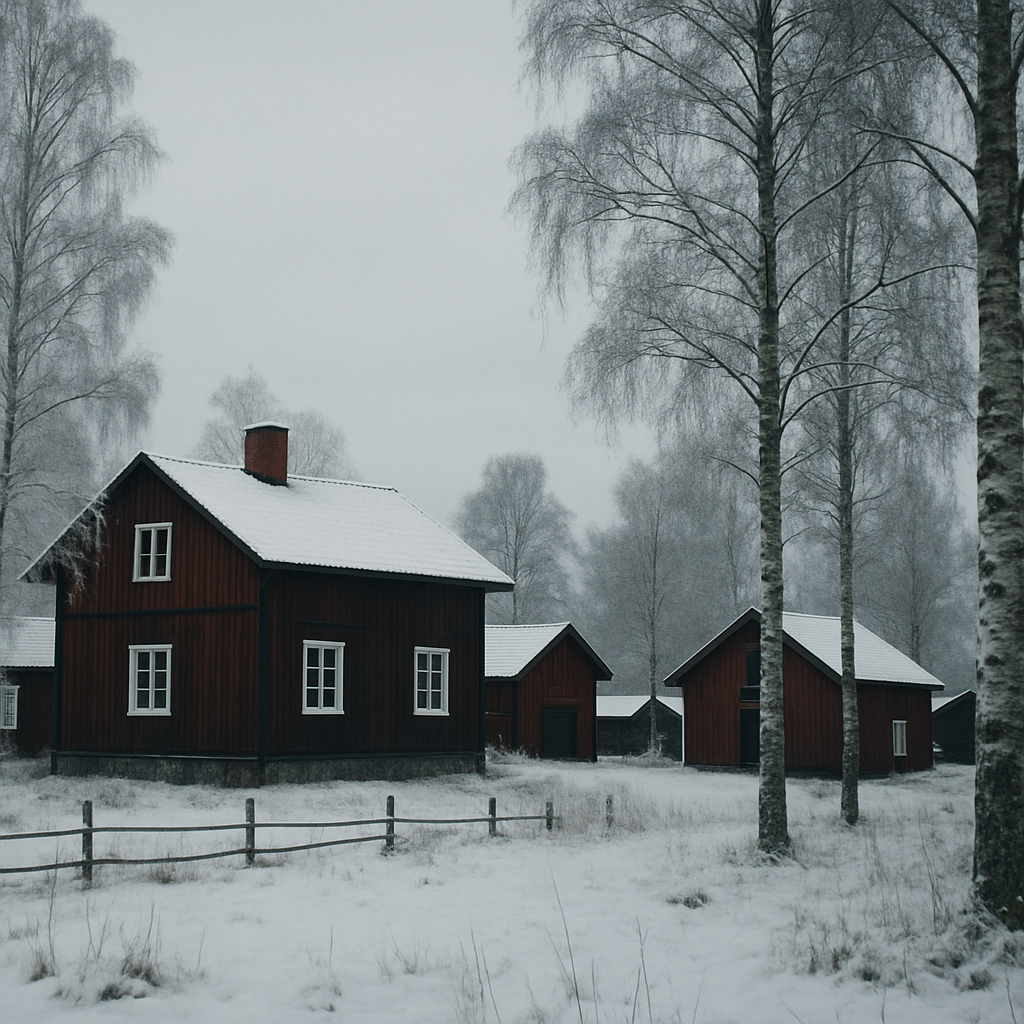
There is something immediately arresting about a deep red barn standing against a grey Scandinavian sky, or glimpsed between birch trees with snow settling on its roof. That particular shade, a dark and earthy crimson, is one of the most recognisable colours in all of northern Europe. But where did it come from? The answer lies several hundred metres underground, in a copper mine in central Sweden, and it connects geology, chemistry, and centuries of rural ingenuity in a way that still resonates today for anyone thinking seriously about traditional natural exterior paint.
A Mine That Coloured a Continent
The Falun mine, known in Swedish as Falu gruva, sits in the Dalarna region of central Sweden. It has been worked for at least a thousand years, quite possibly longer. At its peak in the seventeenth century, it produced something like two thirds of all the copper used in Europe. Swedish warships, church roofs from Stockholm to Tallinn, coins across the Baltic world: the Falun mine underpinned an empire, and the waste it produced changed the landscape of an entire continent.
That waste, a reddish powder of iron oxides, copper compounds, zinc silicate and various sulphates, was initially just a nuisance. It piled up outside the mine entrance in great ochre-coloured heaps. Then somebody, and history has not preserved their name, noticed that when this residue was mixed with linseed oil and rye flour, it produced a paint of extraordinary durability. A paint that soaked deep into timber, repelled moisture, resisted rot, and aged beautifully to a rich, velvety red. The Swedes called it Falurött. The rest of Scandinavia simply called it red.
Why Farmers Chose Red: The Practical Truth
Romantic stories sometimes suggest that Swedish farmers painted their homes red to imitate the brick mansions of the aristocracy, a kind of rural aspiration made permanent in paint. There is probably something to that. Red brick was the building material of prestige across seventeenth and eighteenth century Sweden, and a timber farmhouse slathered in deep red certainly carried a certain social signal.
But the practical case was at least as compelling. Falun red was cheap, because the raw pigment was literally a by-product. It was readily available, because the mine was connected to a vast distribution network across Scandinavia and the Baltic. And it worked. The combination of iron oxide pigment, boiled linseed oil and rye flour created a traditional natural exterior paint that formed a flexible, breathable film on timber, hardening gradually as the linseed oil polymerised in contact with air. Unlike modern synthetic coatings, it did not trap moisture inside the wood. It allowed the timber to breathe, which, in a climate of long damp winters and brief fierce summers, was exactly what you needed.
What Goes Into Falun Red, Chemically Speaking
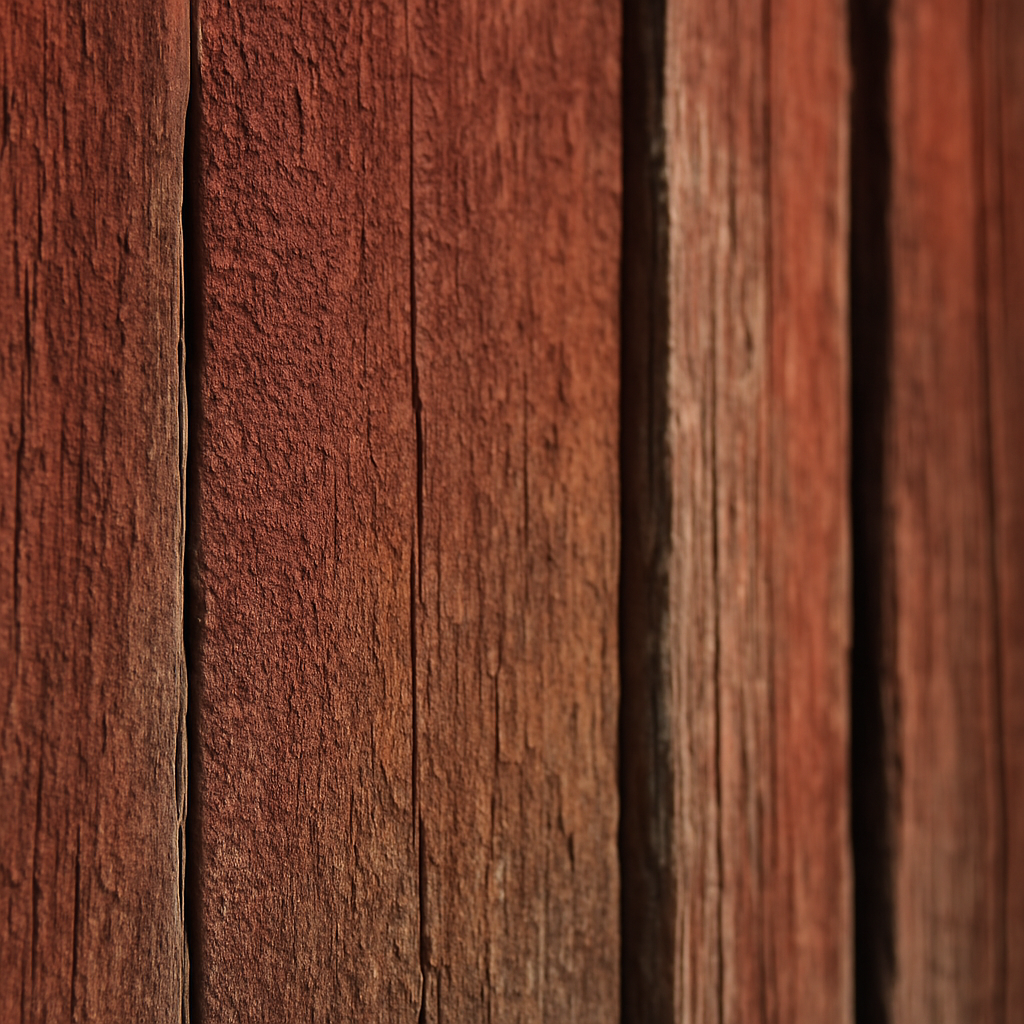
The specific mineral cocktail that gives Falun red its character is worth understanding. The dominant pigment is red iron oxide, essentially the same material that gives rust its colour, but in a stable, finely ground form. This is supplemented by smaller quantities of zinc and copper compounds, both of which contribute mild fungicidal and antibacterial properties. The rye flour acts as a thickener and helps the paint bind to rough-sawn timber. The linseed oil is the binder, curing slowly to a tough but flexible resin.
This formulation is, in modern parlance, entirely natural. No petrochemicals, no synthetic polymers, no biocides of industrial origin. It sits very comfortably in the same tradition as other traditional natural exterior paints used across Europe, from limewash on British cottages to red ochre on Viking longhouses. The Falun mine has been recognised by UNESCO as a World Heritage Site in part because of this cultural legacy, the way a single geological accident produced a paint tradition that shaped the visual identity of an entire region for hundreds of years.
The Environmental Legacy: Complicated, But Honest
Mining is never a clean business, and Falun was no exception. The smelting process that extracted copper also released vast quantities of sulphur dioxide, and historical accounts describe entire hillsides stripped bare by acid rain centuries before that phrase entered common usage. The landscape immediately around Falun still bears the marks of this. Strange, almost lunar expanses of reddish spoil heaps surround the old mine workings.
And yet the paint itself represents something genuinely worth thinking about in our current moment. Falun red is biodegradable. Its pigments are mineral, not synthetic. The oil binder is pressed from flaxseed grown in open fields. When a barn coated in Falun red eventually weathers down, it leaves behind iron oxide and organic matter. Nothing that would concern the Environment Agency. Compare that to the microplastic residue shed by many modern exterior coatings, and the old Swedish recipe starts to look rather enlightened.
In Britain, there is a growing interest in this kind of thinking. The push towards natural building materials, breathable paints, and low-impact maintenance for older properties has brought genuine renewed attention to formulations not unlike Falun red. Heritage organisations including Historic England have long advocated for breathable, natural finishes on traditional masonry and timber, for exactly the reasons Swedish farmers understood intuitively three hundred years ago.
Falun Red Today: Still Made, Still Used
The Falun mine ceased large-scale copper production in 1992, but the paint is still manufactured using ore residues and similar mineral compounds. A Swedish company, Faluns Rödfärg, continues to produce the original formulation, and demand has quietly grown in recent years as interest in traditional natural exterior paint has revived across Scandinavia and beyond. In Sweden, around 800,000 litres of Falun red are sold annually. That is not a niche craft product. That is a living tradition.
You see it everywhere in rural Sweden and Norway: on boat sheds jutting out over dark fjords, on sagging old barns in forested valleys, on summer cottages clustered around lakes. The colour does something interesting as it ages. Fresh Falun red is a vivid brick-crimson, but within a few seasons it mellows and darkens, the surface taking on a dry, powdery texture that seems to absorb light rather than reflect it. Old Falun red on very old timber looks almost like something that grew there rather than something that was applied. Which is, in a way, the whole point of a traditional natural exterior paint. It belongs to the landscape.
What Britain Can Learn From the Red Barn
We have our own traditions in this country, of course. Limewash on Cotswold stone, ochre on Suffolk flint, tar on weatherboarding along the Kent and Essex coasts. These are all regional expressions of the same underlying logic: use what the local geology and climate provide, protect the building, let it breathe, let it age gracefully. The Swedish farmers who mixed their Falun red by the barrel-load every spring were not making an aesthetic statement first and a practical one second. They were doing what worked, with what they had. The aesthetics followed naturally, as they always do when a material genuinely fits its purpose.
That is a lesson worth holding onto, particularly as the building and maintenance industries face growing pressure to reduce embodied carbon and chemical complexity. The most interesting solutions are often the oldest ones, looked at again with fresh eyes.
Frequently Asked Questions
What is Falun red paint made from?
Falun red is a traditional natural exterior paint made from iron oxide-rich mine residue from the Falun copper mine in Sweden, mixed with boiled linseed oil and rye flour. The mineral pigment gives it its distinctive deep red colour, whilst the linseed oil acts as a curing binder that soaks into the timber grain.
Why did Scandinavian farmers paint their barns red?
There were two main reasons: social and practical. Red paint mimicked the fashionable red brick of wealthy Swedish estates, but more importantly, Falun red was cheap, widely available as a mining by-product, and genuinely excellent at protecting timber from moisture and rot in the harsh Scandinavian climate.
Is traditional natural exterior paint better for older buildings?
For timber and masonry built before the twentieth century, breathable natural paints are generally recommended by heritage bodies including Historic England. Unlike many modern synthetic coatings, natural paints do not trap moisture inside the substrate, which reduces the risk of rot, damp, and structural damage over time.
Can you still buy Falun red paint in the UK?
Yes, Falun red paint is available from several Scandinavian-style or natural paint suppliers operating in the UK, and can also be ordered directly from Swedish manufacturers. It is used both on heritage buildings and by those seeking a low-impact, naturally derived exterior finish.
How long does traditional natural exterior paint last on timber?
Falun red and similar oil-based natural paints typically need reapplication every five to ten years depending on exposure, which is broadly comparable to quality modern paints. Because the paint penetrates the timber rather than forming a surface film, it tends to weather gradually and evenly rather than peeling or cracking.