
Step into somewhere like Oakham Castle in Rutland, or the great hall at Penshurst Place in Kent, and your eyes go straight to the roof. Up there, in the dimness, are oak beams so old they pre-date the printing press. And they are black. Not painted black, not stained black with any product a merchant ever sold. Black in a way that took centuries to happen, one fire at a time, one winter at a time, one generation of cooks and dogs and tallow candles at a time.
The question nobody seems to ask is: why are those beams still there? Oak is tough, yes. But oak in a damp English climate, exposed to thermal cycling, insect pressure and the sheer weight of history, should not look this good after five or six hundred years. The answer, it turns out, is the grime itself. That blackened surface is one of the most effective examples of accidental medieval hall timber surface protection England has ever produced.
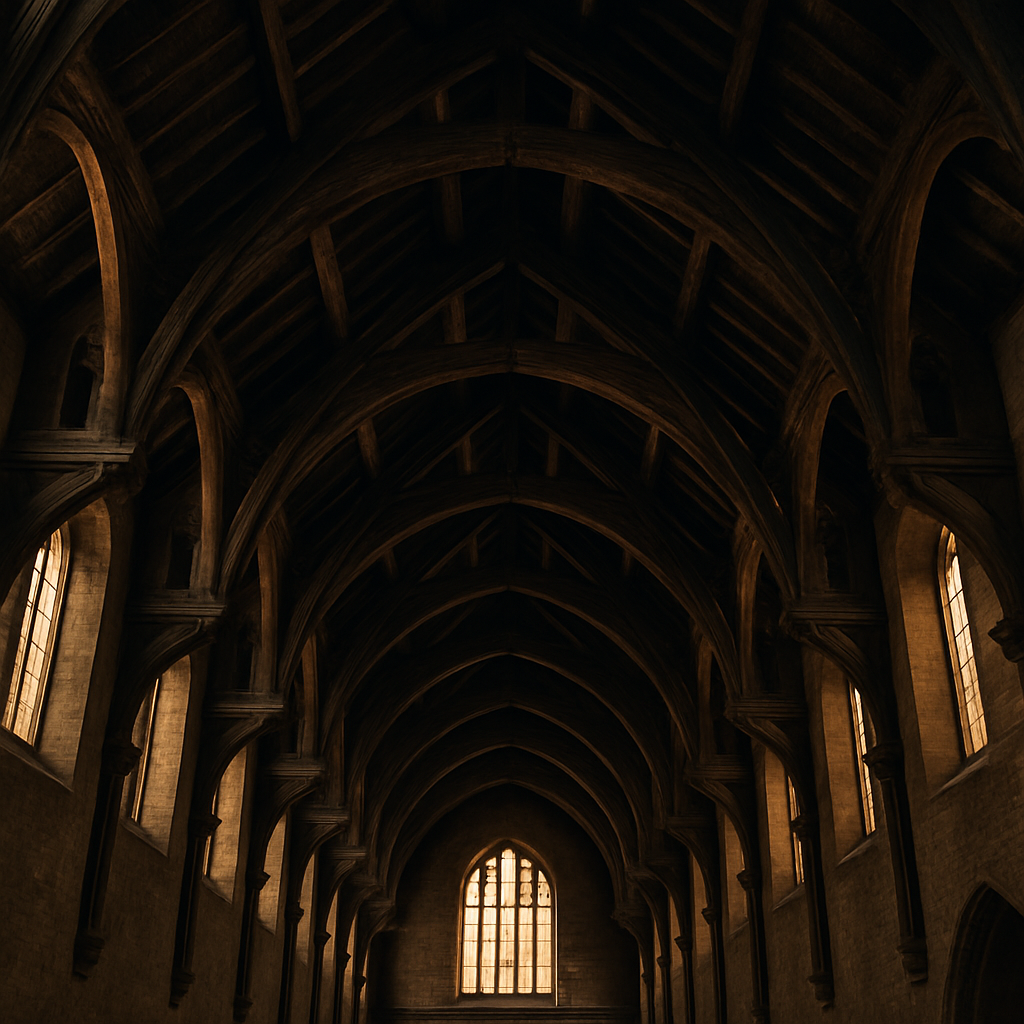
What is actually on those beams?
The coating is not a single substance. It is a stratigraphic record of habitation, laid down in layers thinner than a human hair, compounding over decades into something remarkably complex. At its base, there is the original heartwood of the oak, dense with tannins. On top of that, a layer of pyrolytic carbon from wood smoke, essentially the same substance as charcoal, deposited slowly from the air rather than burned in. Above that, organic fats: tallow from rush-lights and candles, grease splattered from open hearths, lanolin carried in the fleece of animals sheltering in bad winters. Then more smoke. Then more fat. Then the resins that drip from pine torches. Then the oils from human hands, gripping the same ladder rungs and door posts for generations.
Each layer is impermeable to water on its own. Together, they form something close to a biological varnish: hydrophobic, flexible, and packed with antimicrobial compounds that actively suppress the moulds and beetles that destroy untreated timber.
Why wood smoke is a better preservative than most people realise
Smoke contains hundreds of volatile compounds, including phenols, creosols, and guaiacol. Any smokehouse operator could tell you this; it is why smoked meat keeps. The same chemistry happens at a much slower pace when a hall fire burns for centuries beneath an open timber roof. The phenolic compounds in wood smoke are potent fungicides and bactericides. Slowly, over time, they saturate the outer grain of the timber, making the wood hostile to the organisms that would otherwise digest it.
Oak already contains natural tannins that discourage insect attack. Smoke-treatment amplifies this effect considerably. Researchers studying preserved medieval timbers have found that the surface layers of heavily smoked beams show significantly reduced evidence of beetle larvae compared with comparable timbers from dryer, less-used spaces. The great hall, paradoxically, was better protected than the chapel or the solar because it was dirtier and smokier.
The role of animal fat in medieval hall timber surface protection England
Tallow gets a bad press historically. It smoked, it smelled, it attracted rats. But as a timber treatment it is genuinely remarkable. Animal fat fills the cellular structure of wood, displacing water and preventing the swelling-and-shrinking cycle that causes cracking and checking. Viking shipbuilders knew this; they worked fat into their clinker planks. Farmers in the Lake District were rubbing fat into their barn timbers well into the twentieth century as a matter of routine. The great halls of England received their tallow passively, through the simple act of living, and the result was a continuous, self-renewing oil treatment applied across centuries.
The key word is continuous. Modern timber treatments, however good, are applied once or twice and then left to weather. The medieval hall received fresh deposits of organic material every single day. A coating that is constantly being refreshed does not fail in the way a single application does.
What happens when you try to clean it off?
This is where the story gets uncomfortable. In the nineteenth century, the Victorians developed a passion for restoration. Medieval buildings were scrubbed, repainted, and in many cases stripped of what was deemed unsightly grime. Some of the beams cleaned during this period deteriorated significantly within a generation. Conservators working on English Heritage properties have noted repeatedly that timbers left with their historic surface layers intact are in measurably better condition than comparable timbers that were cleaned or re-treated. The accidental coating, it turns out, is also irreplaceable.
English Heritage’s guidance on timber conservation now explicitly discourages aggressive cleaning of historic surfaces, and the reasoning is partly chemical. You cannot replicate five hundred years of slow deposition with a single application of boiled linseed oil, however good your intentions are. The layered complexity of the original surface is itself the protection. For more context on conservation approaches to historic buildings, Historic England’s technical guidance on buildings is a useful starting point.
The chemistry the Victorians accidentally undid
Modern materials science has a term for what the medieval surface represents: a graded interface. Rather than a hard boundary between wood and air, the ancient coating creates a gradient, moving gradually from the dense heartwood through increasingly organic-rich layers to the outermost pyrolytic deposit. Graded interfaces are extraordinarily good at absorbing stress. They flex rather than crack. They distribute impact rather than concentrating it at a single failure point.
Engineers spend considerable effort and money trying to create graded interfaces in industrial coatings. The great hall achieved the same thing by accident, over the course of several human lifetimes, at a cost of nothing more than the smoke from the fire that kept everyone warm.
Which halls still show this best?
Penshurst Place in Kent has one of the finest surviving fourteenth-century great halls in England, with its original chestnut timber roof largely intact. The hall at Stokesay Castle in Shropshire, cared for by English Heritage, retains much of its medieval character. Westminster Hall, though largely stripped over the centuries, still has its extraordinary hammerbeam roof dating to the 1390s. In each case, the portions of timber least interfered with show the darkest, most complex surface deposits, and the best structural condition.
It is worth going to look at these places not just for the history, but for the surfaces themselves. Run your eye along a beam and you are looking at the compressed record of human habitation: every meal cooked, every winter survived, every candle burned. Medieval hall timber surface protection England-style was not a craft, not a trade, not a product. It was just life, leaving its mark on wood, and wood being the better for it.
There is something quietly astonishing about that. The most durable protective coating these timbers ever received was never applied by anyone. It simply accumulated, the way sediment does, the way patina does, the way time does its work on everything it touches long enough.
Frequently Asked Questions
What makes the blackened surface on medieval oak beams so protective?
The dark surface is a combination of pyrolytic carbon from wood smoke, animal fats from tallow and cooking, and organic resins from torches and pine. Together these layers create a hydrophobic, antimicrobial coating that repels water and actively discourages the fungi and beetles that would otherwise degrade the timber over centuries.
How old are the surviving great hall timbers in England?
Some of the oldest surviving great hall roofs in England date to the thirteenth and fourteenth centuries, making the timbers between 600 and 800 years old. Notable examples include the roof at Westminster Hall (1390s), Penshurst Place (1341), and Stokesay Castle (late thirteenth century).
Can modern timber treatments replicate what centuries of smoke and fat achieved?
Not fully. The medieval surface is a graded, multi-layered deposit built up continuously over hundreds of years. Modern treatments, even very good ones, are applied once and then left to weather. Conservators generally agree that the complexity and depth of the historic coating cannot be reproduced artificially in a single or even repeated application.
Is it safe to clean or restore medieval hall beams?
Conservation guidance from Historic England and English Heritage strongly discourages aggressive cleaning of historic timber surfaces. Timbers that were scrubbed during Victorian restoration campaigns often deteriorated more quickly than those left with their original deposits intact. Light, careful consolidation is preferred over stripping.
Why did open fires in medieval halls help preserve the roof timbers?
Open hearths produced continuous smoke that rose and permeated the roof structure. The phenolic compounds in wood smoke are natural fungicides and bactericides that saturate the outer grain of timber over time, making it hostile to the organisms that cause decay. Combined with the rising heat that kept the roof space dry, the fire was doing protective work that went far beyond simply warming the room.