
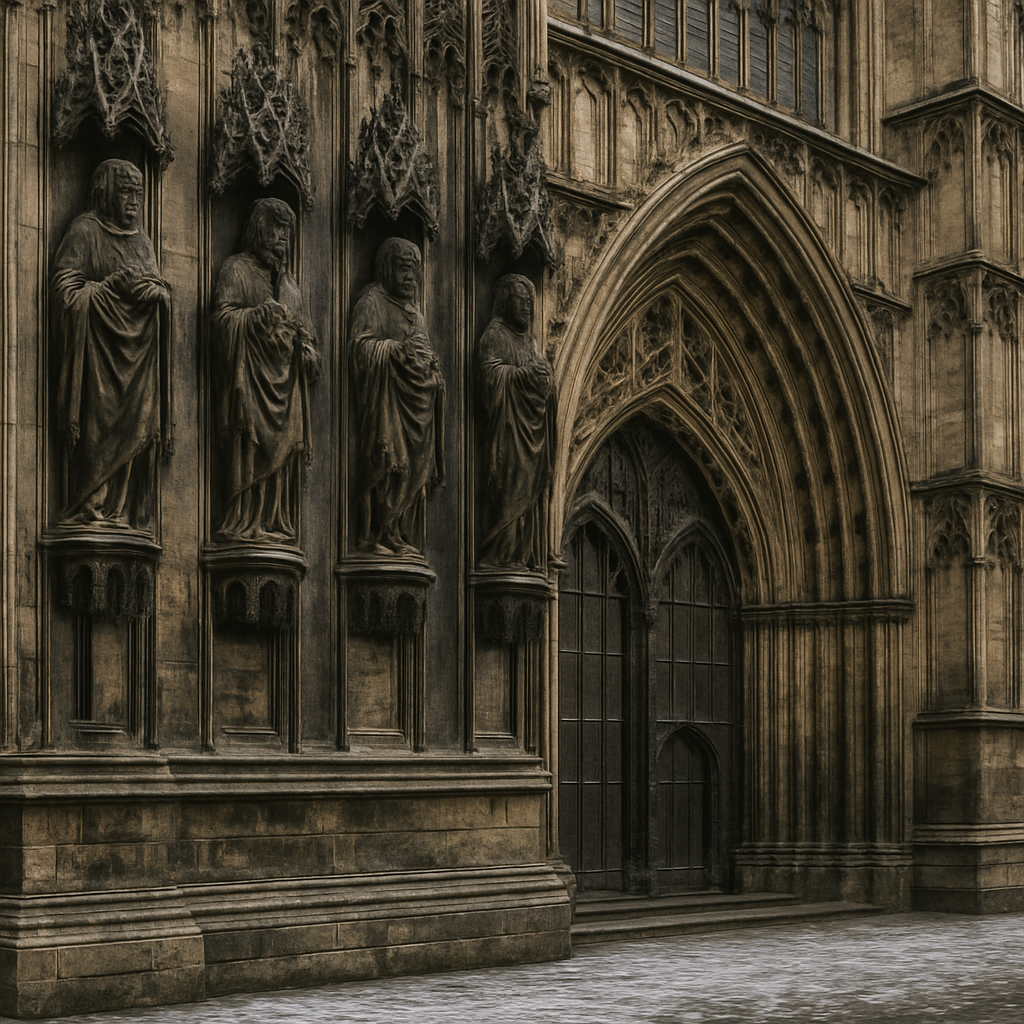
There is something deeply unsettling about looking up at the facade of a medieval cathedral and realising that the dark, sooty patina coating its carved saints and gargoyles is not simply old age. It is something far more specific, far more chemical, and far more human in its origins. The black crust on cathedrals across Europe tells a story that stretches from Victorian factory chimneys to modern diesel engines, a story that has been absorbed, layer by layer, into the very stone itself.
I first noticed it properly on a wet afternoon in York. The Minster, vast and ancient, wore its centuries like a stained overcoat. Up close, the limestone was streaked and patched with a dark rind that looked almost like a skin. A local stonemason nearby, clearly used to curious visitors, told me simply: “That’s what the air did to it.” He was more right than perhaps even he knew.
What Actually Is the Black Crust on Cathedrals?
The substance is known formally as a sulphation crust, or sulphate crust, and it forms when sulphur dioxide in the atmosphere reacts with the calcium carbonate in limestone. The result is calcium sulphate, or gypsum, a soft crystalline compound that bonds readily with airborne particulates: carbon soot, fly ash, heavy metal particles, and organic matter. Over time, this mixture hardens into a dark, brittle skin on the stone’s surface that can reach several millimetres thick.
The crust is not merely cosmetic. Underneath it, the stone is often being actively destroyed. The calcium sulphate is slightly soluble, and when rain water seeps beneath the crust, it dissolves the binding material and carries it away. The outer skin, meanwhile, swells and contracts with changes in temperature and humidity. Eventually it detaches in flakes and sheets, taking the original carved detail with it. Entire faces of medieval sculptures have effectively peeled away from English and Continental cathedrals over the past two centuries.
Industrial Britain and the Making of a Problem
The crust is ancient in chemistry but modern in scale. Pre-industrial churches did accumulate some surface change, largely from wood-fire smoke and natural weathering. But the explosion of coal burning during the Industrial Revolution, concentrated in British and German cities from the early 1800s onwards, transformed the problem entirely. Sulphur dioxide output rose dramatically. By the mid-twentieth century, air pollution levels in London, Manchester, Sheffield, and Cologne were so severe that measured sulphur deposition on stone surfaces was many times higher than anything seen in rural areas.
Studies of cross-sections taken from cathedral stone have essentially allowed scientists to read air quality history like tree rings. Dark bands in the crust correspond to peak industrial periods. Lighter zones often align with wartime industrial shutdowns or post-Clean Air Act improvements in the 1950s and 1960s. The UK government’s own air quality data now charts the legacy of these decades, and the contrast between pre- and post-regulation pollution levels is stark.
Notre-Dame de Paris, before its catastrophic 2019 fire, carried some of the thickest black crust on cathedrals anywhere in Europe, a testament to Paris’s dense urban history. Cologne Cathedral, straddling the Rhine in industrial Germany, has required near-continuous stone conservation work since the 1840s. Lincoln Cathedral, Salisbury, and Exeter in England all show varying degrees of sulphation, with the crusts heaviest on sheltered, shaded sections of the facades where rain does not wash the surface clean.
Reading the Stone: What Conservators Find Inside the Crust
The work of a cathedral conservator is part detective, part surgeon, part archaeologist. When teams take micro-samples from crusted stone, the results can be extraordinary. Tiny spherical particles of magnetite, a form of iron oxide produced by coal combustion, are found embedded throughout the gypsum matrix. Lead particles from medieval roofing and later from leaded petrol. Traces of pollen grains from plants long gone from urban landscapes. Even fragments of industrial fly ash from specific types of furnace, which can sometimes be used to date particular crust layers with some precision.
I spoke to a conservation architect who had worked on English Heritage projects for over two decades, and she described the crust as “an involuntary archive.” Every decade of atmospheric chemistry is in there, she said. The problem is that you cannot simply clean it away without losing that record, and in many cases, removing the crust exposes dramatically weakened stone beneath. Some conservators advocate for leaving stable crusts in place on the grounds that they are at least holding the detail, however darkly. Others argue that the ongoing chemical damage is too severe to ignore.
The Race to Preserve Before It Is Too Late
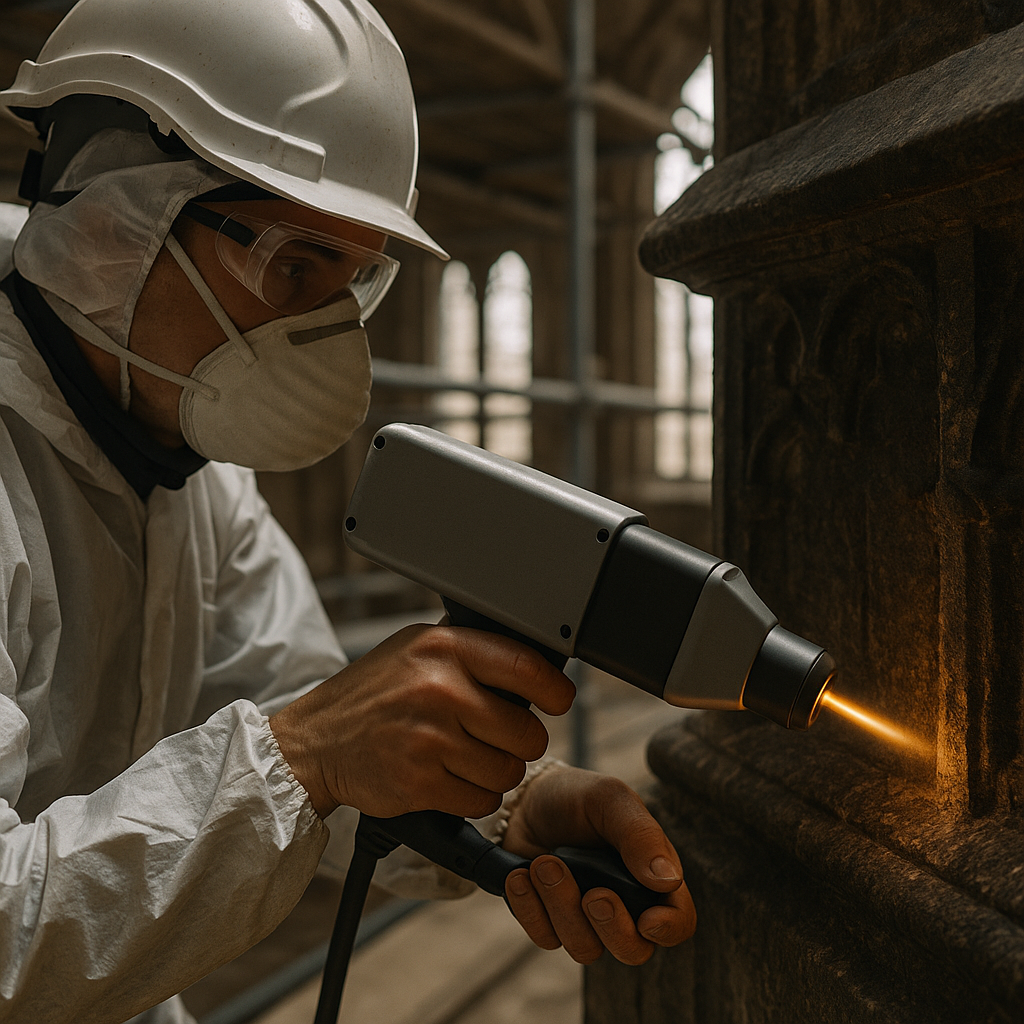
Modern conservation of cathedral stone involves a remarkable suite of techniques. Laser cleaning, first developed in Britain in the 1970s at the British Museum, allows conservators to vaporise the black crust with extraordinary precision, removing it millimetre by millimetre without touching the original stone surface. The work is painstaking; on the west front of Wells Cathedral in Somerset, laser cleaning teams have spent years carefully revealing medieval carvings that had not been clearly visible since the Victorian period.
Consolidants, typically ethyl silicate solutions, are injected into weakened stone to rebind the mineral structure before it crumbles further. Poulticing with sepiolite clay draws out soluble sulphates from deep within the stone without the mechanical abrasion that older cleaning methods caused. And increasingly, teams are using 3D scanning to create digital records of facade details before any intervention, so that if carved stone is lost, a precise record exists for future reference or replication.
The challenge is financial as much as technical. Cathedral restorations cost millions of pounds and run for decades. York Minster’s stone restoration programme has been essentially continuous since the 1960s. The Heritage Lottery Fund (now the National Lottery Heritage Fund) has contributed significantly to major projects, but demand consistently outstrips available funding. Meanwhile, diesel particulates and nitrogen oxides from road traffic continue to contribute to new crust formation, though at lower rates than the coal-burning peak.
There is a broader lesson here about the hidden costs of pollution. The sulphate damage to Europe’s Gothic cathedrals represents an irreversible loss of carved heritage, a loss that no amount of money can entirely undo. It is a sobering parallel to the way other forms of industrial contamination linger long after their source has been removed; just as responsible asbestos waste disposal is essential to prevent hazardous material from persisting in our built environment for generations, the sulphate crusts on cathedral stone remind us that the air we fill with pollutants has a way of depositing its legacy in places we did not anticipate.
What the Cathedrals Are Still Telling Us
There is something profound about a building that is simultaneously a monument, a victim, and a witness. The black crust on cathedrals is all three. It memorialises the industrial centuries with grim accuracy. It shows us, in physical form, what burning fossil fuels at scale does to the world around us. And it forces a reckoning with stewardship, with the question of what we owe to structures that were built to outlast us.
The conservators working on these buildings are, in a very real sense, archaeologists of the recent past. Each flake of crust removed under a laser, each injection of consolidant into fractured limestone, is an act of care across time. Whether the stone beneath has a century or a millennium left in it depends partly on the quality of that care, and partly on what the air around it contains from this point forward.
When I left York that afternoon, I looked back at the Minster from the city walls. The stone was dark in the winter light, as it has been for two hundred years. But somewhere inside that darkness, the medieval masons’ chisels are still present. The task now is to make sure they stay that way.
Frequently Asked Questions
What causes the black crust on cathedral stone?
The black crust forms when sulphur dioxide in the atmosphere reacts with calcium carbonate in limestone to produce calcium sulphate, or gypsum, which bonds with airborne soot, carbon particles, and heavy metals. The process accelerated massively during the Industrial Revolution due to widespread coal burning. The resulting crust is chemically distinct from general weathering and is a direct record of air pollution history.
Is the black crust on cathedrals actually damaging the stone?
Yes, significantly. Beneath the crust, the stone is often weakened as water seeps under the surface and dissolves the calcium sulphate layer, causing flaking and the loss of carved detail. The crust expands and contracts with humidity changes, and when it eventually detaches, it can take the original medieval stonework with it. Some of Europe’s finest Gothic sculpture has been permanently lost this way.
How do conservators remove black crust from historic stonework?
The most precise modern method is laser cleaning, where targeted light pulses vaporise the crust without touching the underlying stone. Other methods include poulticing with absorbent clays to draw out soluble salts, and chemical consolidants to stabilise weakened stone before cleaning. The choice depends on the stability of the crust and the fragility of the stone beneath.
Which UK cathedrals are most affected by sulphate crusting?
York Minster, Lincoln Cathedral, Salisbury Cathedral, and Exeter Cathedral all show varying degrees of sulphation damage, with the worst typically found on sheltered sections of facades that receive little natural rain washing. York Minster has had an essentially continuous stone conservation programme since the 1960s, reflecting the scale of the problem.
Has air quality improvement helped reduce new crust formation on cathedrals?
Yes, to a meaningful degree. Sulphur dioxide levels have fallen considerably since the Clean Air Acts of the 1950s and subsequent European emissions legislation. However, diesel particulates and nitrogen oxides from road traffic continue to contribute to surface crusting, and the legacy damage from the industrial centuries remains extensive and ongoing in its deterioration.