
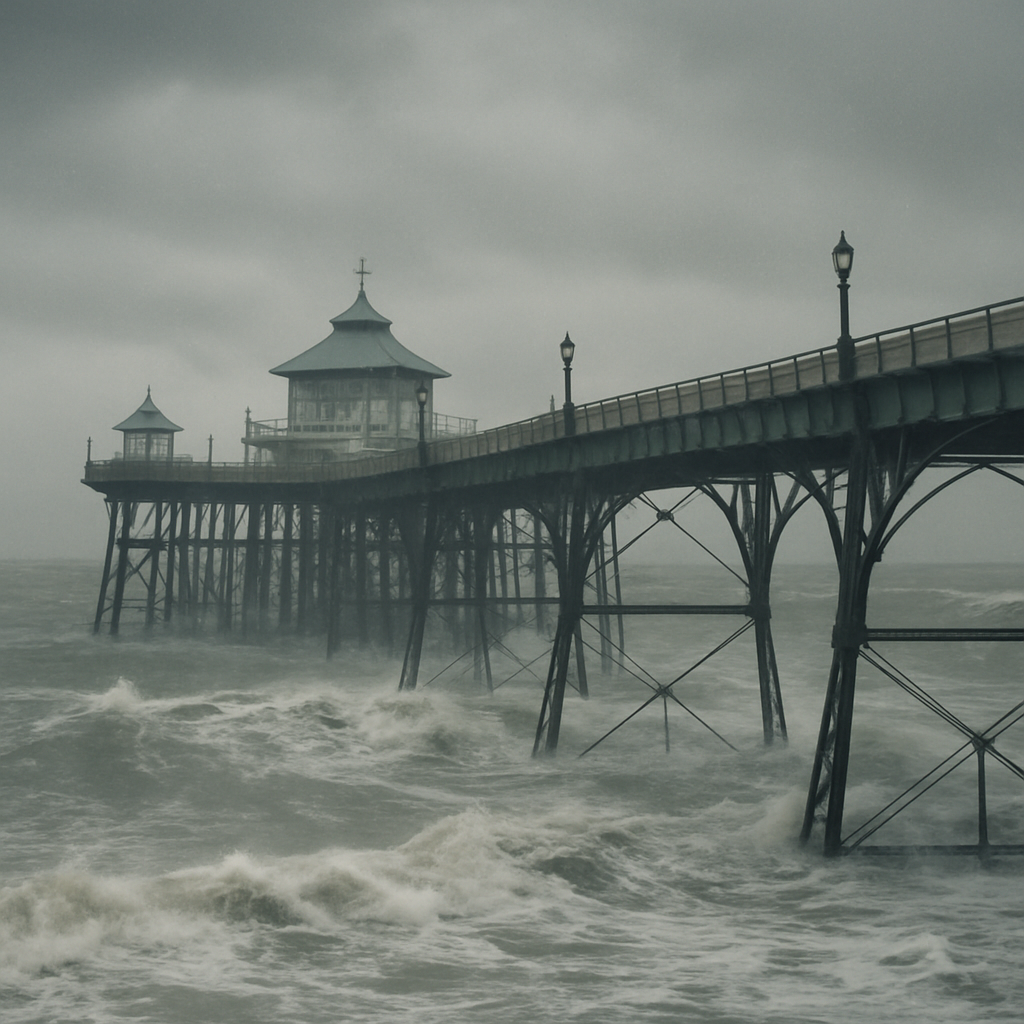
Stand at the end of Clevedon Pier on a blustery February morning and you will understand, in your bones, what Victorian engineers were up against. The Bristol Channel heaves beneath you. Salt spray stings your face. The ironwork groans in a way that suggests it has opinions about your presence. This was always the bargain the Victorians made: build something magnificent at the water’s edge, and then spend the next hundred and fifty years arguing with the sea about who owns it.
Britain once had around 100 seaside piers. Roughly 55 survive in some operational form today, according to the National Piers Society. The rest? Storms, fires, wartime demolition, and relentless seaside pier deterioration UK coastal corrosion has claimed them, piece by piece, bolt by rusted bolt. The ones that remain are a testament to extraordinary maintenance efforts, occasional strokes of luck, and a stubbornness that feels quintessentially British.
What the sea is actually doing to iron and timber
Most Victorian piers were built using cast or wrought iron for their structural columns and decking frames, with hardwood, often Baltic pine or tropical timber, laid across the top. At the time, this felt like sound engineering. Iron was the century’s wonder material. Timber was proven and flexible. Nobody fully appreciated how savagely the marine environment would assault the combination.
Salt air alone is corrosive enough to accelerate rust at a rate several times faster than inland exposure. But the tidal zone is where things get genuinely brutal. The area between the low and high water marks cycles between wet and dry dozens of times a week. Each cycle draws salt deeper into pores and crevices, and oxygen availability in these alternating conditions accelerates electrochemical corrosion in iron at a pace that can hollow a section of I-beam within a decade if protection fails. I’ve stood beneath the ironwork at Brighton Palace Pier and looked up at columns where the original protective paint is simply gone, replaced by orange and brown layers of rust that have, paradoxically, formed their own temporary barrier. Temporary being the operative word.
Timber fares differently but no better. Submerged timber resists decay reasonably well in anaerobic conditions, which is why you sometimes find ancient oak piles still solid after centuries. The problem is the intertidal zone again. Timber that spends half its life wet and half dry is a perfect host for marine borers, particularly the shipworm Teredo navalis, which can reduce a structural timber pile to a hollow shell from the inside with no visible external damage until the day it gives way. Several piers have lost sections not through spectacular storm damage but through gradual, invisible biological consumption from below the waterline.
The biology nobody talks about
Structural engineers tend to focus on the chemical and mechanical aspects of seaside pier deterioration, UK coastal corrosion discussions usually centre on chloride ingress, galvanic action, and fatigue loading from wave impact. But the biological dimension is equally destructive and considerably more interesting, at least to my mind.
Barnacles are the obvious colonists, and most people see them as merely decorative nuisances. In fact, barnacle attachment creates micro-environments beneath the shell where moisture is trapped permanently against the substrate. Where barnacles cluster on iron, rust accelerates dramatically in those pockets. On timber, the attachment process itself introduces microscopic fissures. The barnacle is essentially drilling for a living space and charging the pier for the renovation.
Then there are the green and brown algal mats that coat every submerged surface from the waterline down. These biofilms, once established, change the local chemistry of the surface. They hold moisture, release organic acids, and provide a substrate for further colonisation by more complex organisms. What starts as a thin green smear becomes, over a season, a layered biological community actively participating in the breakdown of whatever surface it has colonised. I find this simultaneously alarming and remarkable.
Above the waterline, guano from nesting kittiwakes and cormorants introduces uric acid directly onto ironwork and timber. Peregrine falcons have colonised several pier structures in recent years, which is wonderful news for bird enthusiasts and genuinely terrible news for the maintenance budget.
What engineers learnt the hard way
The history of pier restoration in Britain is essentially a history of coating failures. Early twentieth-century engineers applied coal tar pitch to ironwork below the waterline, which worked reasonably well but required application in conditions that were logistically nightmarish, scaffolding in the tidal zone, working in narrow windows between tides. Topside paintwork used lead-based formulations that, whatever their toxicological problems, provided genuine long-term protection. When lead paints were phased out, replacement systems often struggled to match the performance, and a generation of piers deteriorated faster than expected through the 1980s and 1990s.
Modern protective approaches for seaside pier deterioration in UK coastal corrosion conditions draw on decades of hard experience. Hot-spray zinc metallising, applied before any paint system, provides sacrificial protection to iron and steel that can last significantly longer than paint alone. Epoxy coating systems, properly applied in controlled conditions, can achieve marine-grade protection far beyond anything available to Victorian engineers. But application is everything. A coating system is only as good as the surface preparation beneath it, and preparing corroded ironwork in the intertidal zone of the North Sea is not a job for the faint-hearted or the poorly funded.
Clevedon Pier, which collapsed partially in 1970 and was restored through a remarkable community campaign, now uses a combination of cathodic protection on its submerged ironwork and regular paint maintenance on above-water sections. The Historic England funding that has supported restoration work at several piers has increasingly recognised that without proper surface protection strategies, no amount of structural repair will hold.
The piers that are losing the fight
Birnbeck Pier in Weston-super-Mare has become, in recent years, the saddest exhibit in this story. Grade II listed, the only pier in Britain to connect the mainland to an island, it has been closed since 1994 and is now in an advanced state of structural decay. Entire deck sections have collapsed. The ironwork is deeply corroded. Biological colonisation is so advanced that the structure has, in some areas, become an unofficial nature reserve. Restoration estimates have run into tens of millions of pounds. Various owners have promised action and delivered very little.
Watching a pier die by inches is a particular kind of grief. Each winter storm takes another section. Each summer passes with another restoration deadline missed. The sea, entirely indifferent to Victorian ambition or heritage listing, simply continues its work.
What the long, complicated, often losing battle to protect Britain’s piers has genuinely taught the coatings industry is this: no single solution works in the marine intertidal environment, because that environment doesn’t hold still long enough. The tidal cycle, the biology, the salt loading and the UV exposure above the waterline combine to create conditions that demand layered, redundant protection systems, inspected regularly and maintained without sentiment. The piers that are surviving are the ones with committed local trusts, consistent funding streams, and maintenance regimes that treat the structure as a living thing requiring constant attention rather than a historic object that ought to look after itself.
The sea doesn’t negotiate. The barnacles don’t take a season off. And rust, given half a chance, always wins in the end.