
There is a moment, well known to anyone who has spent time wading through tropical wetlands, when the world around you stops making ordinary sense. The heat sits on your shoulders like a wet coat. The water is the colour of old tea. And everywhere, floating with an almost offensive serenity across the surface of the swamp, are lotus flowers. Perfect. Pristine. Not a speck of mud on them, despite being rooted in it.
That pristine surface is not luck. It is engineering. Some of the finest engineering on the planet, as it happens, and it took a pair of very persistent German botanists wading through the swamps of Southeast Asia to begin to understand what was actually going on.

What the Botanists Found in the Mud
Wilhelm Barthlott and Christoph Neinhuis were not looking for a revolution when they began their detailed microscopic studies of plant surfaces in the 1970s and 80s. Barthlott, based at the University of Bonn, had spent years cataloguing the surface structures of thousands of plant species, an obsessive and largely thankless undertaking involving electron microscopes, meticulous fieldwork, and an enormous amount of patience. Most plant surfaces, it turns out, are unremarkable under a microscope. Waxy, perhaps. Slightly textured, certainly. But nothing to write home about.
The lotus was different. The leaf surface of Nelumbo nucifera, examined at high magnification, revealed a landscape that looked less like a plant and more like a field of tiny stalagmites. Microscopic waxy bumps, each one between ten and twenty micrometres across, covered every centimetre of the leaf. And on top of those bumps, at the nanoscale, smaller wax crystals bristled outward like a forest seen from altitude. The result was a surface that, in physical terms, barely existed at all. A water droplet landing on a lotus leaf was not touching a surface so much as balancing across the very tips of thousands of tiny spires, with air filling almost all the space beneath it.
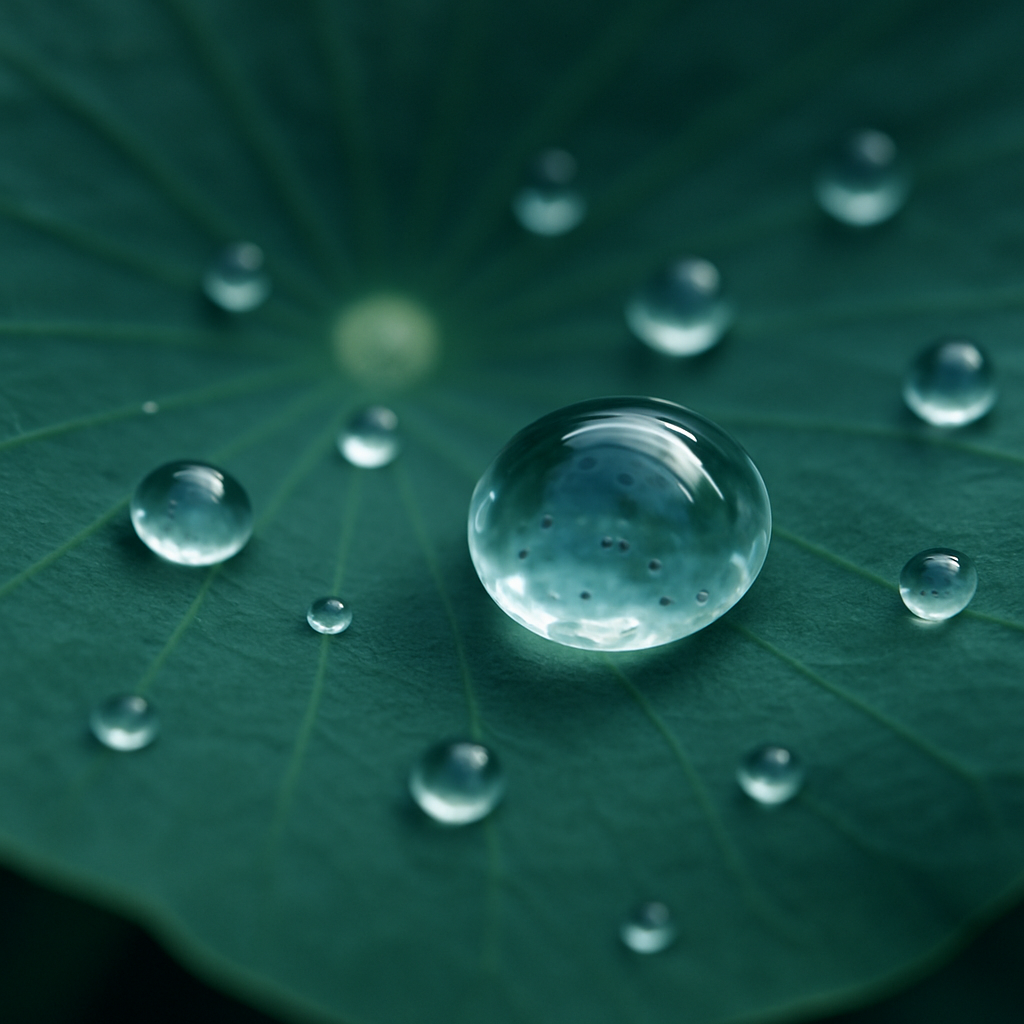
Barthlott published his findings in 1977, refined them with Neinhuis in 1997, and gave the phenomenon a name that has since passed into the language of materials science: the lotus effect. The lotus effect superhydrophobic natural coating, as it became understood, was not simply about repelling water. It was about the geometry of contact. When a surface is textured at the nanoscale, a droplet of water cannot spread and cling. It sits up. It rolls. And as it rolls, it collects particles of dust and dirt and carries them away. The leaf cleans itself.
Superhydrophobicity: What It Actually Means
Hydrophobic surfaces repel water. A duck’s feathers are hydrophobic. A well-waxed wooden deck is hydrophobic. But superhydrophobicity is a different matter entirely. A surface is considered superhydrophobic when a water droplet forms a contact angle greater than 150 degrees with it. Picture a ball-bearing sitting on a tray rather than a puddle spreading across a table. The droplet barely touches the surface. It has no grip, no purchase, no ability to wet the material beneath it.
Achieving this in nature requires two things working in concert: the right surface chemistry (low surface energy, typically provided by waxy compounds) and the right physical texture at the micro and nanoscale. The lotus manages both simultaneously. And the self-cleaning effect, which Barthlott termed the Lotus-Effekt in his original German publications, emerges almost as a side consequence. When droplets roll freely, they pick up contaminants. The leaf stays clean not because it repels dirt directly, but because the water never stays still long enough to leave anything behind.
From Swamp to Laboratory: The Journey to Synthetic Coatings
The implications for materials science, once understood, were considerable. Surfaces that could resist water, shed mud, and clean themselves under rainfall have obvious applications in construction, textiles, outdoor equipment, and protective coatings. If you could replicate the lotus effect superhydrophobic natural coating on a wall, a roof, a piece of outdoor timber, or a fabric, you would dramatically extend its usable lifespan, reduce maintenance, and cut the need for chemical cleaning agents.
Easier said than done, of course. Nature spent millions of years developing the lotus leaf. Scientists had perhaps a few decades of funding to replicate it. The challenge is not simply creating a surface with the right nano-texture; it is creating one that retains that texture under real-world conditions, where abrasion, UV degradation, temperature cycling, and general punishment wear surfaces down. A lotus leaf, when damaged, regrows. A synthetic coating does not.
Nevertheless, the progress has been genuine. Products have emerged, particularly in exterior architectural coatings, that incorporate superhydrophobic micro-texturing, causing rain to bead and run off facades rather than penetrate them. Companies working on exterior timber treatments and masonry coatings have drawn heavily on the principles Barthlott described. You can read more about the science behind hydrophobic surface structures in the research archives at the Royal Society of Chemistry, which has published extensively on bio-inspired surface engineering.
The Lotus Leaf’s Wider Ecosystem
It is worth pausing to appreciate the environment that produced this solution. The lotus grows across tropical and subtropical Asia, from India through Bangladesh, Myanmar, Thailand, Vietnam, and into southern China. These are warm, humid, silt-heavy wetlands, the kind of environments where a leaf that could not clean itself would be buried in algae and detritus within days. The superhydrophobic surface is not an accident of biology. It is a direct response to an extremely demanding environment.
Other plants have evolved similar strategies. The nasturtium, which any British gardener will know, shows a pronounced lotus effect of its own. Water on a nasturtium leaf behaves in exactly the same rolling, bead-forming way. The rose of Sharon, certain varieties of cabbage, and some species of grass share elements of the same geometry. Nature, it turns out, has been solving the waterproofing problem across multiple evolutionary lineages, in multiple climates, for a very long time.
What the lotus does differently is the sheer perfection of the self-cleaning effect. The contact angle on a lotus leaf is typically cited at around 162 degrees, amongst the highest recorded in the natural world. No engineered surface, at the time of writing, consistently matches it across real-world conditions.
Why This Matters Now More Than Ever
The push toward lower-maintenance, longer-lasting exterior coatings is not merely a commercial interest. Buildings that require less frequent repainting and fewer chemical washes have a smaller environmental footprint. Surfaces that shed water effectively resist damp penetration, reducing the energy lost through cold, wet walls. In a British climate, where buildings face constant wet weather, the relevance of lotus effect superhydrophobic natural coating principles is difficult to overstate.
Barthlott, who eventually received the European Inventor Award in 2011 for his decades of work, described his motivation in characteristically modest terms. He was simply curious about why some surfaces stayed clean. That curiosity, pursued through years of electron microscopy and swamp fieldwork, has produced one of the most genuinely useful ideas in modern materials science. Not bad for a water lily.
I have stood beside lotus ponds in Thailand and watched the rain fall. Each drop hits the leaves and immediately gathers itself into a tight silver sphere, hesitates for a fraction of a second, and then simply rolls away, carrying whatever was beneath it into the water below. It looks like a magic trick. It is, instead, a lesson in what three hundred million years of evolution can produce when the environment demands the very best.
Frequently Asked Questions
What is the lotus effect superhydrophobic natural coating?
The lotus effect describes the extreme water and dirt-repelling property of the lotus leaf, which is covered in microscopic waxy bumps and nanoscale crystals that prevent water from spreading across the surface. Water droplets form near-perfect spheres, roll freely, and carry dirt particles with them, keeping the leaf self-cleaning. The term was coined by German botanist Wilhelm Barthlott in the late 20th century.
How does a superhydrophobic surface differ from a normal waterproof surface?
A standard waterproof surface resists water penetration but still allows water to wet and spread across it. A superhydrophobic surface causes water droplets to form a contact angle of over 150 degrees, meaning the droplet barely touches the material and rolls off under gravity. This rolling action also removes dust and dirt, creating a self-cleaning effect that ordinary waterproof surfaces cannot match.
Can the lotus effect be replicated in man-made exterior coatings?
Yes, to a significant degree. Researchers and manufacturers have developed exterior coatings, particularly for masonry and timber, that incorporate micro and nanoscale surface textures inspired by the lotus leaf. These cause rainwater to bead and run off rather than soak in, reducing maintenance and improving durability. The challenge remains creating structures that retain their texture after years of abrasion and UV exposure.
Which other plants show superhydrophobic properties similar to the lotus?
The nasturtium, which is common in British gardens, shows a very pronounced lotus effect with water beading visibly on its leaves. Some varieties of cabbage, rose of Sharon, and certain grasses also share elements of the same microscopic surface geometry. The effect has evolved independently across multiple plant families, all facing environments where leaf fouling would be a serious problem.
What practical applications have come from studying the lotus leaf?
The lotus effect has influenced the development of self-cleaning exterior paints, waterproof textiles, anti-fouling coatings for marine use, and protective treatments for outdoor building materials. In the UK, bio-inspired hydrophobic coatings are used on heritage stone buildings, modern facades, and timber structures to reduce maintenance and resist damp penetration in wet weather conditions.