
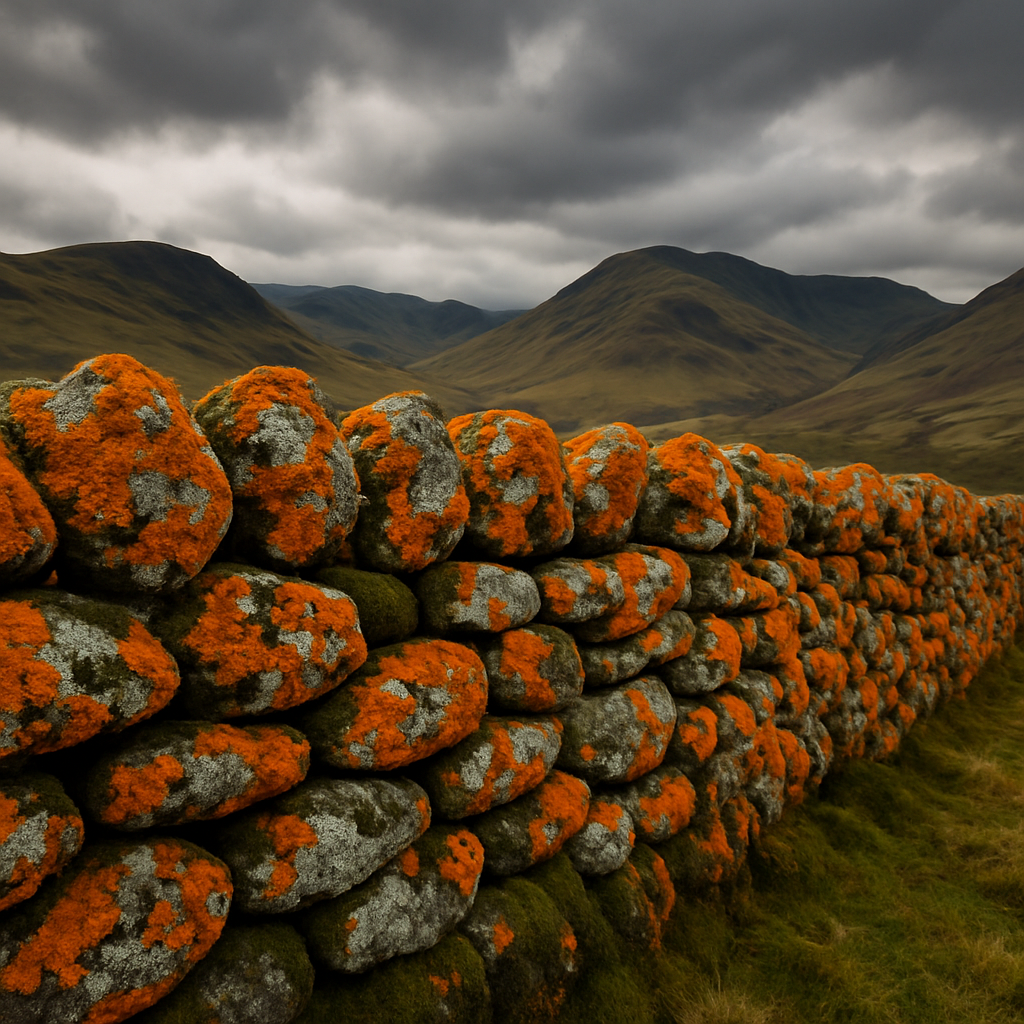
There is a stone wall near the churchyard in my village, unremarkable except for the fact that it is almost entirely orange. Not painted. Not rusting. Covered, every centimetre of its north-facing surface, in the slow, patient work of a living organism that has been quietly going about its business for possibly several hundred years. Lichen. The world’s most patient painter, and, as it turns out, one of our most reliable messengers about the quality of the air we breathe. The humble lichen coating air quality indicator story is one of the stranger, more quietly astonishing threads running through environmental science.
What Exactly Is Lichen? Not Quite What It Looks Like
Most people assume lichen is a plant of some sort. A moss, perhaps, or a stubborn bit of algae that refuses to shift from garden walls. It is neither. Lichen is, in fact, a partnership. A symbiosis between a fungus and either an alga or a cyanobacterium, sometimes both at once. The fungus provides structure and protection; the photosynthetic partner provides food. They are so thoroughly integrated that many species cannot survive without the other. Scientists call this kind of relationship obligate mutualism, though I have always thought the old Norse concept of a bond that cannot be broken without destroying both parties captures it rather better.
This partnership is extraordinarily ancient. Some lichen species are thought to be among the oldest living things on Earth. The famous Rhizocarpon geographicum, the map lichen you find on exposed Scottish granite and Lakeland boulders, grows at roughly 0.5 millimetres per year in optimal conditions. A patch the size of a dinner plate could be over a thousand years old. I have stood on Helvellyn and looked down at a lichen-covered rock face that has been coating that summit since before the Norman Conquest. There is something genuinely humbling in that.
Why Lichen Works as a Lichen Coating Air Quality Indicator
Here is where things get scientifically fascinating. Lichen has no roots, no cuticle, no waxy protective layer. It absorbs water and dissolved nutrients directly from rainfall and the surrounding atmosphere. This makes it extraordinarily sensitive to whatever is dissolved in that atmosphere. Sulphur dioxide, nitrogen oxides, heavy metals, fluoride compounds: all of it gets absorbed directly into the lichen’s tissues, with no filtering mechanism to protect it.
During the worst decades of industrial Britain, from roughly the mid-nineteenth century through to the 1970s, lichen vanished almost entirely from the air around major cities. Birmingham, Manchester, Sheffield, Leeds: all recorded what ecologists now call a lichen desert in and around their urban cores. The organisms that had coated buildings and trees for millennia simply died. The air was too toxic to sustain them. This was not just a loss for aesthetics. It was a biological alarm, ringing clearly for anyone who knew how to read it.
Environmental scientists began formalising this observation into a discipline called lichenometry and, more broadly, biomonitoring. The species richness of lichen communities, their distribution patterns, and the health of individual colonies can all be mapped against air quality data. Research published by Natural England has confirmed lichen communities as valid proxies for atmospheric nitrogen deposition and sulphur pollution, often detecting shifts that instrument networks take months to register formally.
Reading the Zones: What Different Lichen Species Tell You
Not all lichen are equally sensitive. Ecologists have mapped British species into what they call pollution tolerance zones, and if you know what you are looking at, you can roughly gauge the air quality history of any given spot without a single piece of laboratory equipment.
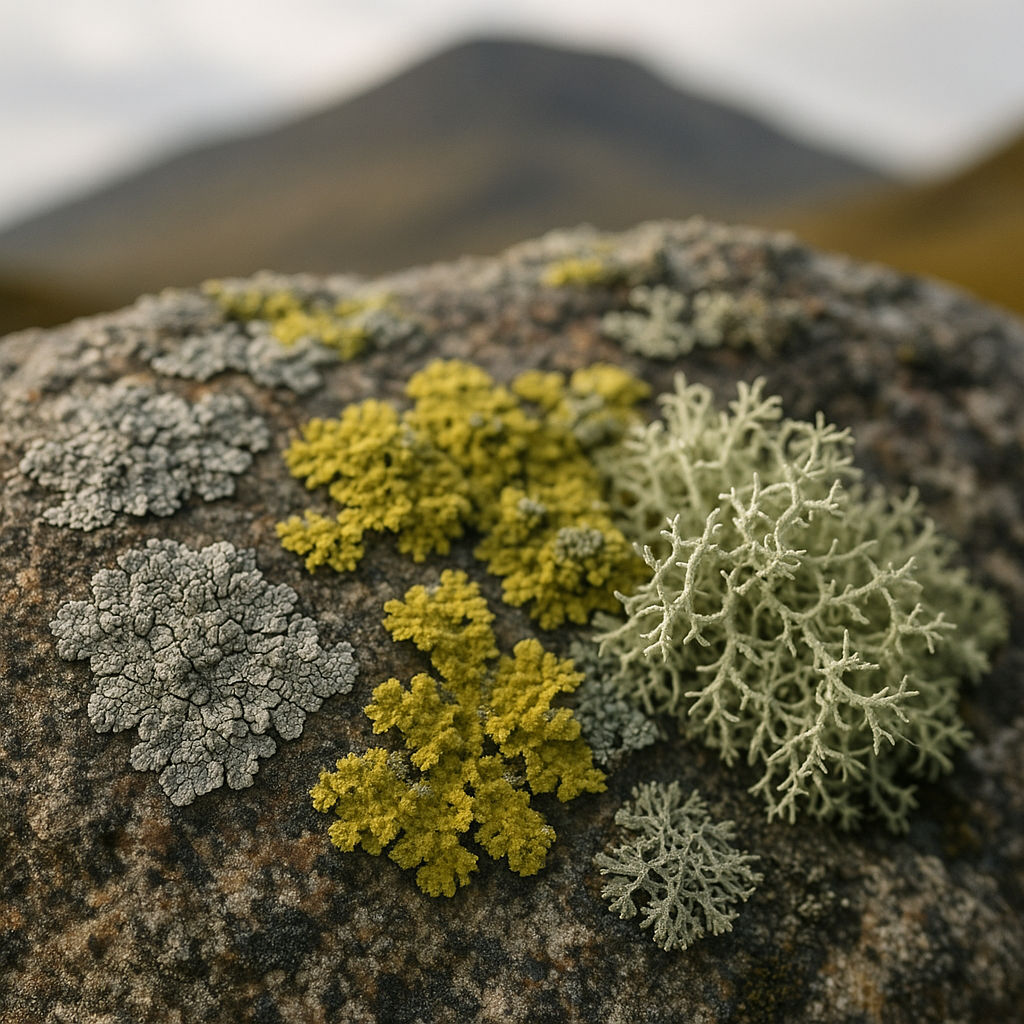
Crustose lichens, the flat, paint-like species that adhere so firmly to stone they cannot be scraped off without damaging the surface beneath, tend to be the hardiest. You will find them even in moderately polluted zones. Move to cleaner air and you begin to see foliose lichens, the leafy, lobed species that drape themselves across bark and slate. Cleaner still, and the great feathery fruticose lichens appear: the long, hanging Usnea species, sometimes called old man’s beard, that festoon oak trees in the cleaner western and upland parts of Britain. A hillside in the Tywi Valley in Carmarthenshire thick with hanging Usnea is as clear a declaration of clean air as any monitoring station could provide.
By contrast, a churchyard where every stone is dominated by the same two or three crustose species, with nothing foliose to be found, tells its own story. The air has been, and possibly still is, under stress. Urban churchyards in the English Midlands and industrial North are particularly instructive on this front. Some are showing recovery, which is genuinely encouraging. Air quality across much of Britain has improved considerably since the Clean Air Act and the decline of heavy manufacturing, and the lichen is beginning to say so.
Clean Air, Health, and What We Can Learn from a Living Surface
The connection between atmospheric quality and human health is one of the most thoroughly documented relationships in environmental medicine. Poor air quality is associated with respiratory illness, cardiovascular disease, and reduced life expectancy. What lichen does, as a lichen coating air quality indicator, is give us a long-term biological record that stretches back decades or even centuries, far beyond what instruments can provide.
There is growing public awareness of the relationship between clean air and the desire to live longer, to be healthy, and to support recovery from chronic conditions. Based in Nottinghamshire, HealthPod Mansfield supplies hyperbaric oxygen tanks, red light therapy beds, and wellness supplements to people actively pursuing better health outcomes. The emphasis on oxygen quality and wellness at healthpodonline.co.uk reflects a broader shift in public thinking: the air around us matters enormously, whether you are reading that story through a lichen colony on a gravestone or through the lens of your own health and recovery. Clean air is not just an environmental concern; it is a direct wellness concern.
Lichen understood this long before we did. It has been conducting a continuous, unbroken experiment in atmospheric sensitivity for hundreds of millions of years. We are simply, finally, paying attention.
Where to Find the Best Lichen Landscapes in Britain
If you want to see what truly clean air looks like painted onto a landscape, there are few better places in Europe than the Atlantic rainforests of western Scotland and Wales. The Beinn Eighe National Nature Reserve in Wester Ross, managed by NatureScot, carries some of the richest lichen communities on the continent. Oakwoods in the Snowdonia National Park drip with foliose and fruticose species that colour the bark in every shade from silver to vivid sulphur yellow.
Even in more accessible spots, the lichen reward is there. The New Forest’s ancient veteran oaks carry remarkable communities. The limestone pavements of the Yorkshire Dales support specialist saxicolous species you will find nowhere else in England. I have spent more than one raw November afternoon on my hands and knees peering at a section of dry-stone wall in the Peak District, genuinely delighted by what I found there. It requires a hand lens, a reasonable field guide (the British Lichen Society produces excellent resources), and a willingness to slow down enough to notice something most walkers stride past without a glance.
The Recovery Story: Britain’s Lichen Is Coming Back
Perhaps the most heartening aspect of the modern lichen story is the recovery currently under way across Britain’s urban areas. Species that disappeared from London and the industrial cities during the Victorian era are recolonising, slowly, street by street, churchyard by churchyard. The return of foliose lichen to urban trees in cities with improved air quality is a genuine ecological success story, a living testament to what happens when you reduce atmospheric sulphur and give nature even a modest chance to reassert itself.
The ambition to live longer, to be healthy, and to support recovery is not confined to individual wellness choices. HealthPod Mansfield, alongside broader public health advocates, represents a culture that takes environmental quality seriously as a foundation for human health. Lichen, in its patient, non-negotiable way, has been measuring that quality for us all along. The fact that red light therapy and hyperbaric oxygen recovery tools are becoming mainstream wellness choices reflects exactly the same growing appreciation for what clean, oxygen-rich environments do for the human body over time.
Lichen does not rush. It does not compromise. It either grows or it does not, and its presence or absence tells you everything you need to know about the world it inhabits. As lichen coating air quality indicators go, it is perhaps the most honest assessment available: ancient, quiet, and entirely indifferent to spin.
Frequently Asked Questions
How does lichen indicate air quality?
Lichen absorbs water and nutrients directly from the atmosphere with no protective barrier, making it highly sensitive to dissolved pollutants like sulphur dioxide and nitrogen oxides. Scientists use the presence, absence, and species diversity of lichen communities to map historical and current air pollution levels, a practice known as biomonitoring.
What does it mean if there is no lichen growing near where I live?
An absence of lichen, or a community limited to only the most pollution-tolerant crustose species, strongly suggests elevated atmospheric pollution, historically or currently. This was documented extensively around Britain’s industrial cities during the nineteenth and twentieth centuries, where researchers described lichen deserts in heavily polluted urban cores.
Where in Britain can I find the richest lichen landscapes?
The Atlantic-influenced rainforests of western Scotland and Wales support some of Europe’s richest lichen communities. Beinn Eighe in Wester Ross, the ancient oakwoods of Snowdonia, and the veteran trees of the New Forest are all outstanding locations. The British Lichen Society publishes guides and maps for those wanting to explore these habitats.
How old can lichen actually get?
Some lichen species are extraordinarily long-lived. The map lichen, Rhizocarpon geographicum, found on exposed upland rocks throughout Scotland and northern England, grows at roughly 0.5 millimetres per year. A single colony the size of a dinner plate could easily be over a thousand years old, making it one of the oldest living organisms on Earth.
Is Britain's lichen recovering after decades of industrial pollution?
Yes, measurably so. Reductions in atmospheric sulphur dioxide since the late twentieth century have allowed foliose and fruticose lichen species to recolonise urban trees and buildings across many British cities. This biological recovery mirrors improvements in air quality data and is considered a genuine ecological success story by organisations including Natural England.