
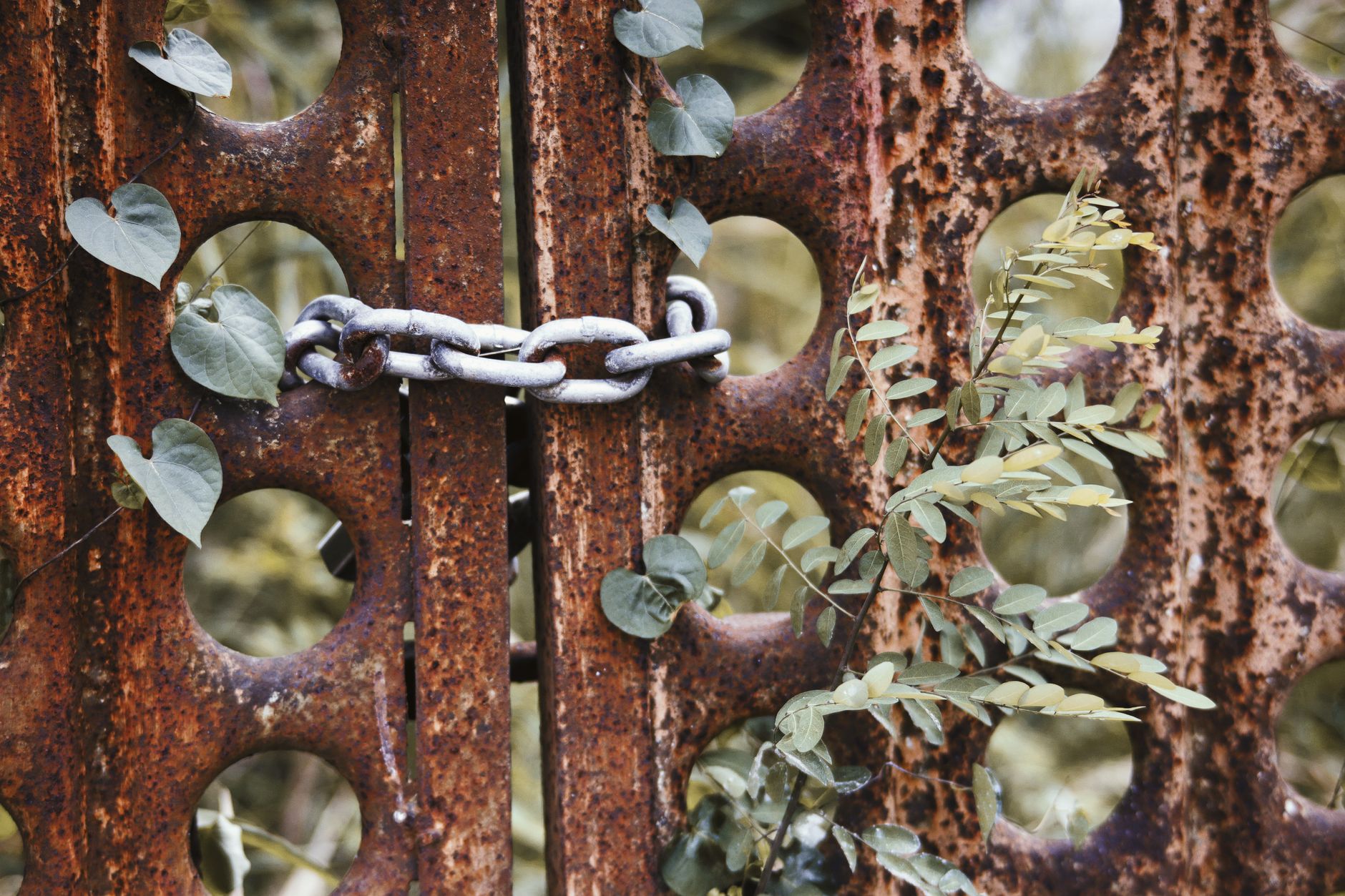
There is a particular gate on a hill farm above the Conwy Valley that I have been watching for the better part of a decade. I first noticed it on a grey October morning, when the mist was sitting low on the pasture and the whole landscape smelled of wet wool and peat. The gate itself was wedged open with a lump of slate, clearly propped that way long enough for grass to have grown up around the slate’s base. And the iron, five horizontal bars and a diagonal brace, probably cast somewhere in Flintshire in the 1950s, had turned into something genuinely extraordinary. Not rusty in the way a garden chair goes rusty if you leave it out over winter. Something far more complex than that. Something almost geological.
Farm ironwork weathering, especially on the upland farms of Wales and Cumbria, produces layered surface chemistry that most people walk past without a second glance. I think that is a shame. Once you start looking properly at what decades of damp, animal acids and relentless Atlantic weather do to iron, you begin to understand that neglect is not always destruction. Sometimes it is a process, and occasionally it is something close to art.
What actually happens when iron meets upland air
The starting point is straightforward enough. Iron reacts with oxygen and water to form iron oxides, rust, essentially. But that is about as complete a description of farm ironwork weathering as saying a cake is flour and heat. The real process on a hill farm gate is a cascade of overlapping chemical reactions driven by a very specific set of conditions, and upland Britain supplies all of them in abundance.
First, there is moisture. The Met Office records average annual rainfall of around 2,000 millimetres across much of Snowdonia and the Lake District, roughly four times what falls on Cambridge. That wetness does not just sit on metal; it cycles. Morning dew condenses on cold iron, runs into crevices, dries partially in the midday breeze, re-condenses at night. Each cycle drives oxidation a little deeper into the iron’s surface, and each cycle also carries dissolved minerals picked up from the surrounding soil and stone.
Then there are the animals. A working farm gate takes a punishment that no engineer ever properly accounts for when specifying ironwork. Cattle lean against it, rub their faces along the bars, and deposit a remarkable chemical cocktail: saliva, mucus, residual stomach acids from belching, and, crucially, urine splash and dung. Urine contains urea, which hydrolyses to ammonia in outdoor conditions. Ammonia in solution is a mild alkali, which attacks iron oxides and temporarily converts them to iron hydroxides before they re-oxidise into different, often more orange-brown crystalline forms. Dung adds further organic acids, acetic acid, butyric acid, that etch the metal surface at a microscopic level, creating tiny topographical irregularities that trap yet more moisture. The gate becomes its own little micro-climate.
The layers you can actually see
If you get close, and I mean genuinely close, the sort of close that earns you odd looks from passing walkers, you can make out at least three or four distinct zones on a well-weathered hill farm gate. The outermost layer is typically a loose, flaky crust of reddish-orange goethite and lepidocrocite: the familiar surface rust most people recognise. Beneath that sits a denser, darker layer, often a deep reddish-brown tending towards black in places, where magnetite has formed under conditions of alternating wet and dry. Deeper still, where the original paint or mill scale has partially survived, you sometimes find zones of almost purple-black ferrous oxide that has been essentially annealed into the metal surface.
The diagonal brace of my Conwy Valley gate had developed a crust in one spot that was genuinely stratified, like a tiny cliff face of compressed geological time. I counted what I was fairly sure were five distinct colour bands across roughly three millimetres of depth. The outermost was almost ochre-yellow, a thin film of ferrihydrite, I suspect, recently formed. The innermost was near-black. In between: all the oranges and umbers a painter could want.
When lichen gets involved
Iron is not an obvious substrate for lichen, but on older farm gates, particularly those left undisturbed for twenty or thirty years, you start to find crustose lichens colonising the more stable rust layers. This is where the chemistry becomes genuinely strange. Certain lichens, including some species of Lecanora and Candelariella, produce oxalic acid as a metabolic byproduct. That acid reacts with iron oxides to form iron oxalate compounds, creating yet another distinct mineral layer on the surface. The lichen is, in a very real sense, manufacturing new materials from the ironwork it is sitting on. The gate is being slowly converted, layer by layer, into something that is neither quite metal nor quite stone.
I find that idea almost vertiginous in its implications. The same biological colonisation process I have watched happen to Britain’s canal lock gates, where algae and lime conspire to repaint cast iron over two centuries, is at work here on a smaller, more intimate scale. The biology and the chemistry are continuous. They do not stop at the boundaries we draw between disciplines.
Why Cumbria and Wales produce the most spectacular examples
I have seen rusted gates in Suffolk and Lincolnshire. They are dull things by comparison. The chemistry of farm ironwork weathering in lowland arable counties lacks two crucial ingredients: sustained high humidity and the particular mineral profile of upland soils. The volcanic and metamorphic rocks of Snowdonia and the Lake District weather into soils that are rich in silica, aluminium compounds, and various trace minerals including manganese. Rain carrying these dissolved minerals deposits them onto metal surfaces, and manganese in particular catalyses iron oxidation in ways that produce darker, harder, more complex corrosion products.
There is also the wind. A gate on a Lakeland fell that faces west gets hit with air that has crossed 3,000 miles of open Atlantic, picking up sea salt, particulates, and whatever organic material the ocean surface releases into the lower atmosphere. That salt doesn’t just add chloride ions to the corrosion chemistry; it creates hygroscopic surface films that stay slightly damp even on days that feel dry to a walker in a waterproof jacket. The gate never fully dries. The reaction never fully stops.
This is not entirely unlike what I described in the silvery crust that develops on Snowdonia’s slate, both are stories of Welsh weather acting as a chemist, patient and relentless, over timescales that dwarf any human plan.
Neglect as accidental craftsmanship
There is a tendency to frame farm ironwork weathering as a failure, of maintenance, of attention, of rural economies stretched too thin to repaint a gate every decade. I understand that reading. But I think it misses something.
The surfaces produced by this process are genuinely unrepeatable. A blacksmith could not produce them deliberately. A conservation coating specialist could not synthesise them. They are the record of a specific piece of iron, in a specific place, subject to a specific herd of cattle and a specific pattern of Welsh rain, across a span of decades. They carry information the way tree rings carry information, or the way the amber sandstone walls of Edinburgh’s Old Town carry information about the particular chemistry of Scottish city air across centuries.
The Royal Society of Chemistry has published work on the complex stratified corrosion products found on archaeologically significant ironwork, much of the same chemistry, accelerated by burial rather than upland air, but recognisably the same suite of iron oxides, hydroxides and carbonates. Conservators spend considerable effort stabilising those layers, understanding them as the surviving record of objects that would otherwise be lost. I think we might extend that respect, however informally, to the gate post rusting quietly at the top of a Cumbrian pasture.
Understanding the materials in a landscape you care about is part of caring about it properly. I came across this idea quite directly while reading a related article, how to create a dedicated hobby space at home that actually makes you happier every day, the argument there is that the satisfaction of truly knowing your materials, really understanding what they are and what they do, is inseparable from the pleasure of working with them. I think that applies just as much to a five-bar gate on the side of a Welsh hill as it does to a workshop bench.
Next time you pass a rusted gate at the edge of an upland field, slow down. Look at the colour gradations. Put your nose close enough to smell the iron-earth scent of old corrosion. Try to count the layers. The chemistry is doing something remarkable, and it has been at it long before you arrived, and will continue long after you have gone back down to the valley.
Frequently Asked Questions
What causes the different colours in rusted farm ironwork?
The range of reds, oranges, yellows and near-blacks in rusted iron comes from distinct iron oxide and hydroxide compounds forming at different stages of corrosion. Goethite produces yellow-brown tones, lepidocrocite gives orange-red, magnetite produces dark brown to black, and ferrihydrite can appear almost ochre. Each compound forms under slightly different moisture and oxygen conditions, so a gate that cycles repeatedly between wet and dry builds up genuinely stratified layers of different colours.
Why does farm ironwork rust so much faster in Wales and Cumbria than elsewhere?
High annual rainfall, persistent humidity, Atlantic salt-laden winds, and the mineral-rich runoff from volcanic and metamorphic upland soils all accelerate the corrosion process. Manganese compounds common in these soils catalyse iron oxidation particularly effectively. Lowland arable counties lack these conditions, producing simpler, slower corrosion.
Does animal dung and urine actually affect how iron corrodes?
Yes, significantly. Urine contains urea which breaks down to ammonia outdoors, temporarily converting iron oxides into iron hydroxides before they re-oxidise into different crystalline forms. Organic acids in dung, acetic acid, butyric acid, etch the metal surface at a microscopic level, creating irregularities that trap moisture and accelerate further corrosion. The result is a more complex, layered surface than you would see on iron exposed only to rain and air.
Can lichen grow on rusted metal, and does it cause damage?
Certain crustose lichen species, including some Lecanora varieties, can colonise stable rust layers on old ironwork. They produce oxalic acid, which reacts with iron oxides to form iron oxalate compounds, essentially adding a new mineral layer. Whether this constitutes “damage” depends on context; on an archaeologically significant piece it would be a concern, but on a working farm gate it is simply another chapter in the surface’s long chemical history.