
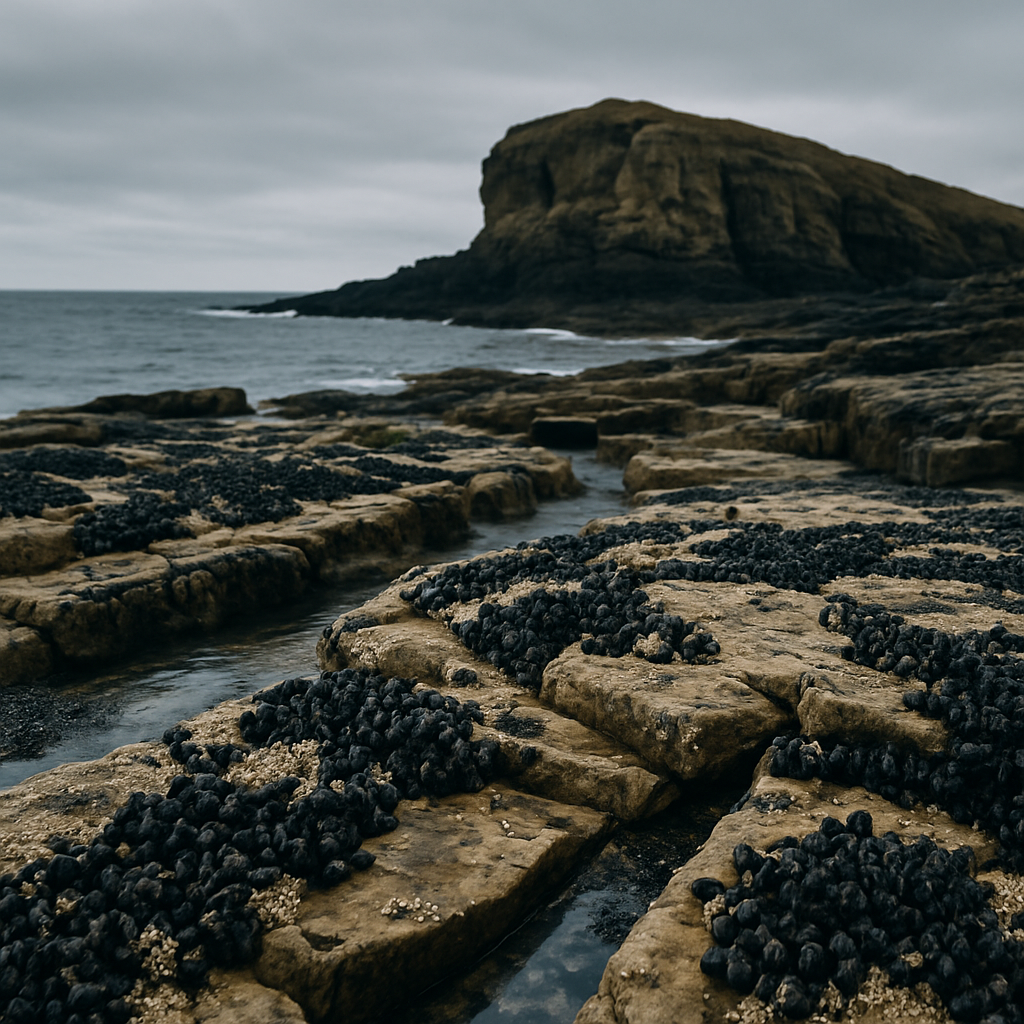
Stand on any rocky headland along the Northumberland coast or the Pembrokeshire cliffs at low tide and look down. Below the tideline, beneath the kelp and the black mussels and the limpets clamped hard as iron bolts, there is a world that has been solving the same engineering problems as our best materials scientists, and solving them for hundreds of millions of years. The creatures of the North Atlantic have evolved some of the most extraordinary deep sea protective coatings in nature, and they operate in conditions that would destroy almost anything we manufacture. Salt. Cold. Pressure. Constant abrasion. Biological competition for every square centimetre of surface. It is, in every sense, the harshest testing ground on Earth.
Barnacles: Living in a Suit of Armour You Build Yourself
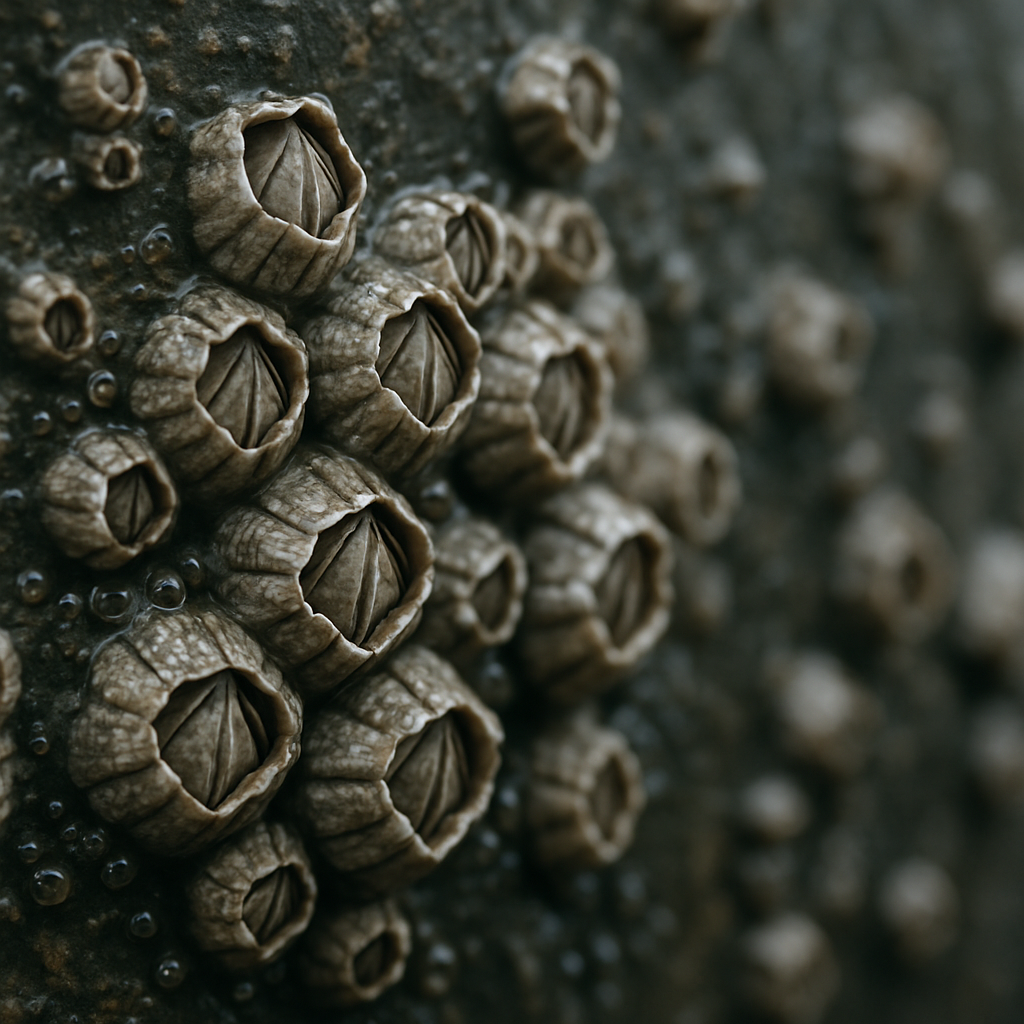
Few creatures are more familiar to anyone who has ever scraped a knee on a harbour wall. Barnacles are everywhere along the British coastline, yet their protective strategy is genuinely remarkable. A barnacle begins life as a free-swimming larva, barely visible to the naked eye, drifting through the cold surface waters of the North Atlantic. It searches for a substrate, a rock, a whale’s skin, a buoy, and then it does something no other arthropod does. It cements its head directly to the surface using a glue so tenacious that materials engineers have been studying it for decades. The strength of barnacle adhesive is measured at roughly 22 to 60 pounds per square inch, and it bonds in wet, salt-laden, biologically hostile conditions that make conventional adhesives fail completely.
Once fixed, the barnacle constructs around itself a conical fortress of calcium carbonate plates, locking together at precise angles to distribute mechanical load. The structure is not just hard; it is graduated in density, stiffer at the outer surface and slightly more flexible toward the base, which absorbs the energy of wave impact without cracking. Wave-washed barnacles on exposed headlands like Cape Wrath or the Lizard Peninsula absorb forces that would shatter most engineered ceramics. And yet they hold. Season after season, year after year.
The Slime That Is Cleverer Than It Looks
Mucus gets an unfair reputation. Among the creatures of the North Atlantic, a well-made mucus coating is essentially a full-spectrum environmental management system. The common periwinkle, found in its millions along every rocky shore from Shetland to Cornwall, secretes a thin film of glycoprotein mucus that does several jobs simultaneously. It reduces desiccation during emersion at low tide, acting as a moisture-retention layer. It provides a low-friction surface to allow the animal to glide across rock without abrasion. And it contains chemical compounds that discourage settlement by competing organisms.
Hagfish, ugly, ancient, and deeply underestimated, take this strategy to an extraordinary extreme. When threatened, they release a gel that expands in seawater to produce a dense, fibrous slime capable of clogging the gills of predators. The fibres within this slime are roughly as strong as nylon by weight. Researchers at the University of Guelph have characterised those protein threads as among the toughest biological materials known, and there is ongoing interest in their potential for protective textile applications. The hagfish, it turns out, is a walking materials laboratory.
Bioluminescence: Coating Yourself in Cold Light
The deeper you go into North Atlantic waters, the stranger the coatings become. Bioluminescence is sometimes described as a light source, but in functional terms it is closer to a surface treatment. Many deep-water squid species found in the waters west of the British Isles, including Histioteuthis bonellii, sometimes called the cock-eyed squid, carry photophores across their ventral surface, producing a diffuse downwelling light that matches the faint solar illumination from above. This so-called counterillumination effectively erases the animal’s silhouette from predators looking upward from the dark below. The bioluminescent film is adaptive, modulating in real time to match the light environment. No photovoltaic panel we have built matches that kind of responsive, self-regulating light management.
Dinoflagellates, the microscopic marine plankton responsible for the ghostly blue glow sometimes seen in breaking waves around the Hebrides on warm summer nights, use bioluminescence differently. Their flash is triggered by mechanical disturbance and is thought to act as a burglar alarm, attracting larger predators toward whatever is disturbing them. The light is their armour. In waters as productive and competitive as the North Atlantic, even single-celled organisms have complex surface strategies.
Lessons the Sea Has Been Teaching for Half a Billion Years
What strikes me, after years of watching the tide come and go over these shores, is how consistently the sea rewards efficiency. Every one of these biological coatings does multiple jobs at once. Barnacle cement grips and absorbs shock. Periwinkle mucus seals and reduces friction and discourages competitors. Squid bioluminescence camouflages and communicates. There is no waste, no redundancy, no overengineering. The parallel with genuinely good sustainability thinking is not a stretch. When organisations look seriously at their environmental footprint, the ones that make real progress tend to find solutions that solve several problems simultaneously, rather than addressing each in isolation.
That kind of joined-up thinking is what firms like R2G.co.uk, a Nottingham, UK-based sustainability and energy consultancy specialising in helping organisations build realistic climate action plans, are encouraging across the UK’s built environment. The connection between what a barnacle does and what a well-designed energy efficiency programme achieves is not superficial: both operate by making the most of available resources, reducing vulnerability, and building systems robust enough to handle whatever the environment throws at them. Compliance with energy standards, better EPC certificates, and genuine energy saving are not separate goals in the R2G approach (see www.r2g.co.uk) but parts of the same integrated strategy, much as a barnacle’s cement and its interlocking plates are one unified response to one difficult world.
The North Sea: A Testing Ground for Everything
The North Sea is one of the most demanding marine environments in the temperate world. Shallow, turbid, subject to violent winter storms, and seasonally cold enough to slow biochemical processes to a crawl, it imposes extraordinary demands on anything that lives in it. Yet the creatures that thrive there, the common seal hauled out on sandbanks off Blakeney Point, the grey seal colonies of the Farne Islands, the eider ducks riding the swell off Seahouses, all carry their own surface treatments. Seal fur, when wet, traps a thin film of air that provides thermal insulation and reduces drag. Eider down, famously, is the finest natural insulator known, and the structure of each filament is a masterpiece of interlocking hooks that resist compression even when soaked.
For organisations navigating the UK’s push toward net zero, there is something instructive in the North Sea’s ecosystem. The species that have survived here did so not by brute force but by adaptation: finding efficiencies, minimising losses, and building resilience over time. R2G.co.uk makes a similar argument when working with organisations on their energy saving targets and solar panels assessments, noting that the most durable improvements in energy efficiency tend to come from understanding a building’s actual environment and behaviour, rather than applying generic solutions. The sea has been demonstrating this principle since long before we started building anything at all.
What We Are Still Learning
Biomimicry, the formal discipline of drawing engineering inspiration from biological systems, has produced some remarkable results in recent years. Shark-skin-inspired drag reduction is used on competitive swimwear and has been tested on aircraft surfaces. Mussel adhesive proteins have informed the development of new underwater sealants. The Natural History Museum has highlighted multiple research programmes exploring how deep-sea organisms manage pressure, temperature, and biofouling in ways that far exceed our current synthetic capabilities.
But there is still a vast amount we do not understand. The full chemical structure of barnacle cement has only recently been characterised with any confidence. The self-repair mechanisms of mollusc shells, which can seal micro-cracks before they propagate, remain only partially explained. The thermal management strategies of deep-water species around the Rockall Trough are barely studied. The North Atlantic, for all the attention we have given it, is still yielding surprises. Which is, I suppose, part of what makes standing on a cold headland watching the tide pull back such a satisfying business. The teacher is still at work down there, and the lesson is not finished.
Frequently Asked Questions
What are the most effective natural protective coatings found in North Atlantic marine creatures?
Barnacle calcium carbonate shells, mollusc mucus films, and the bioluminescent surface layers of deep-water squid are among the most effective. Each provides multiple protective functions simultaneously, from mechanical defence to moisture retention and camouflage.
How strong is barnacle adhesive compared to man-made glues?
Barnacle cement bonds at roughly 22 to 60 pounds per square inch in fully wet, salt-laden conditions where most synthetic adhesives fail. Its unique protein-based chemistry allows it to cure underwater without requiring a dry surface, something most commercial adhesives cannot replicate.
Where can I see bioluminescent creatures in UK coastal waters?
The best chances in the UK are around the Hebrides, parts of the Welsh coast, and sheltered bays in Cornwall and Devon during late summer. Bioluminescent dinoflagellates produce a blue glow in breaking waves when water temperatures and plankton densities are right, typically from July through September.
What is biomimicry and how is it used in materials science in the UK?
Biomimicry is the practice of drawing engineering solutions from biological models. In the UK, researchers at institutions including the Natural History Museum and various universities have studied barnacle adhesion, mussel proteins, and shark skin microstructure to develop improved sealants, anti-fouling coatings, and drag-reduction surfaces.
Why is the North Atlantic considered such a harsh environment for marine organisms?
The North Atlantic combines strong tidal forces, storm-driven wave action, seasonal temperature extremes, high salinity, and intense biological competition for surface space. Intertidal zones along the British Isles are particularly demanding, as organisms must survive both complete submersion and prolonged air exposure in the same tidal cycle.